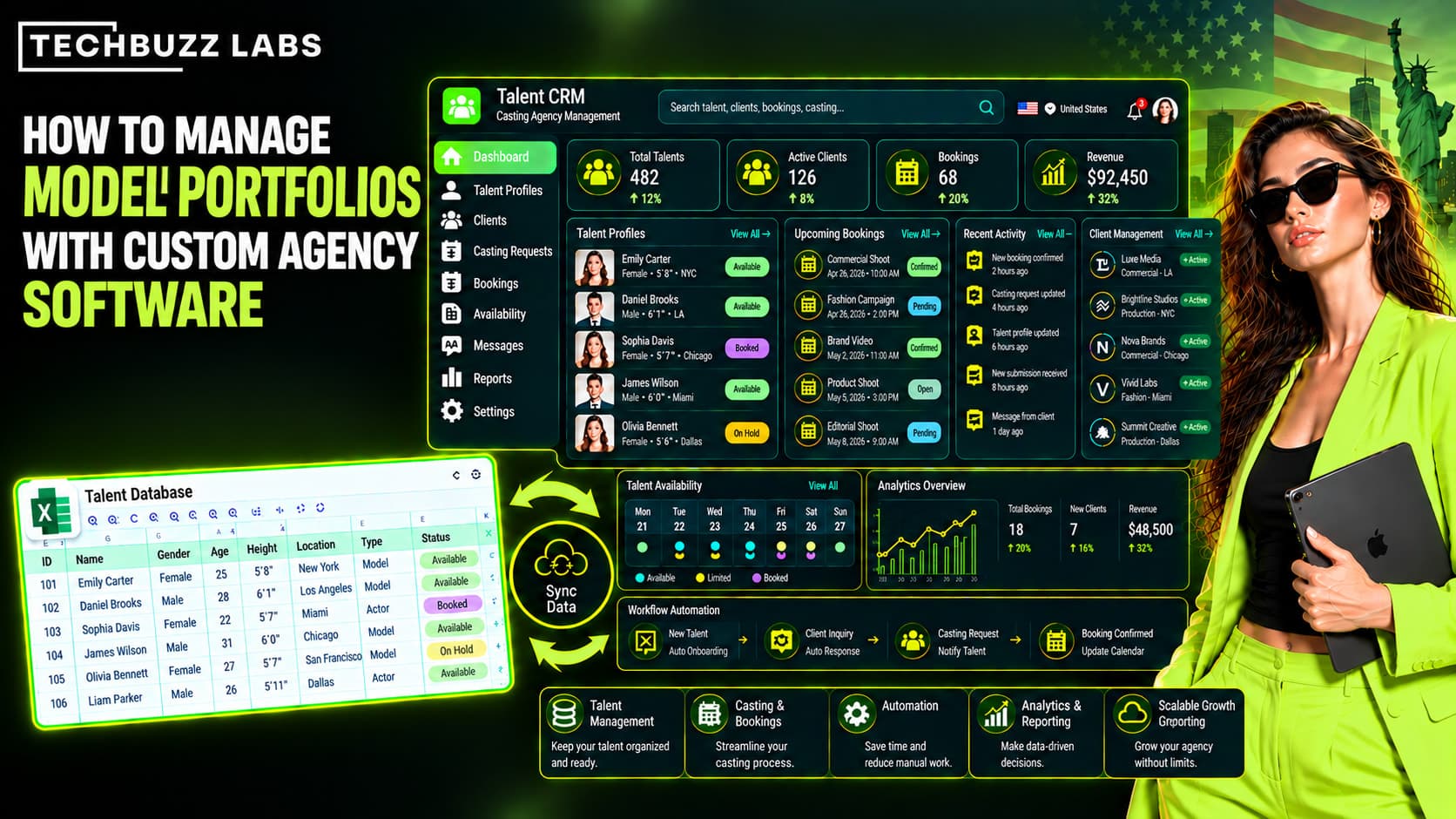
How to Manage Model Portfolios With Custom Agency Software
Unlike basic file storage, custom agency software can connect model portfolios with other business processes, including client inquiries, casting submissions, availability, and booking records.
Managing model portfolios is an essential part of running a successful modeling agency. Agencies need to organize professional photographs, measurements, experience, skills, comp cards, and contact information while keeping profiles updated for casting opportunities. As agencies expand their talent networks and work with more clients, managing these details through spreadsheets, email attachments, and separate folders can become inefficient.
For modeling agencies across the United States, custom agency software offers a more organized way to manage portfolios, improve talent discovery, and streamline communication with clients. With the right technology, agencies can reduce administrative work and present their talent more professionally.
What Is Model Portfolio Management Software?
Model portfolio management software helps modeling agencies create, organize, update, and share digital profiles for the models they represent. Depending on its features, the platform may include image galleries, searchable talent databases, digital comp cards, client access, casting tools, and booking management.
For example, when a US fashion brand requests talent for an upcoming campaign, an agency can search its database, shortlist suitable models, and share relevant portfolios without manually collecting information from multiple sources.
Why Modeling Agencies Need a Centralized Portfolio System
Many modeling agencies work with dozens or hundreds of models across fashion, commercial photography, advertising, fitness, and lifestyle campaigns. Each model may have multiple photographs, updated measurements, different portfolio versions, and changing availability.
When information is scattered across different systems, several problems can arise:
Outdated information: Clients may receive old photographs, measurements, or contact details.
Time-consuming searches: Booking managers may spend hours locating suitable talent.
Duplicate records: Multiple versions of the same profile can create confusion.
Communication delays: Teams may struggle to find the latest portfolio or casting feedback.
Limited visibility: Managers may find it difficult to track which profiles have been shared with clients.
Custom agency software can bring these records together, making portfolio management more consistent and efficient.
Essential Features for Managing Model Portfolios
1. Centralized Digital Model Profiles
A centralized database is the foundation of effective portfolio management. Each model should have an organized profile containing essential information, including photographs, measurements, experience, skills, location, and professional contact details.
Agencies can also include information about previous assignments, portfolio updates, and relevant casting requirements.
With centralized records, authorized team members can access the information they need without searching through disconnected folders. This is especially useful for agencies operating across multiple US cities, such as New York, Los Angeles, Miami, and Chicago.
2. High-Quality Image and Portfolio Management
Professional photographs are a major part of a model's presentation. Custom software should support organized image galleries, clear previews, and appropriate image quality for digital portfolio sharing.
Agencies may categorize photographs by portfolio type, such as editorial, commercial, runway, lifestyle, or fitness modeling. This makes it easier to select relevant images for specific client requests.
Version control or clear update dates can also help teams identify the latest approved portfolio. Since image files can require significant storage, agencies should evaluate image optimization, storage limits, and backup options before choosing a solution.
3. Advanced Search and Filtering
Searching for the right talent should not require reviewing every profile manually. Custom agency software can include filters for relevant criteria such as location, experience, availability, skills, and client-defined campaign requirements.
For example, an advertising agency in Texas may need models available for a commercial shoot within a particular timeframe. A searchable database can help the booking team identify suitable candidates more quickly.
Search filters should support legitimate professional requirements while helping agencies apply consistent, relevant, and non-discriminatory selection practices.
4. Digital Comp Cards and Portfolio Sharing
Comp cards provide clients with a concise overview of a model's photographs and key professional details. Creating these documents manually for every inquiry can add unnecessary work.
Custom agency software can help teams generate or maintain digital comp cards using approved profile information and selected images. Depending on the system, agencies may also share portfolio links with clients through controlled access.
Permission settings are important when portfolios contain personal information or images that should not be publicly accessible. Agencies should establish clear rules for image use, client access, and portfolio distribution.
5. Integration With Casting and Booking Workflows
Portfolio management becomes more valuable when it connects with casting and booking operations.
For instance, when a client requests talent for a campaign, the team can search portfolios, create a shortlist, record client feedback, and track selected models through the booking process.
Connecting these activities reduces repeated data entry and helps team members understand the status of each opportunity. It can also provide a clearer record of which portfolios were submitted for particular projects.
6. Portfolio Updates and Data Security
Model information changes over time. Photographs, measurements, experience, contact details, and professional availability may need regular updates.
A good system should make updates straightforward and help staff identify incomplete or outdated records. Agencies can establish review schedules and assign responsibility for maintaining profile accuracy.
Security is equally important. Modeling portfolios may include personal data and photographs that require careful handling. Agencies should evaluate role-based access, secure sharing, backup procedures, data retention policies, and applicable privacy obligations.
Clear agreements about image rights and portfolio permissions can further help agencies manage talent information responsibly.
Custom Agency Software vs. Generic Portfolio Tools
Generic file storage and basic portfolio platforms may be sufficient for agencies with simple requirements. However, growing businesses may need more control over how portfolios connect with casting, client relationships, booking schedules, and internal workflows.
Custom agency software can be designed around an agency's specific processes. It may also support integrations with existing business tools and accommodate specialized reporting requirements.
The trade-off is that custom development requires planning, implementation time, and ongoing maintenance. Agencies should compare the total cost, flexibility, usability, and long-term support of each option before investing.
How Techbuzz Labs Can Help Modeling Agencies
Techbuzz Labs is a technology partner that agencies can explore when considering customized software, CRM solutions, and workflow improvements.
For modeling agencies that find traditional tools limiting, a tailored platform could bring model profiles, digital portfolios, client records, casting submissions, and booking information into one connected system.
The development process should begin by identifying the agency's biggest challenges and defining the features that will provide measurable value. Agencies evaluating Techbuzz Labs should discuss their requirements, expected budget, integrations, data protection needs, implementation timeline, and ongoing maintenance arrangements.
A clearly defined scope helps ensure that the resulting solution supports real business needs instead of adding unnecessary complexity.
Conclusion
Managing model portfolios effectively requires more than storing photographs. Modeling agencies need accurate profiles, searchable talent records, organized image galleries, convenient portfolio sharing, and connections between casting and booking workflows.
Custom agency software can help US modeling agencies reduce manual administration, improve client service, and maintain better control over their growing talent databases. By choosing the right features and working with a suitable technology partner such as Techbuzz Labs, agencies can create a more efficient portfolio management process that supports long-term growth.