Best CRM Software Company: Comparing Generic CRM With Industry-Specific Solutions
A modeling agency is not simply managing leads. It is managing relationships between clients, models, agents, casting opportunities, and bookings.
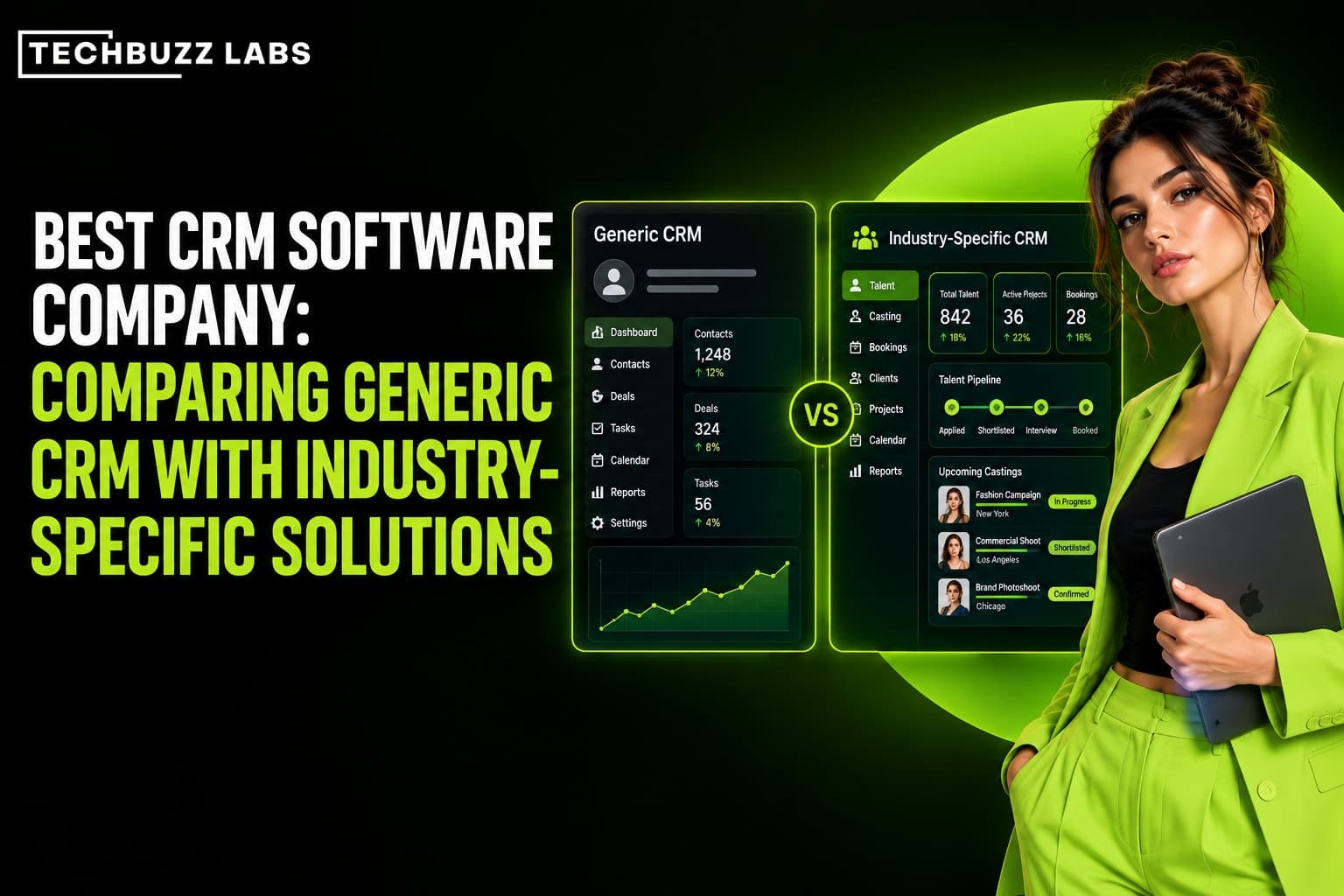
Choosing a CRM software company is an important decision for businesses that need to organize customer information, communication, sales activities, and business relationships. However, not every industry manages relationships in the same way.
A generic CRM may work well for a traditional sales-focused business, but talent and modeling agencies have a much broader workflow. They need to manage talent profiles, casting opportunities, availability, submissions, client requests, feedback, and bookings alongside their client relationships.
This raises an important question: should a talent agency use a generic CRM or choose an industry-specific solution designed around its workflow?
Understanding the differences can help agencies select technology that supports their actual operations rather than forcing their teams to adapt to a system built for another type of business.
What Is a Generic CRM?
A generic CRM is designed to support relationship management across many industries.
Most general CRM platforms focus on areas such as contacts, companies, sales pipelines, leads, communication, tasks, follow-ups, and reporting.
For example, a company selling software products might use a CRM to track prospects from initial contact through sales conversion.
These capabilities can be useful for many businesses, but they may not cover the specialized requirements of a talent agency.
What Is an Industry-Specific CRM?
An industry-specific CRM is designed around the requirements of a particular type of business.
For a talent or modeling agency, this can mean combining traditional client relationship management with talent management and casting operations.
Instead of treating talent information as ordinary contacts, the system can provide dedicated profiles for models and other talent. Casting projects, availability, submissions, client feedback, and bookings can then be connected to those profiles.
This creates a workflow that is much closer to how a talent agency actually operates.
Generic CRM vs. Industry-Specific CRM
The difference becomes clearer when comparing the workflows each type of system is designed to support.
Talent Profile Management
A generic CRM normally treats a person as a contact or lead.
A talent agency, however, may need detailed professional information about each model. Profiles can include photographs, portfolio information, measurements, skills, location, experience, availability, and previous work.
An industry-specific CRM can structure these details specifically for talent management.
This makes it easier for agents to search and manage a growing roster.
Casting Management
Casting is another major difference.
A generic CRM may provide a sales pipeline that can technically be adapted to casting stages, but it may not provide specialized tools for managing casting requirements and talent submissions.
An industry-specific system can structure the casting process around stages such as client request, talent search, shortlist, submission, feedback, approval, and booking.
This allows the CRM to reflect the agency's actual workflow.
Talent Search and Filtering
Talent agencies often need to search through large databases to find profiles that match specific client requirements.
Generic CRMs generally focus their search functionality around contact and sales information.
An industry-specific talent CRM can provide filters relevant to the agency's needs.
Agents may be able to search by location, experience, category, availability, skills, measurements, or other custom talent attributes.
This can make the process of creating a casting shortlist more efficient.
Availability Management
Availability is particularly important for agencies.
A model may match a casting brief but already be committed to another project.
In a generic CRM, availability may need to be managed through custom fields, notes, or another connected application.
An industry-specific solution can make availability part of the talent and casting workflow itself.
This allows agents to consider scheduling information when evaluating talent for a project.
Client Relationship Management
This does not mean an industry-specific CRM should ignore traditional CRM functionality.
Client management remains essential.
Agencies need to maintain client profiles, contact details, project history, communication records, casting requests, preferences, and booking information.
The advantage of a specialized system is that client information can be connected to the casting and talent information associated with each project.
TechBuzzLabs describes this type of approach as connecting model profiles with casting opportunities, availability, client requests, submissions, communication, and bookings.
Where Generic CRM Software Can Still Work
Generic CRM software is not necessarily unsuitable for every talent agency.
A small agency with relatively simple requirements may be able to adapt a general CRM using custom fields, pipelines, integrations, and workflows.
Generic software can also be useful when an agency primarily needs conventional sales and client relationship management.
The key consideration is how much customization is required to make the platform fit the agency's operations.
If employees have to create numerous workarounds to manage talent, casting, and bookings, the agency may eventually need a more specialized approach.
The Cost of Customization
One factor agencies should consider is the amount of customization required.
A generic CRM may initially appear straightforward because it already provides common CRM functionality.
However, an agency may later need custom fields, additional workflows, integrations, automations, dashboards, talent databases, and specialized processes.
These additions can increase complexity.
An industry-specific platform may already provide functionality closer to the agency's requirements, potentially reducing the amount of adaptation necessary.
The actual cost depends on the provider, number of users, required features, integrations, and level of customization, so agencies should evaluate the complete technology requirement rather than comparing subscription prices alone.
Workflow Integration Matters
One of the biggest advantages of an industry-specific CRM is workflow continuity.
Consider a typical agency process:
Client Request → Casting Brief → Talent Search → Shortlist → Availability → Submission → Client Feedback → Approval → Booking
A generic CRM may require several custom workflows or external tools to represent this process.
An industry-specific system can be designed around these stages from the beginning.
This creates a more connected experience for agents and managers.
Data and Reporting
Another consideration is reporting.
Generic CRMs can provide reports about leads, sales pipelines, conversion rates, and customer activity.
Talent agencies may need different information.
They might want to understand active castings, submission activity, booking history, talent availability, client activity, or workflow bottlenecks.
Industry-specific reporting can make the information more relevant to agency managers.
Instead of simply asking how many leads were converted, an agency may want to understand how casting opportunities move through its workflow and which processes require attention.
Scalability for Growing Agencies
A CRM should also support the agency as it grows.
A small talent roster can be relatively easy to manage manually. As an agency adds more models, clients, projects, team members, and locations, information becomes more difficult to coordinate.
Industry-specific technology can provide a structured foundation for this growth.
However, agencies should still evaluate scalability carefully. A specialized system should be able to handle increasing data volumes, additional users, new workflows, and changing business requirements.
Custom CRM Solutions for Talent Agencies
Some agencies may have workflows that are too specialized for either a standard generic CRM or a rigid industry platform.
In that situation, custom CRM development can provide another option.
A custom system can be designed around the agency's specific requirements, including talent management, casting, availability, submissions, client relationships, bookings, dashboards, and automation.
TechBuzzLabs takes this approach by focusing on custom CRM and workflow solutions for modeling and talent agencies. Its existing guidance describes custom CRM as an option for agencies that need technology built around their specific operational processes.
How to Decide Between Generic and Industry-Specific CRM
The decision should start with the agency's actual workflow.
A generic CRM may be appropriate when the agency mainly needs contact management, sales tracking, and basic client communication.
An industry-specific CRM becomes more relevant when the agency needs integrated talent profiles, casting management, availability tracking, submissions, client feedback, and booking workflows.
Agencies should also consider how much customization their current system requires.
If agents regularly move information between spreadsheets, messaging apps, email, and CRM records, that may indicate a need for a more connected solution.
Final Thoughts
The difference between a generic CRM and an industry-specific CRM is not simply the number of features each platform offers. The more important question is whether the technology reflects the way the business actually works.
For talent and modeling agencies, relationship management extends beyond clients. It involves talent, casting opportunities, availability, submissions, communication, and bookings.
A generic CRM can provide a useful foundation for basic relationship management, while an industry-specific or custom CRM can connect those specialized workflows more directly.
For agencies evaluating a CRM software company, the right choice depends on the agency's size, workflow complexity, customization requirements, budget, and future growth plans.
The best technology fit is ultimately the one that helps the agency manage its real-world workflow with less fragmentation and greater visibility.