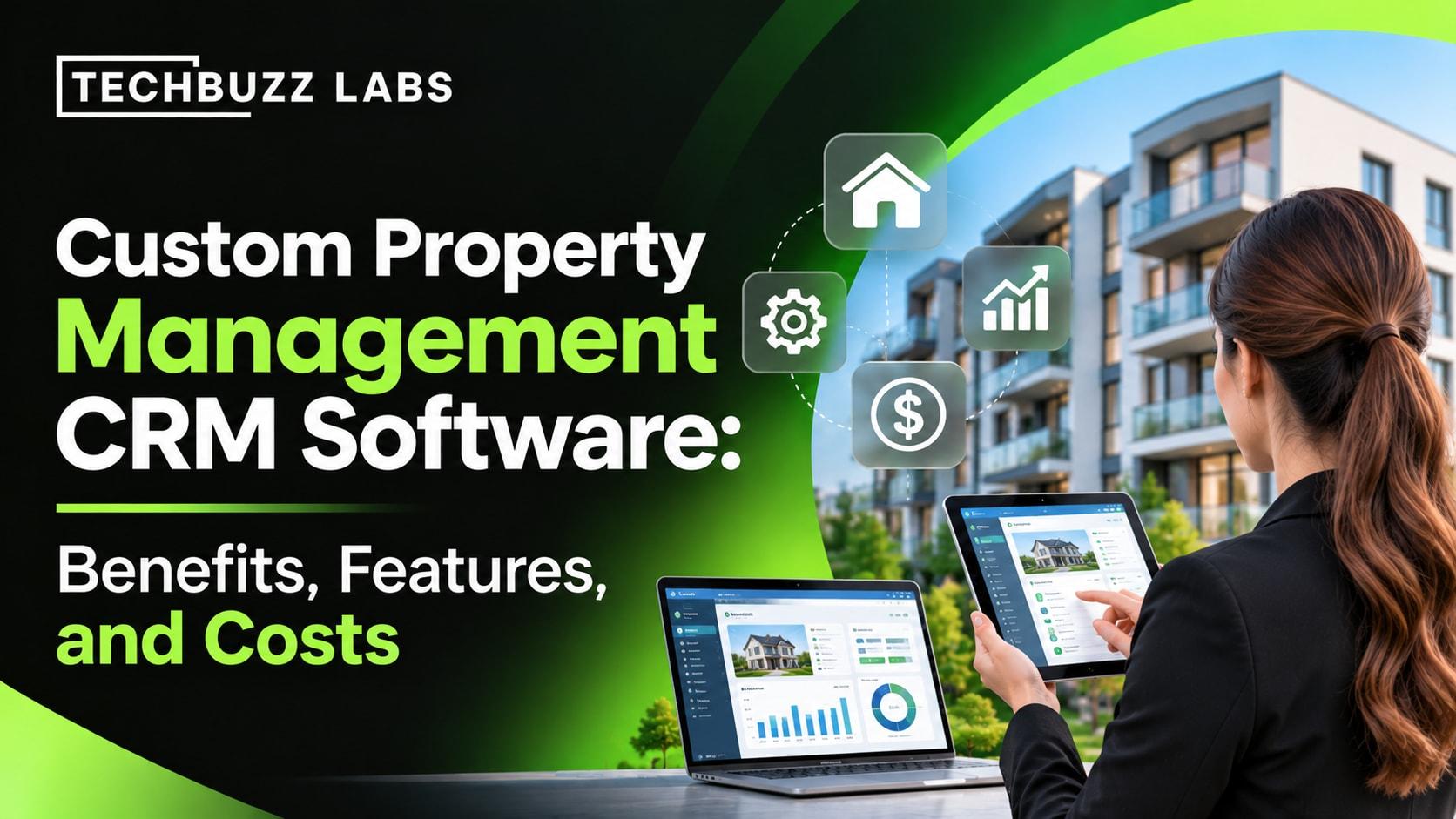
Custom Property Management CRM Software: Benefits, Features, and Costs
In this guide, we will explore the benefits, essential features, and development costs of custom property management CRM software.
The real estate industry in the United States is becoming increasingly technology-driven. Property management companies must handle growing portfolios, tenant relationships, rental payments, lease agreements, maintenance requests, and financial reporting. Managing all these responsibilities through separate applications can create unnecessary administrative work and slow business growth.
This is why many real estate businesses are exploring custom property management CRM software. Unlike standard platforms with predefined features, custom CRM solutions can be designed around a company's specific workflows, operational requirements, and long-term business goals.
Whether you manage residential apartments, commercial buildings, rental homes, or multiple properties across different locations, a customized CRM can help organize operations and improve productivity.
What Is Custom Property Management CRM Software?
Custom property management CRM software is a tailored digital platform designed to help real estate businesses manage properties, tenants, landlords, vendors, and daily management activities.
It combines customer relationship management capabilities with property-specific tools, allowing businesses to manage important operations from one centralized system.
Depending on business requirements, a custom platform may include:
Property and unit management
Tenant and landlord databases
Lease and contract management
Online rent collection
Maintenance request tracking
Vendor management
Financial reporting
Automated communication
Property performance dashboards
Unlike ready-made software, custom CRM development allows businesses to select features, integrations, and workflows that match their operational needs.
Key Benefits of Custom Property Management CRM Software
1. Centralized Property and Tenant Management
Managing multiple properties becomes challenging when information is scattered across spreadsheets, documents, and separate applications.
Custom CRM software provides a centralized database where property managers can organize tenant profiles, property details, lease agreements, payment histories, and maintenance records.
Employees can access relevant information without searching through multiple systems.
This improves data organization and helps real estate businesses manage larger property portfolios more efficiently.
2. Automated Administrative Workflows
Property managers regularly perform repetitive activities, including sending rent reminders, scheduling inspections, following up with tenants, and tracking lease renewals.
Custom CRM software can automate these tasks through configurable workflows.
For example, the platform can automatically notify tenants about upcoming rent payments or alert property managers when lease agreements are approaching expiration.
Automation reduces manual administrative work and gives employees more time to focus on customer relationships and business development.
3. Improved Tenant Experience
Tenant satisfaction is important for maintaining long-term rental relationships and reducing unnecessary turnover.
A custom property management CRM can include a tenant portal where residents can submit maintenance requests, review payment information, access lease documents, and receive important notifications.
Businesses can also customize communication workflows to provide timely updates and improve service delivery.
A more organized tenant experience can help property management companies build stronger relationships and encourage lease renewals.
4. Better Financial Management
Tracking rental income, maintenance expenses, outstanding payments, and property-related costs is essential for real estate businesses.
Custom CRM platforms can integrate financial management tools that provide better visibility into daily transactions.
Property managers can monitor payment histories, generate financial reports, track expenses, and organize owner statements.
Integration with accounting platforms such as QuickBooks Online can also help reduce duplicate data entry and improve financial workflows.
5. Scalability for Growing Real Estate Businesses
As property management companies expand, their software must support additional properties, tenants, employees, and locations.
Custom CRM software can be developed with scalability in mind.
Businesses can introduce new modules, expand user permissions, integrate additional applications, and improve existing workflows as operational requirements change.
This flexibility is especially useful for US real estate companies managing properties across multiple cities and states.
Essential Features of Custom Property Management CRM Software
Choosing the right features is one of the most important parts of custom CRM development. The platform should address actual business challenges rather than include unnecessary functionality.
1. Property and Unit Management
The system should allow managers to create property profiles, organize individual units, monitor occupancy, and maintain property-related records.
2. Tenant and Landlord Management
A centralized contact database should store tenant information, landlord profiles, communication histories, lease details, and important documents.
3. Lease and Contract Management
Digital document storage, lease expiration alerts, renewal tracking, electronic signatures, and contract management can simplify rental administration.
4. Rent Collection and Payment Tracking
Online payment integration, automated reminders, payment histories, and outstanding balance tracking help property managers organize rental finances.
5. Maintenance and Work Order Management
Tenants should be able to submit maintenance requests, while managers can assign vendors, schedule repairs, and monitor work order progress.
6. Vendor and Contractor Management
A dedicated vendor module can organize contractor information, service histories, contact details, assigned jobs, and maintenance expenses.
7. Reporting and Analytics
Custom dashboards can display occupancy rates, rental income, maintenance expenses, overdue payments, and property performance.
8. Mobile and Cloud-Based Access
Mobile-friendly interfaces allow property managers to access important information, receive notifications, and manage operations remotely.
9. Security and Role-Based Access
The platform should include secure authentication, role-based permissions, encrypted data handling, and regular backups to protect sensitive business information.
How Much Does Custom Property Management CRM Software Cost?
The cost of custom property management CRM software depends on the platform's complexity, feature requirements, integrations, design, and development team.
For US businesses, the following figures provide illustrative 2026 development budget ranges rather than fixed vendor quotes.
Development levelEstimated costBasic CRM solution$15,000–$35,000Mid-level CRM platform$35,000–$80,000Advanced CRM solution$80,000–$150,000Enterprise-level platform$150,000–$300,000+
These estimates vary by development scope and provider. Published 2026 development estimates also show substantial differences depending on whether a project includes basic property operations, tenant and owner portals, advanced integrations, or enterprise functionality. https://ortemtech.com/blog/how-to-build-property-management-software/ https://yusmpgroup.com/blog/property-management-software-development
Factors That Affect Development Costs
1. Feature Complexity: A platform with basic tenant and property management features generally costs less than one with advanced accounting, automation, and analytics.
2. UI/UX Design: Custom dashboards, mobile interfaces, and separate portals for tenants, owners, and employees can increase design and development requirements.
3. Third-Party Integrations: Payment gateways, accounting applications, tenant screening services, and property listing platforms require additional integration work.
4. Mobile Application Development: Building separate mobile applications for tenants, property managers, and maintenance teams can increase the overall budget.
5. Security Requirements: Advanced authentication, access controls, data encryption, and security testing contribute to development expenses.
6. Ongoing Maintenance: Software requires regular updates, technical support, security improvements, and infrastructure management after launch.
How Techbuzz Labs Helps Businesses Develop Custom Property Management CRM Software
Every property management business has different operational needs. A residential rental company may prioritize tenant communication and rent collection, while a commercial property management organization may require advanced lease management, vendor coordination, and financial reporting.
Techbuzz Labs helps businesses explore custom software development solutions designed around their specific requirements.
With a tailored property management CRM, businesses can bring property databases, tenant records, lease management, maintenance workflows, financial tracking, and reporting into one centralized platform.
Techbuzz Labs can help businesses plan solutions with features such as:
Custom property management dashboards
Tenant and landlord portals
Automated rental workflows
Payment and accounting integrations
Maintenance and vendor management
Multi-property management capabilities
Scalable software architecture
The objective is to develop a solution that supports existing operations while providing flexibility for future business expansion.
Custom CRM vs. Ready-Made Property Management Software
Before investing in development, businesses should evaluate whether custom software is actually necessary.
Ready-made platforms are generally suitable for companies with standard property management requirements. They can offer faster implementation and lower initial costs.
Custom CRM solutions are more appropriate when businesses have specialized workflows, unique reporting requirements, complex integrations, or operational needs that existing platforms cannot adequately support.
The decision should depend on portfolio size, workflow complexity, available budget, and long-term business objectives.
Conclusion
Custom property management CRM software can help real estate businesses improve operational efficiency, organize tenant information, automate administrative tasks, and manage expanding property portfolios.
Features such as centralized property databases, lease management, rent collection, maintenance tracking, financial reporting, and mobile accessibility make it easier to coordinate everyday operations.
Although development costs vary depending on complexity and integrations, a properly planned custom solution can provide long-term flexibility and better alignment with business requirements.
For US property management companies looking to modernize their operations, working with a development partner such as Techbuzz Labs can be a valuable step toward building a scalable, customized CRM solution.