Agency Owner to SaaS Founder The Mindset Shift That Changes Everything
In 2026, many agency owners across the United States are reaching an important realization. Service businesses create income.
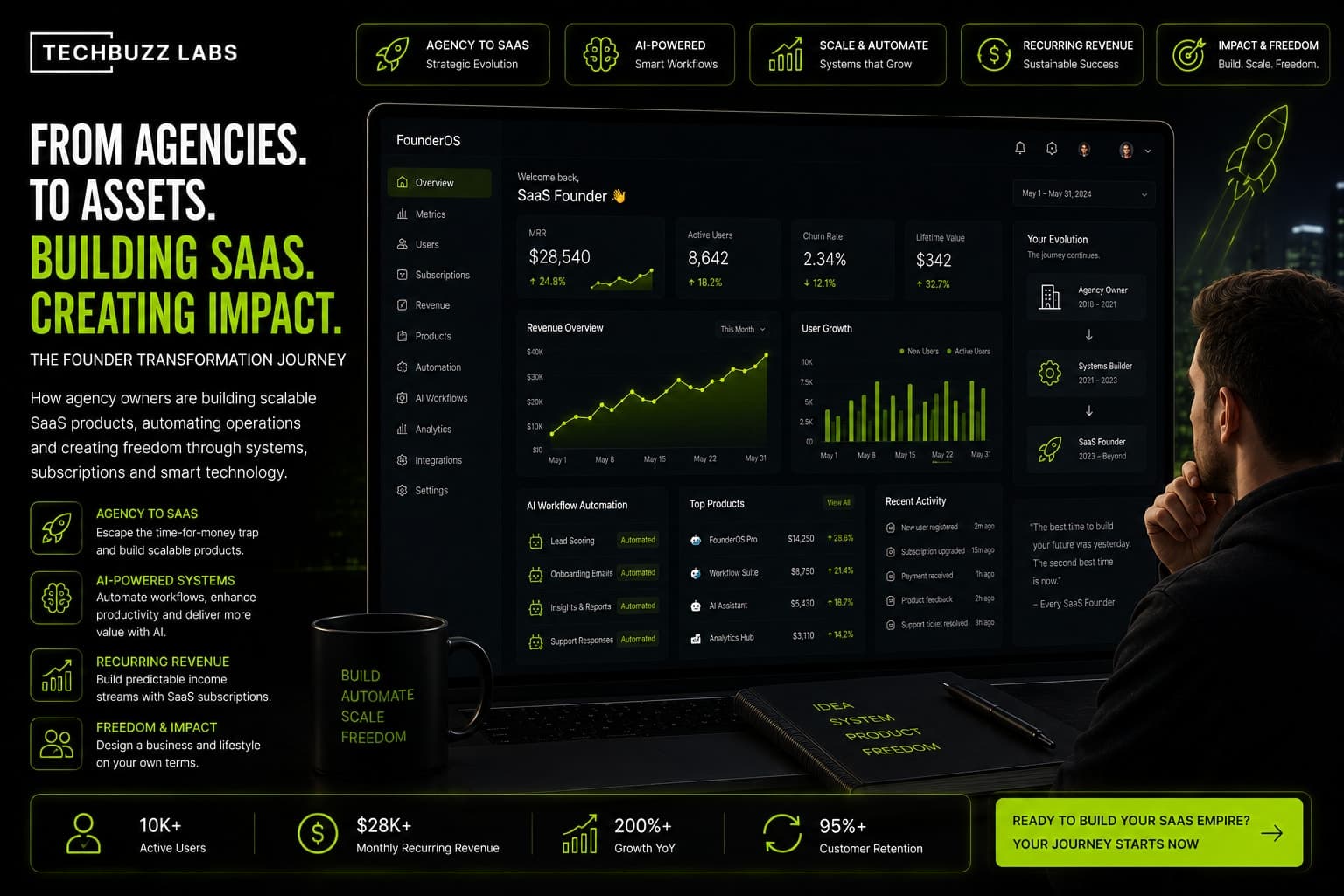
In 2026, many agency owners across the United States are reaching an important realization.
Service businesses create income.
Software creates scalability.
This is why more creative agency owners, marketing consultants, casting professionals, and operational experts are transitioning from client service work into SaaS entrepreneurship.
The shift is happening rapidly in cities like Dallas, Austin, Miami, Los Angeles, and New York where digital businesses are growing aggressively.
But becoming a SaaS founder requires much more than building software.
It requires a completely different mindset.
The difference between running an agency and building a SaaS company is operational philosophy.
One focuses on delivering services manually.
The other focuses on creating systems that deliver value repeatedly at scale.
Why Agency Owners Are Moving Into SaaS
Agency owners often discover recurring operational problems inside their industries.
These problems usually appear repeatedly across multiple clients.
Examples include:
Booking management
Client communication
Lead tracking
Workflow automation
Reporting systems
Approval processes
Scheduling
Talent management
At first, agencies solve these issues manually through services.
But eventually many founders realize something important.
If one client has this problem, many businesses probably have the same problem.
This is where SaaS opportunities emerge.
The Biggest Mindset Shift
Agency thinking focuses on projects.
SaaS thinking focuses on systems.
This changes how founders approach growth completely.
Instead of selling time repeatedly, SaaS founders build infrastructure that users subscribe to continuously.
This creates recurring revenue.
It also creates scalability that service businesses often struggle to achieve.
Many agency owners initially underestimate how important systems become during this transition.
SaaS businesses depend heavily on:
Product design
User experience
Automation
Customer retention
Operational data
Product iteration
Customer onboarding
Workflow optimization
The focus shifts from delivering work manually to improving systems continuously.
Why Operational Thinking Matters
Successful SaaS founders think operationally.
They ask:
What process can be simplified?
What workflow can be automated?
What friction can be removed?
This operational perspective becomes extremely valuable in industries still relying on outdated systems.
Many successful SaaS founders are not traditional engineers.
They are industry operators who deeply understand specific workflow problems.
This is why vertical SaaS is growing rapidly in 2026.
Founders with niche industry knowledge are building highly specialized software solutions that outperform generic platforms.