CRM Software Data Model: Understanding the Structure Behind Modern Agency CRMs
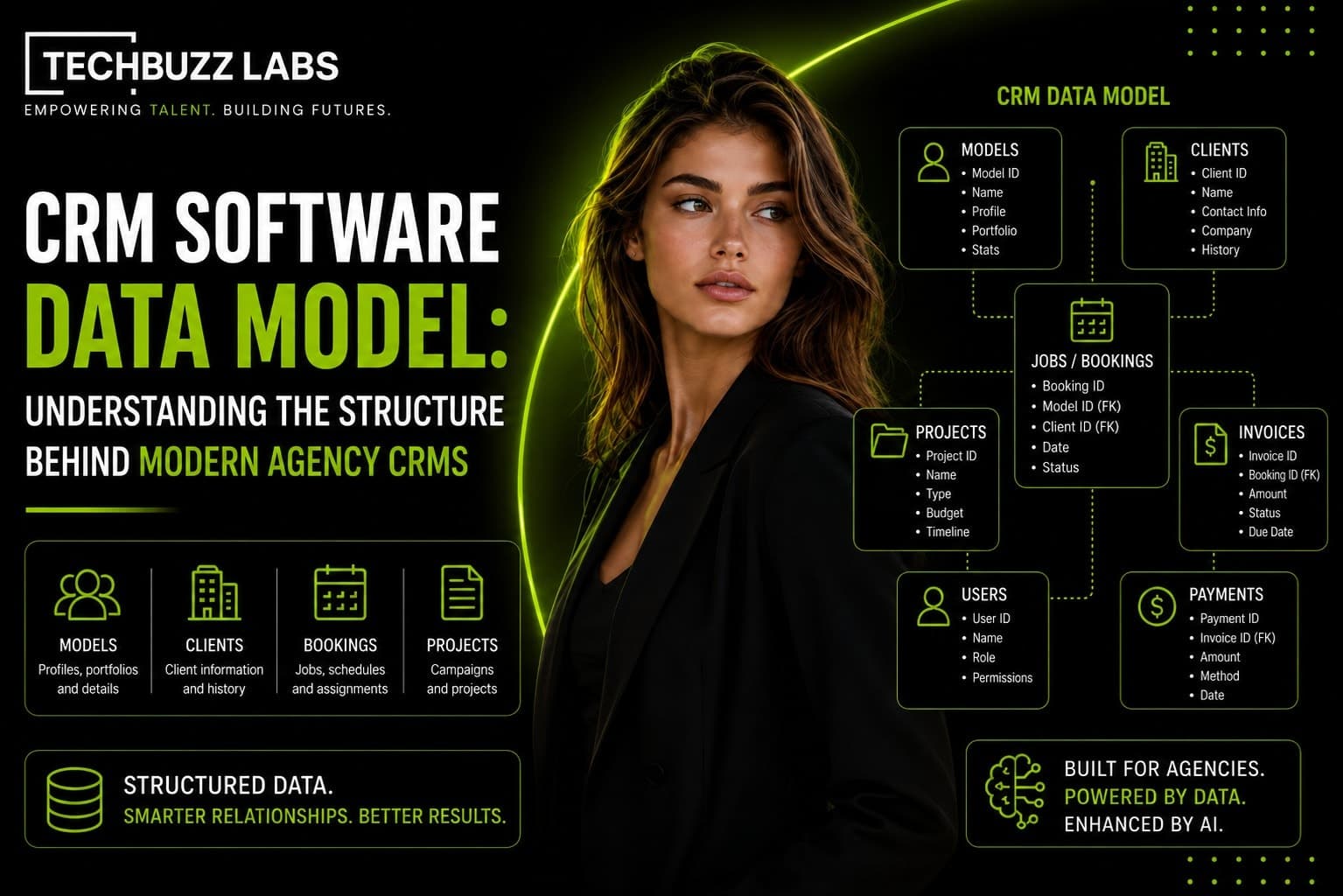
For a modeling agency, these records might include models, clients, casting calls, bookings, projects, communications, and schedules.
Modern modeling and talent agencies manage a large amount of information every day. From model profiles and portfolios to client relationships, casting calls, bookings, schedules, and communications, agencies need an organized system to keep everything connected. As agencies grow, relying on spreadsheets and separate files can make it increasingly difficult to manage this information efficiently.
This is where a CRM software data model becomes important. The data model provides the underlying structure that determines how information is stored, connected, and accessed within a CRM. For modeling and talent agencies in the USA, understanding this structure can help businesses choose better technology and create more efficient workflows.
TechBuzzLabs recognizes the growing role of technology in the modeling industry. As agencies adopt CRM platforms, understanding how their data is structured can help them make smarter decisions about talent management, client relationships, casting, and bookings.
What Is a CRM Software Data Model?
A CRM software data model is the framework that defines how information is organized within a Customer Relationship Management system.
Think of it as a blueprint for the CRM. It identifies the different types of records the system needs to store and explains how those records relate to one another.
For example, one client may have multiple projects, each project may have several casting calls, and each casting may involve multiple models. The data model establishes these relationships so the CRM can keep the information connected.
Why Is the Data Model Important?
A CRM is only as useful as the information structure behind it. If data is poorly organized, employees may struggle to find records, reports may become inaccurate, and duplicate information can appear throughout the system.
A well-designed CRM data model helps agencies maintain consistency and provides a reliable foundation for their workflows.
For a U.S. modeling agency managing hundreds or thousands of talent profiles, structured data can make it easier to search for models, track clients, manage castings, and monitor bookings.
Key Components of an Agency CRM Data Model
Every CRM can have a different structure, but modern agency CRMs generally contain several important entities.
Model or Talent Records
A model record represents an individual talent profile.
It may include the model's name, location, contact information, measurements, skills, experience, availability, portfolio images, and other professional details.
These records form the foundation of a modeling agency's talent database.
Client Records
Client records contain information about brands, photographers, advertising agencies, retailers, production companies, and other organizations working with the agency.
The CRM can connect client records with contacts, projects, casting calls, and previous bookings.
This gives agents a complete view of their business relationships.
Casting Records
A casting record represents a specific opportunity.
It may include the client's requirements, project details, location, deadline, compensation information, and selected talent.
Connecting casting records with model profiles allows agents to see which models were considered, submitted, selected, or rejected for an opportunity.
Booking Records
When a model is selected, the casting can lead to a booking.
A booking record can contain information such as the model, client, project, date, location, rate, and booking status.
Connecting bookings to both model and client records helps agencies maintain a complete history of their business activities.
Communication Records
Emails, calls, meetings, notes, and other interactions can also be connected to CRM records.
For example, an agent could open a client's profile and review previous conversations, projects, and bookings.
This provides useful context when communicating with the client about a new opportunity.
Understanding Relationships Between Records
The relationships between records are one of the most important parts of a CRM data model.
Consider a simple agency workflow:
Client → Project → Casting → Models → Booking
A client may have several projects. Each project may involve one or more castings. Multiple models may be submitted for a casting, while selected models can become bookings.
A properly designed data model keeps these relationships connected.
This means an agent can move from a client record to its projects, review related castings, see submitted models, and check previous bookings without searching through separate databases.
CRM Data Model and Search
A strong data model also improves search and filtering.
Suppose a client needs models in Los Angeles for an upcoming commercial campaign. The CRM can use structured information such as location, availability, experience, and modeling category to help agents find potentially suitable profiles.
The more consistently information is structured, the more useful the search functionality becomes.
This is particularly valuable for large agencies with extensive talent databases.
CRM Data Model and Automation
Automation also depends heavily on organized data.
For example, a CRM may be configured to send a reminder when a casting deadline is approaching or notify an agent when a booking status changes.
These workflows require the system to understand relationships between records.
If a model is connected to a casting and the casting is connected to a client, the CRM can use those relationships to trigger relevant actions.
This allows agencies to reduce repetitive administrative tasks and create more efficient workflows.
Supporting AI and Advanced Analytics
A structured CRM data model can also provide a foundation for AI and analytics.
When information is organized consistently, technology can analyze patterns in casting activity, bookings, client relationships, and talent performance.
For example, agencies could use analytics to understand which clients generate the most bookings or which types of casting opportunities produce the strongest results.
AI-assisted search and recommendations can also benefit from structured data. However, agencies should maintain human oversight when technology is used to support talent recommendations or professional decisions.
Data Security and Access Control
Modeling agencies manage important personal and business information, so security should be considered when designing a CRM data model.
Different employees may need different levels of access. For example, an agent may need access to model profiles and bookings, while another employee may have access to financial information.
User permissions and access controls can help ensure that sensitive information is only available to authorized individuals.
For U.S. agencies, appropriate privacy and data-handling practices should also be part of the overall CRM strategy.
Choosing a CRM With the Right Data Structure
When evaluating CRM software, agencies should look beyond the interface and feature list. Understanding how the platform organizes information can be equally important.
Consider whether the CRM can handle model profiles, clients, contacts, castings, bookings, availability, communications, portfolios, and reporting.
Agencies should also consider whether the data model can adapt as the business grows. A system that works for a small agency should ideally be capable of supporting a larger talent database and more complex workflows in the future.
The Role of TechBuzzLabs
The growing use of CRM platforms demonstrates how technology is changing agency operations. TechBuzzLabs focuses on the relationship between technology and the modeling industry, including CRM, casting management, automation, and other digital solutions.
For agencies looking to modernize, understanding the structure behind CRM software can help them select technology that supports their operational needs rather than simply choosing a platform based on surface-level features.
Conclusion
A CRM software data model provides the structure behind a modern agency CRM. It determines how models, clients, castings, bookings, communications, and projects are stored and connected.
For modeling agencies in the USA, a well-designed data model can improve organization, search, automation, reporting, and scalability. It can also provide a foundation for advanced technologies such as AI-assisted search and business analytics.
As agencies continue to adopt digital tools, understanding the data structure behind those systems becomes increasingly important. With the right CRM architecture and technology strategy, agencies can create more connected workflows, reduce administrative complexity, and manage their growing talent and client relationships more effectively. TechBuzzLabs reflects this broader shift toward smarter technology in the modern modeling industry.