From Model Application to Booking: Mapping the Modern Agency Workflow
Instead of managing applications through scattered emails and spreadsheets, modern agency software can centralize applicant information. Agents can review applications, organize potential talent, and determine which candidates should move forward.
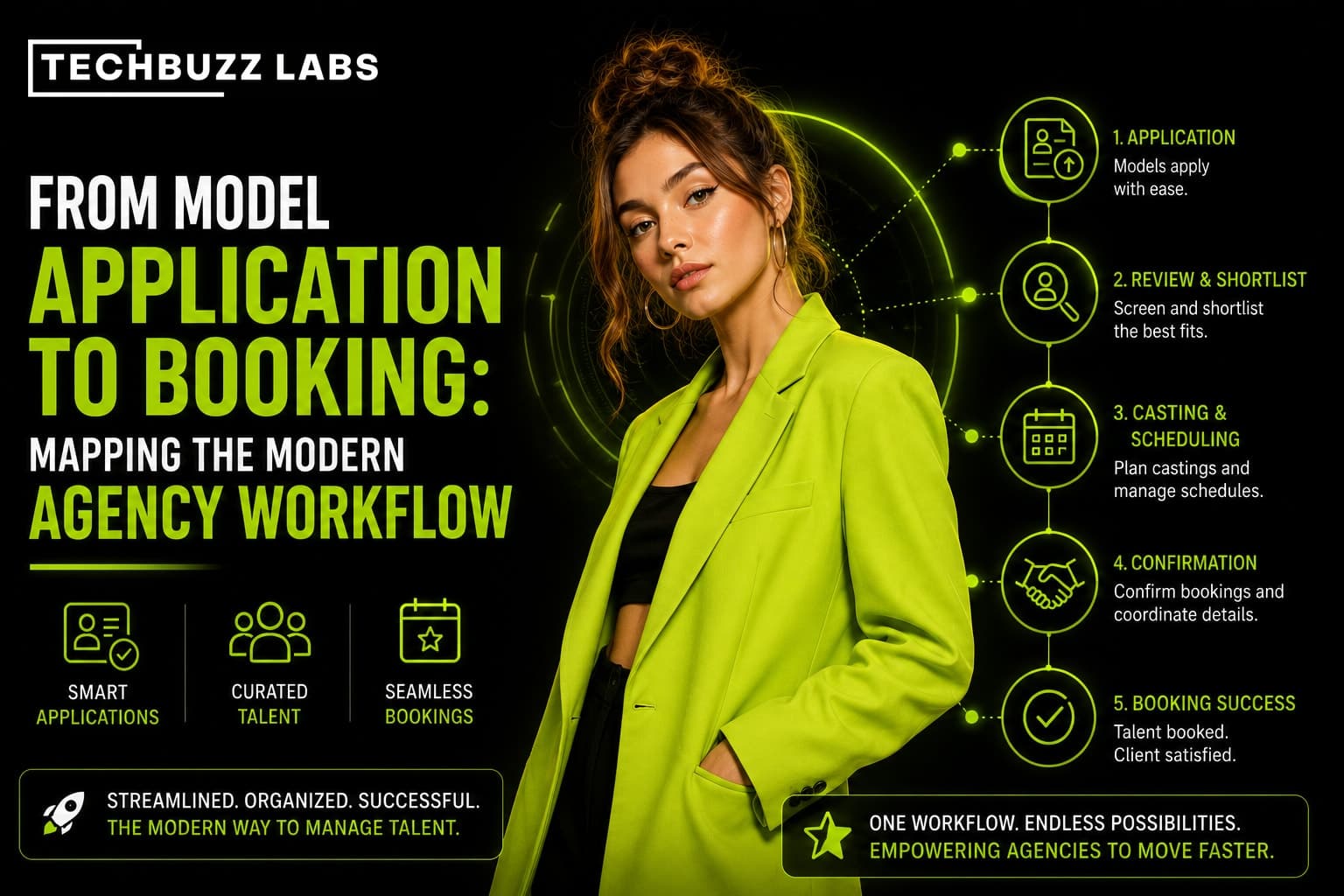
The journey from a model's first application to a confirmed booking involves far more than simply finding talent. Modern modeling agencies in the USA manage applications, talent profiles, portfolios, casting opportunities, client communication, availability, submissions, and bookings across multiple stages. Without an organized workflow, these processes can quickly become difficult to manage.
A modern modeling agency workflow connects each stage so that information moves smoothly from one step to the next. With the right technology, agencies can reduce repetitive administrative work, improve communication, and manage growing talent pools more efficiently.
1. Model Application and Talent Discovery
The agency workflow often begins when a prospective model submits an application.
Applications may arrive through a website, referral, social media, scouting activity, or an agency's recruitment process. The agency typically needs to review basic information, photographs, location, experience, measurements, and other relevant details.
Instead of managing applications through scattered emails and spreadsheets, modern agency software can centralize applicant information. Agents can review applications, organize potential talent, and determine which candidates should move forward.
This creates a more structured starting point for talent acquisition.
2. Talent Evaluation and Onboarding
After reviewing an application, the agency may decide to evaluate the model further.
The process can include portfolio reviews, interviews, test shoots, document collection, and other onboarding activities depending on the agency's business model.
A centralized system can help agents track where each applicant is in the onboarding process.
For example, candidates can be organized according to stages such as:
New Application → Under Review → Approved → Onboarding → Active Talent
This gives the agency a clearer picture of its talent pipeline and reduces the chance of applications being overlooked.
3. Creating a Complete Model Profile
Once a model joins an agency, the next step is creating a professional talent profile.
The profile may include photographs, measurements, experience, skills, location, portfolio information, contact details, and availability.
A centralized talent database makes these details easier for agents to access and update.
Keeping profiles current is especially important because models may gain new experience, update their portfolios, relocate, or change their availability over time.
An accurate profile also makes it easier for agents to recommend the right talent when a client sends a casting request.
4. Matching Models With Casting Opportunities
The next stage begins when the agency receives a casting request from a client.
A client may need models for a fashion campaign, commercial, editorial shoot, e-commerce project, advertising campaign, or other production.
Agents need to compare the client's requirements with the agency's available talent.
Modern agency software can make this process more efficient by providing searchable talent databases and filtering capabilities.
Agents can identify potential models based on factors such as location, experience, category, skills, and availability.
Instead of manually reviewing hundreds of profiles, agents can create a focused shortlist.
5. Checking Model Availability
A model's suitability is only one part of the decision.
The model also needs to be available for the required dates and location.
When availability is managed through separate spreadsheets, calendars, or messages, agents may spend significant time confirming schedules.
A centralized system can connect talent availability with casting and booking information.
This allows agents to check relevant scheduling information before submitting a model and can help reduce conflicts.
For agencies working across major U.S. markets such as New York, Los Angeles, Miami, and Chicago, organized availability management can be particularly valuable.
6. Preparing Talent Submissions
After identifying suitable models, agents need to present them to the client.
A submission may include photographs, profile details, experience, measurements, portfolio information, and other relevant materials.
When all of this information is already stored in a centralized talent profile, agents can prepare submissions without repeatedly searching through different files.
This can make the process faster while helping maintain consistency in how the agency presents its talent.
7. Managing Client Feedback
Once talent has been submitted, the agency needs to track client responses.
A client may shortlist specific models, request additional options, ask for more information, or select talent for the project.
Without a centralized system, these updates can become buried in email conversations.
Modern agency software can associate client feedback with the relevant casting opportunity.
Agents can then see which models have been submitted, shortlisted, approved, or rejected.
This creates greater visibility across active projects.
8. Moving From Casting to Booking
When a client selects a model, the casting process moves into the booking stage.
The agency may need to confirm the date, location, rate, contract, usage requirements, call time, and other project information.
A connected workflow allows agents to move relevant information from the casting record into the booking process.
The overall journey can look like:
Application → Onboarding → Talent Profile → Casting → Submission → Client Selection → Booking
Connecting these stages can reduce duplicate data entry and make it easier for agents to track the status of each project.
9. Automating the Agency Workflow
Modern agency technology can also automate repetitive administrative tasks.
For example, software can help with application notifications, availability requests, casting reminders, follow-ups, booking confirmations, and internal task reminders.
Automation can be particularly useful when an agency is handling a large number of applications and casting opportunities.
Rather than replacing human decision-making, automation handles routine processes while agents focus on evaluating talent, communicating with clients, negotiating opportunities, and developing relationships.
10. Managing the Booking After Selection
The workflow does not necessarily end when a client selects a model.
Agencies may need to coordinate schedules, contracts, payments, usage details, and project information.
Keeping booking information connected to the original model profile and casting record provides a more complete view of the project.
It can also help agency teams quickly access historical information when a client or model returns for another project.
How TechBuzzLabs Can Support the Modern Workflow
TechBuzzLabs focuses on technology solutions for modeling and talent agencies, helping agencies build more organized digital workflows.
For agencies that have outgrown spreadsheets, disconnected folders, and manual processes, centralized technology can bring together talent profiles, casting opportunities, availability, client requests, and bookings.
A technology platform designed around the agency's actual workflow can help reduce operational bottlenecks while providing a foundation for future growth.
By combining talent management, CRM functionality, casting workflows, automation, and booking management, agencies can create a more connected system from the first model application through the final booking.
Benefits for U.S. Modeling Agencies
For modeling agencies in the USA, a streamlined workflow can provide several operational advantages.
Agents can spend less time searching for information and more time working with talent and clients. Centralized records can improve team collaboration, while automated tasks can reduce repetitive administrative work.
A connected workflow can also help agencies respond to casting opportunities more efficiently, which matters in a competitive market where clients may need talent quickly.
Most importantly, a structured system allows agencies to scale without relying entirely on additional manual processes.
Conclusion
The modern agency workflow extends from the moment a model submits an application to the point where that talent completes a client booking.
Modeling agency software can connect every stage of this journey, including application management, onboarding, talent profiles, casting, availability, submissions, client feedback, and bookings.
For U.S. agencies managing growing talent pools, adopting a connected workflow can improve organization, speed, collaboration, and scalability.
With technology solutions from TechBuzzLabs, agencies can move toward a more centralized approach to talent and casting management—creating a workflow that supports both day-to-day operations and long-term growth.