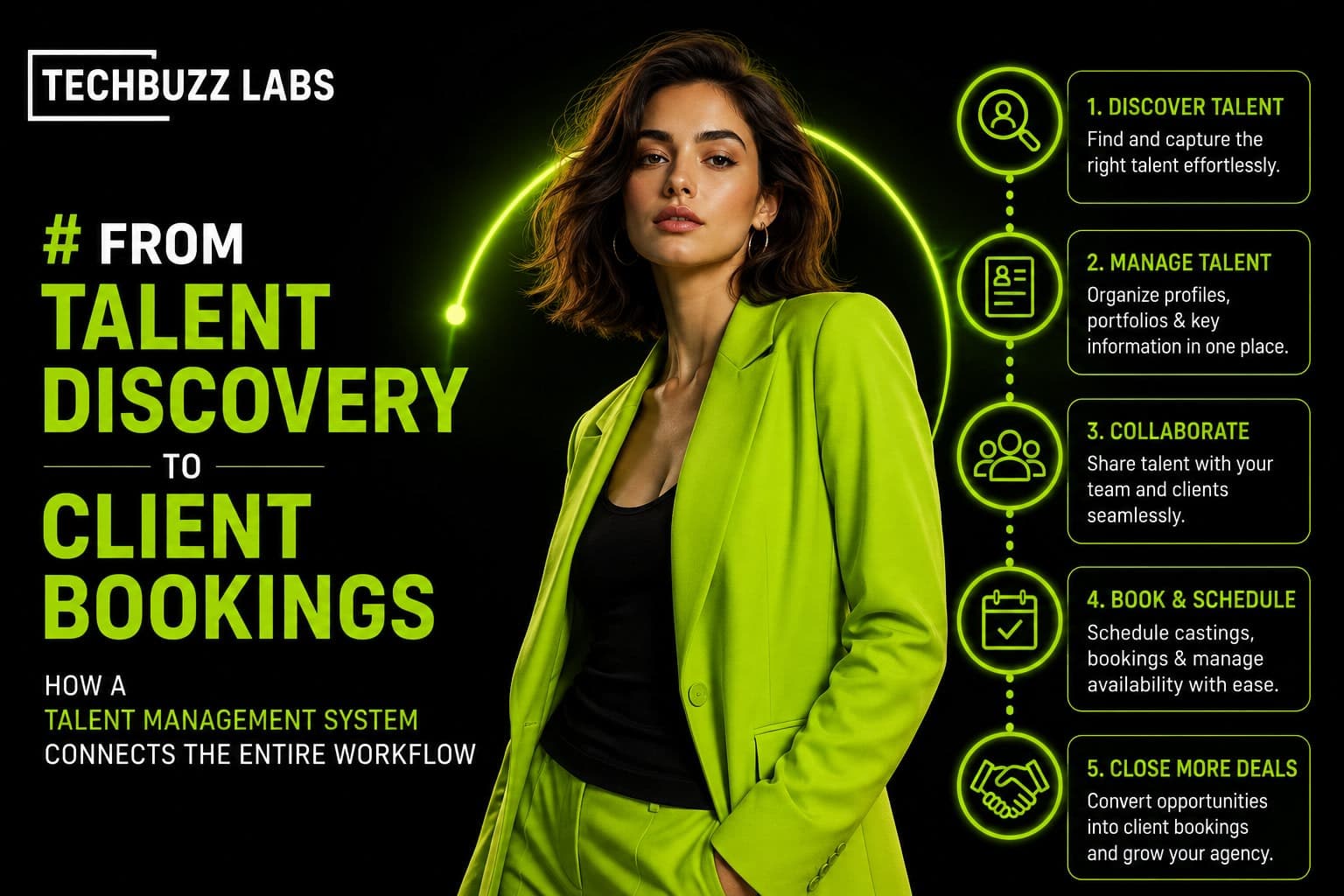
From Talent Discovery to Client Bookings: How a Talent Management System Connects the Entire Workflow
For modeling agencies, it can include digital model profiles, portfolios, measurements, experience, skills, locations, availability, casting opportunities, client information, communications, and booking records.
The U.S. modeling and talent industry is highly competitive, and agencies are expected to move quickly when new opportunities arise. Managing talent is no longer limited to maintaining model profiles. Agencies also need to handle casting requests, client relationships, availability, submissions, schedules, and bookings.
When these activities are managed through spreadsheets, email threads, shared folders, and separate applications, information can become fragmented. Agents may spend more time searching for data and coordinating administrative tasks instead of focusing on talent and clients.
A talent management system can connect these activities in one centralized workflow. From discovering and organizing talent to presenting models to clients and managing final bookings, modern software can help agencies operate more efficiently.
For modeling agencies across the USA, including those working in New York, Los Angeles, Miami, Chicago, and Atlanta, a connected system can provide the structure needed to manage growing talent pools and increasing client demands. TechBuzzLabs focuses on technology solutions for modeling and talent agencies, helping businesses modernize these workflows.
What Is a Talent Management System?
A talent management system is software designed to help agencies organize talent information and manage the processes surrounding talent representation.
For modeling agencies, it can include digital model profiles, portfolios, measurements, experience, skills, locations, availability, casting opportunities, client information, communications, and booking records.
The key difference between a basic database and a modern talent management system is connectivity.
Instead of simply storing information, the system can connect talent profiles to castings, clients, schedules, and bookings. This allows information to move through the agency's workflow without being repeatedly entered into different systems.
1. Discovering and Organizing Talent
The workflow begins with talent discovery.
Agencies may discover new models through applications, referrals, scouting, social media, events, or industry networks. Once talent becomes part of the agency's roster, agents need to organize their professional information.
A talent management system can create centralized profiles containing photographs, portfolio materials, measurements, experience, skills, location, and other relevant information.
As the agency grows, this centralized database becomes increasingly valuable.
Instead of searching through folders and spreadsheets, agents can use filters and search tools to locate relevant talent quickly.
2. Maintaining Accurate Talent Profiles
A talent profile should not remain static.
Models may gain new experience, update their portfolios, change locations, develop new skills, or change their availability.
A centralized system allows agents to update information in one place.
Keeping profiles current can improve the quality of future client submissions. When a client asks for specific talent, agents can work from updated information rather than relying on outdated spreadsheets or old files.
3. Connecting Talent With Casting Opportunities
Once a client sends a casting request, the agency needs to identify appropriate talent.
A talent management system can connect casting requirements with the agency's talent database.
Agents may be able to filter talent according to criteria such as location, experience, category, skills, and availability.
For example, if a client needs commercial models in Los Angeles for a particular campaign, agents can search the relevant talent pool rather than manually reviewing every model represented by the agency.
This can reduce the time required to create a shortlist.
4. Managing Client Relationships
Talent management is closely connected to client management.
Modeling agencies may work with brands, advertising agencies, photographers, production companies, retailers, and other businesses.
A system with CRM capabilities can store client information, communication history, previous projects, preferences, and booking records.
When a client returns with a new project, agents can review previous activity and understand the relationship before recommending talent.
This can help create a more organized and personalized client experience.
5. Managing Availability
Availability is one of the most important elements of the casting process.
A model may match a client's requirements perfectly but be unavailable on the requested dates.
If availability is managed manually, agents may need to contact several models before confirming who can participate.
A talent management system can connect availability with casting and booking information.
This gives agents better visibility into schedules and can help reduce unnecessary communication and scheduling conflicts.
For agencies working across multiple U.S. markets, centralized availability management can be particularly useful.
6. Streamlining Talent Submissions
Once suitable models have been identified, the next step is presenting them to the client.
A manual submission process may require agents to collect photographs, measurements, experience, and other information from multiple sources.
A connected talent management system can pull relevant information directly from model profiles.
Agents can associate selected talent with the appropriate casting and prepare submissions more efficiently.
This can also create consistency in how the agency presents its talent to clients.
7. Tracking Client Feedback
After a submission is sent, the agency needs to track client responses.
A client might shortlist a model, request additional options, ask for more information, or select talent for the project.
A centralized system can record these updates against the relevant casting.
Agents can quickly see which models are still being considered and which have moved forward.
This is particularly useful when an agency is managing multiple casting projects simultaneously.
8. Moving From Casting to Booking
The final stage is turning a successful casting into a booking.
Once a client selects a model, agents may need to confirm dates, locations, rates, contracts, usage information, and other project details.
A connected system can make this transition easier by linking booking information with the original casting and talent profile.
The workflow can look like:
Talent Discovery → Talent Profile → Casting → Submission → Client Selection → Booking
This connected approach reduces duplicate data entry and gives agents better visibility into project progress.
9. Automating Repetitive Agency Tasks
Modern talent management systems can also automate certain administrative tasks.
Agencies may need to send casting notifications, request availability, create reminders, follow up with clients, and update project statuses.
Automation can handle some of these routine activities, allowing agents to focus on higher-value work.
For example, the system could remind an agent to follow up with a client after a submission or notify a team member about an approaching booking deadline.
10. How TechBuzzLabs Supports Modern Talent Management
TechBuzzLabs focuses on technology solutions for modeling and talent agencies, helping businesses create centralized systems around their operational workflows.
For agencies that have outgrown spreadsheets, shared folders, and disconnected communication tools, a technology-driven platform can bring talent profiles, availability, bookings, and client requests into a more organized environment.
The goal is to make information easier to search, update, and use throughout the agency's workflow.
By combining talent management with CRM, casting, automation, and modern digital tools, agencies can build systems that support their current operations while providing room for future growth.
Conclusion
A talent management system can connect the entire agency workflow, from discovering new talent to completing client bookings.
Instead of treating talent profiles, casting opportunities, client relationships, availability, submissions, and bookings as separate processes, agencies can manage them as connected stages of one workflow.
For modeling and talent agencies in the USA, this can lead to faster talent searches, more organized casting processes, better client communication, improved scheduling, and reduced administrative work.
The real value of a modern talent management system is its ability to connect information and people throughout the agency. As talent pools and client demands continue to grow, agencies need technology that can scale with them.
With solutions and technology expertise from TechBuzzLabs, modern modeling and talent agencies can move toward more connected, efficient, and scalable operations—helping agents spend less time managing disconnected information and more time developing talent and building valuable client relationships.