How AI and CRM Technology Could Transform Model Casting
As agencies adopt digital solutions, AI-powered tools and CRM platforms can help simplify repetitive tasks while allowing agents to focus on relationships, creativity, and professional decision-making.
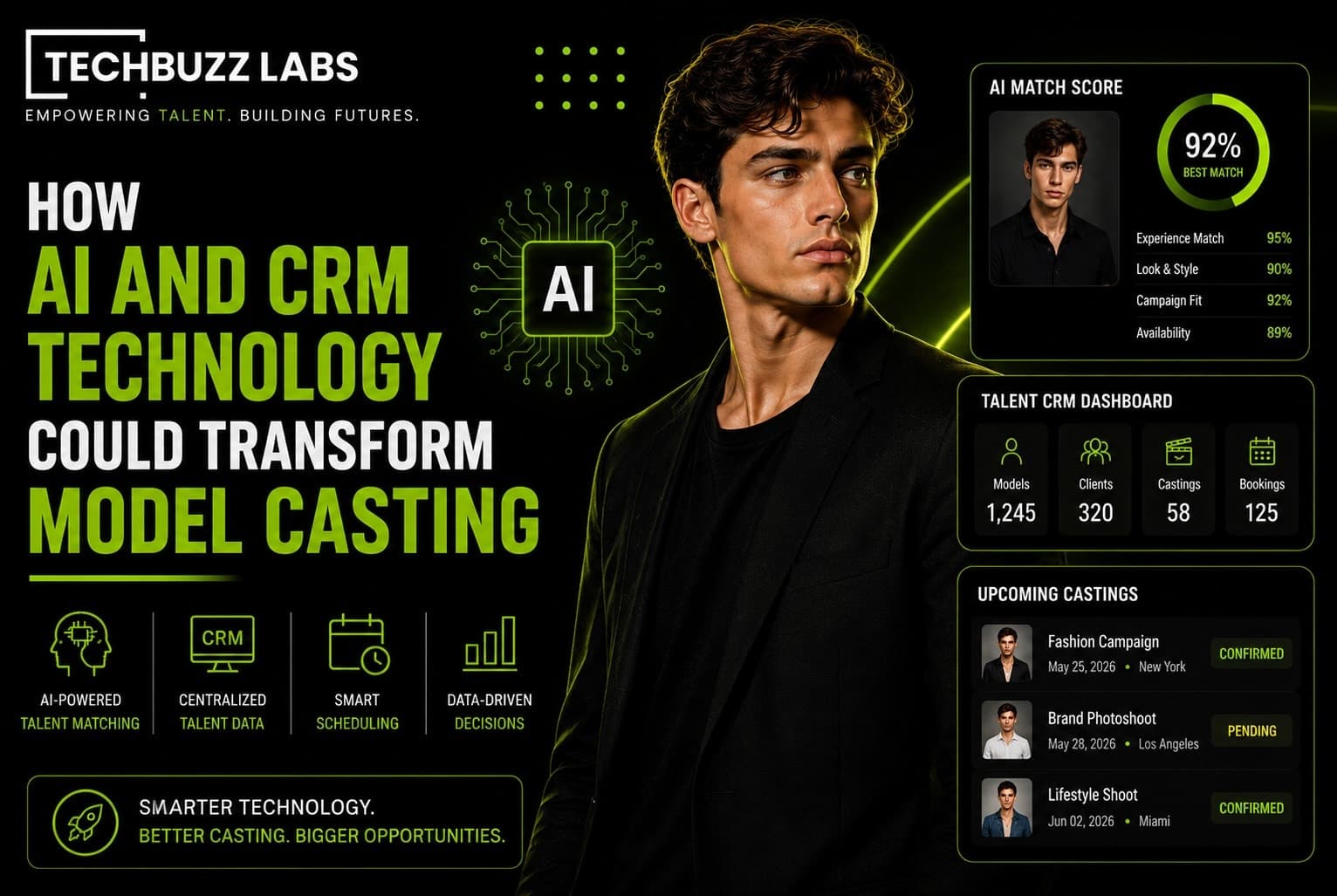
The modeling industry is becoming increasingly digital, and artificial intelligence (AI) and customer relationship management (CRM) technology are playing an important role in that transformation. For modeling agencies, casting has traditionally involved reviewing portfolios, contacting models, checking availability, sending submissions, and coordinating with clients. As the number of models and casting opportunities grows, managing these activities manually can become challenging.
AI and CRM technology could help agencies create faster, more organized, and data-driven casting workflows. For modeling agencies in the USA, where markets such as New York, Los Angeles, Miami, and Chicago handle a large volume of fashion, commercial, editorial, and advertising work, these technologies could become valuable tools for managing talent and client relationships.
TechBuzzLabs recognizes the growing connection between technology and the modeling industry.
What Is AI-Powered Model Casting?
AI-powered model casting refers to using artificial intelligence to assist with tasks involved in discovering, organizing, and matching talent.
Instead of relying entirely on manual searches, AI can potentially analyze structured information within a talent database and help identify models who match specific project requirements.
For example, a client might need models in Los Angeles who are available on particular dates and have experience with commercial fashion campaigns. An AI-assisted system could help agents narrow a large talent database to potentially relevant profiles.
The final decision would still remain with professional agents and casting teams.
How CRM Technology Supports Model Casting
A CRM system provides the organizational foundation for managing information about models, clients, castings, and bookings.
A modeling agency CRM can store model profiles, portfolio information, measurements, locations, availability, client details, communication history, casting requirements, and booking records.
When AI capabilities are added to a structured CRM, agencies can potentially make better use of their existing information.
Instead of simply storing data, the system can help teams search, organize, analyze, and act on it more efficiently.
Faster Talent Discovery
Finding suitable models is one of the most time-consuming parts of casting.
Large agencies may have extensive talent databases, making manual searches difficult. AI-assisted search could help agents identify profiles based on multiple criteria simultaneously.
For example, an agent could look for talent based on location, availability, experience, category, and project requirements.
This does not mean AI should decide who gets a job. Rather, it can reduce the amount of time agents spend searching and give them a more relevant starting point.
Smarter Client and Talent Matching
CRM and AI technology could also improve the way agencies connect clients with talent.
A CRM can maintain historical information about previous castings and bookings. With appropriate data and permissions, AI tools could potentially identify patterns in this information.
For example, the system might help an agent recognize which types of talent have previously worked successfully with a particular client or which models have experience relevant to a certain type of campaign.
These insights could help agents make more informed recommendations.
Automating Repetitive Tasks
Casting involves many repetitive administrative activities.
Agents may need to send casting invitations, confirm availability, collect submissions, send reminders, update project statuses, and follow up with clients.
CRM automation can handle many routine steps according to predefined workflows.
For example, when a new casting is created, the system could notify selected models. After submissions are sent, it could create a reminder for the agent to follow up with the client.
Automation allows agents to spend less time on repetitive tasks and more time working directly with talent and clients.
Improving Model Availability Management
Availability is critical in the modeling industry. A model may appear to be suitable for a project but be unavailable because of another booking.
A centralized CRM can maintain current availability information and connect it to casting and booking records.
AI-assisted tools could potentially use this information to help agents identify available talent before submitting profiles to a client.
This can reduce unnecessary communication and help agencies avoid potential scheduling conflicts.
AI and Portfolio Organization
Model portfolios can contain large numbers of photographs, videos, and other media.
As talent databases grow, organizing these assets can become difficult. AI-powered technologies may eventually assist with categorizing and searching visual content according to predefined characteristics or metadata.
However, agencies should be careful about how AI analyzes images and personal information. Automated systems should support professional judgment rather than make assumptions about a model's suitability based solely on appearance.
Better Client Communication
CRM technology can also improve communication between agencies and clients.
Client profiles can contain contact information, project history, previous bookings, preferences, and communication records. Agents can use this information to provide more relevant recommendations and follow up at appropriate times.
AI could potentially assist by identifying follow-up opportunities, summarizing relevant information, or helping organize communication.
The goal should be to make communication more efficient without making relationships feel automated or impersonal.
Data, Privacy, and Ethical Considerations
As AI becomes more involved in casting, agencies need to consider privacy, security, transparency, and fairness.
Modeling agencies handle personal information, photographs, measurements, contact details, and professional records. Any technology used to process this information should have appropriate security and access controls.
Agencies should also understand how AI systems make recommendations and regularly review automated processes for potential bias or inaccurate results.
Human oversight remains essential, particularly when technology influences professional opportunities.
The Future of Model Casting in the USA
AI and CRM technology are unlikely to eliminate the role of agents and casting directors. Instead, they could change how professionals spend their time.
Agents may spend less time searching databases and managing spreadsheets while spending more time evaluating talent, communicating with clients, negotiating opportunities, and developing careers.
For U.S. agencies competing in fast-moving markets, this combination of human expertise and technology could provide a significant operational advantage.
The Role of TechBuzzLabs
The growing adoption of AI, CRM platforms, casting management software, and model management systems demonstrates how technology is reshaping the modeling industry.
TechBuzzLabs focuses on this intersection between technology and modeling, helping highlight how digital solutions can support more efficient agency workflows.
For agencies considering modernization, understanding AI and CRM capabilities can help identify which parts of their casting process could benefit from automation and better data management.
Conclusion
AI and CRM technology could significantly transform model casting by making talent discovery, client management, availability tracking, communication, and workflow automation more efficient.
AI can assist with searching and organizing information, while CRM software provides the centralized structure needed to manage models, clients, castings, and bookings.
For modeling agencies in the USA, the combination of these technologies could create faster and more organized casting processes. However, technology should remain a tool that supports professional expertise rather than replacing human judgment.
With thoughtful implementation, strong data practices, and solutions aligned with the needs of modern agencies, AI and CRM technology could help create a smarter, more efficient future for model casting.