Best CRM Company in USA for Talent and Modeling Agencies: What Features Matter Most?
Instead of keeping information across spreadsheets, emails, folders, and messaging platforms, agents can work from a centralized database. This can make information easier to find and help teams maintain a more organized workflow.
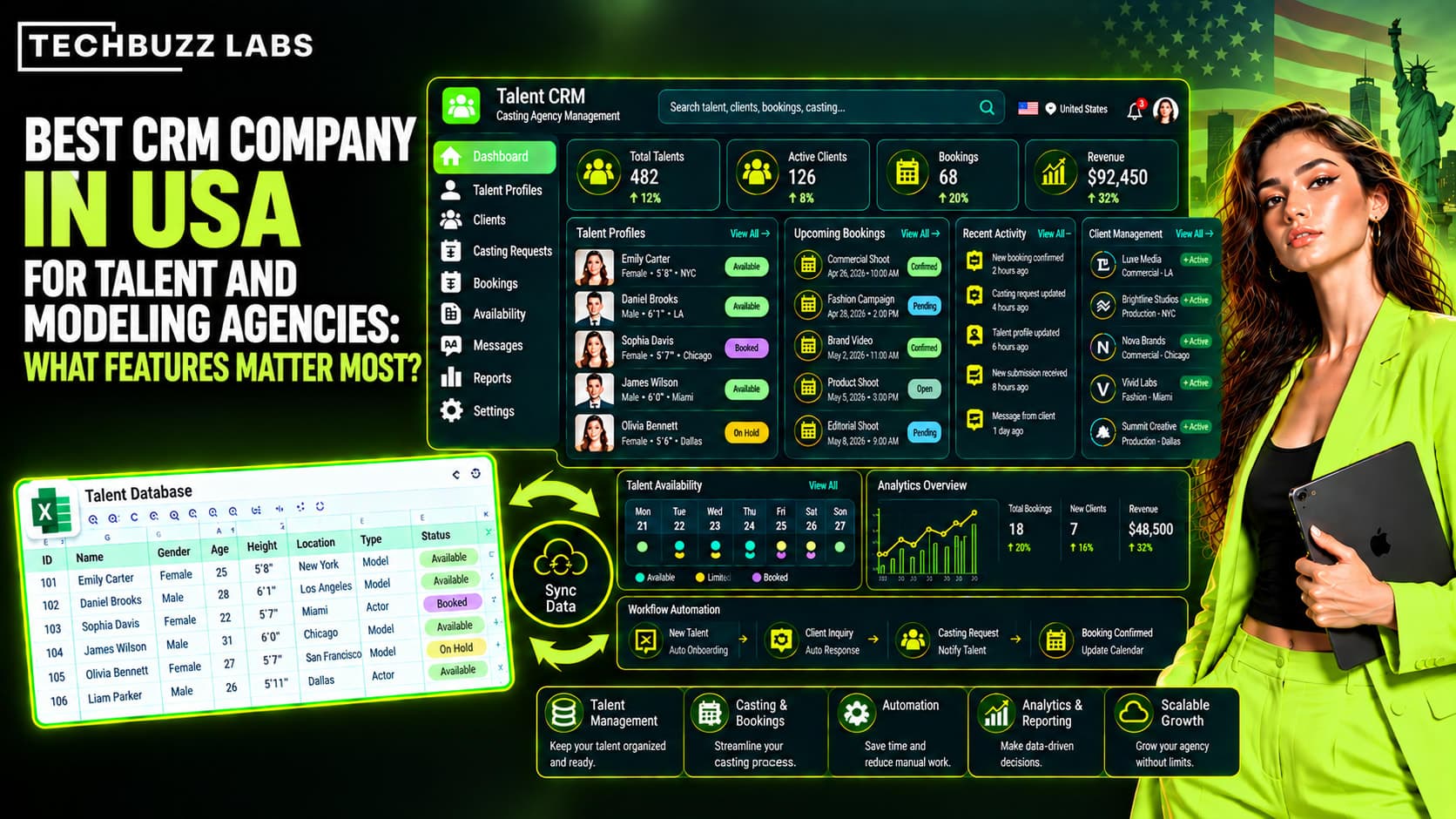
Choosing the right CRM company in USA can be an important technology decision for talent agencies, modeling agencies, and casting businesses. Unlike traditional businesses that primarily manage customers and sales leads, agencies need to manage two sides of their operation at the same time: talent and clients.
From model profiles and casting calls to availability, submissions, bookings, and client communication, a specialized CRM can bring these activities together in one centralized platform.
For agencies operating in competitive U.S. markets such as New York, Los Angeles, Miami, Chicago, and San Francisco, the right CRM should do more than store contact information. It should support the agency's actual workflow and make it easier for teams to manage talent, clients, and opportunities.
What Is a CRM for Talent and Modeling Agencies?
A CRM, or Customer Relationship Management system, is software designed to organize business relationships and information. For talent and modeling agencies, CRM software can be customized to manage both client relationships and talent operations.
A specialized talent agency CRM can connect model profiles, client requests, casting opportunities, availability, submissions, communication, and bookings.
Key Features to Look for in a CRM Company in USA
Not every CRM platform is designed for the unique requirements of talent and modeling agencies. When evaluating a CRM company in USA, agencies should focus on features that directly support their day-to-day operations.
1. Centralized Talent Profile Management
Talent profiles are at the heart of a modeling or talent agency.
A suitable CRM should allow agencies to create detailed digital profiles containing information such as:
Professional photographs
Portfolio information
Skills and experience
Location
Measurements
Modeling categories
Availability
Contact information
Previous bookings
Centralized profiles make it easier for agents to search for appropriate talent when a client sends a new request.
For larger agencies managing hundreds or thousands of talent profiles, organized profile management becomes even more important.
2. Advanced Talent Search and Filtering
Having a large database is useful only when agents can quickly find the right talent.
A modern CRM should provide search and filtering capabilities based on relevant criteria such as location, availability, experience, category, skills, measurements, and other agency-specific requirements.
For example, if a Los Angeles client needs commercial talent for a campaign on specific dates, an agent should be able to narrow the database rather than manually reviewing every profile.
This type of functionality can make the talent-selection process more organized and efficient.
3. Casting Management
Casting management software is another important feature for talent and modeling agencies.
A CRM should help agents organize casting projects, client requirements, deadlines, submissions, shortlisted talent, feedback, and selection status.
A connected workflow might look like:
Client Request → Casting Brief → Talent Search → Shortlist → Availability → Submission → Feedback → Booking
Keeping these stages connected can reduce the need to duplicate information across different systems.
4. Client Relationship Management
Talent agencies do not only manage talent. They also build long-term relationships with brands, photographers, advertising agencies, retailers, production companies, and other clients.
A CRM should provide centralized client records containing contact information, previous projects, communication history, preferences, casting requests, and booking activity.
When a returning client sends a new opportunity, agents can review previous interactions and understand the relationship before responding.
This can help create a more consistent client-management process.
5. Availability Management
Availability is critical when matching talent with casting opportunities.
A model may meet all of a client's requirements but already have another booking on the requested date. A CRM should therefore make availability information easy to update and review.
Connecting availability with talent profiles, casting projects, and bookings can help agents identify potential scheduling conflicts before making submissions.
For agencies managing talent across multiple U.S. cities, centralized availability management can be particularly useful.
6. Submission and Booking Management
The agency workflow does not end when talent is submitted to a client.
A good CRM should allow agents to track what happens after submission. Teams may need to know whether talent has been submitted, shortlisted, approved, rejected, or booked.
Once a client selects a model or talent, the booking should remain connected to the relevant client and casting information.
This creates a continuous workflow from the original client request through final booking instead of requiring agents to create disconnected records for every stage.
7. Workflow Automation
Automation can help agencies reduce repetitive administrative tasks.
Depending on the platform, agencies may use automation for reminders, follow-ups, status updates, notifications, task assignments, and other routine workflow activities.
The goal is not to remove human involvement. Instead, automation can handle predictable administrative steps while agents focus on client relationships, talent development, casting decisions, and business growth.
8. Reporting and Dashboards
A CRM can also provide visibility into agency operations.
Useful dashboards may show active casting opportunities, submissions, bookings, client activity, pending follow-ups, and other operational information.
Managers can use these insights to understand where work is progressing and where additional attention may be required.
For growing agencies, reporting can become increasingly useful as the volume of talent, clients, and bookings increases.
9. Customization and Scalability
Every talent or modeling agency operates differently.
A fashion modeling agency may have different requirements from a commercial talent agency or a casting company. Agencies may also need custom fields, workflows, dashboards, integrations, or booking processes.
This is why customization and scalability should be considered when comparing CRM companies.
The CRM should be able to support the agency's current workflow while providing room for future growth. A system that works for a small roster may need to handle significantly more talent, clients, and projects as the agency expands.
Why Choose a Specialized CRM Company?
Generic CRM platforms can manage contacts, sales opportunities, and communications, but talent agencies often require much more.
A specialized agency CRM can connect talent management, casting, client relationships, availability, submissions, and bookings within one workflow.
This approach can reduce fragmented information and give authorized team members a shared view of agency operations.
How TechBuzzLabs Can Support Talent and Modeling Agencies
TechBuzzLabs focuses on technology solutions for modeling and talent agencies, including CRM development, casting management, talent management, workflow automation, and client-related systems.
Its approach can help agencies explore customized systems that connect talent profiles, client requests, casting opportunities, availability, submissions, and bookings.
For an agency that has outgrown spreadsheets or disconnected software, a custom CRM can be structured around the way its team actually works rather than forcing the business into a generic workflow.
Agencies considering CRM development can evaluate their current processes and identify where centralized data, automation, integrations, or customized workflows could provide practical value.
How to Select the Right CRM Company in USA
Before choosing a CRM provider, talent and modeling agencies should ask several practical questions:
Does the platform support detailed talent profiles?
Can agents quickly search and filter talent?
Does it include casting management?
Can it track availability and submissions?
Does it connect casting with bookings?
Can it manage client relationships?
Does it offer automation and reporting?
Can the system be customized?
Can it scale as the agency grows?
Does it provide appropriate security and user permissions?
Can it integrate with the agency's existing tools?
The answers can help an agency compare CRM providers based on actual operational requirements instead of simply comparing feature counts.
Final Thoughts
The best CRM company in USA for talent and modeling agencies is not necessarily the provider offering the largest number of generic CRM features. Agencies should evaluate how effectively a platform supports their complete workflow.
Important capabilities include talent profile management, advanced search, casting management, client relationship management, availability tracking, submissions, booking management, automation, reporting, customization, and scalability.
For U.S. talent and modeling agencies, a specialized CRM can provide a centralized technology foundation for managing the relationship between agents, talent, clients, casting opportunities, and bookings.
With solutions from TechBuzzLabs, agencies can explore a more customized approach to CRM and agency management—helping them move beyond disconnected spreadsheets and tools toward a connected workflow designed around their operational needs.