Best CRM for Fashion Model Agency: A Practical Guide for Growing Modeling Agencies
Spreadsheets, email conversations, folders, and disconnected applications can make it difficult to keep information organized.
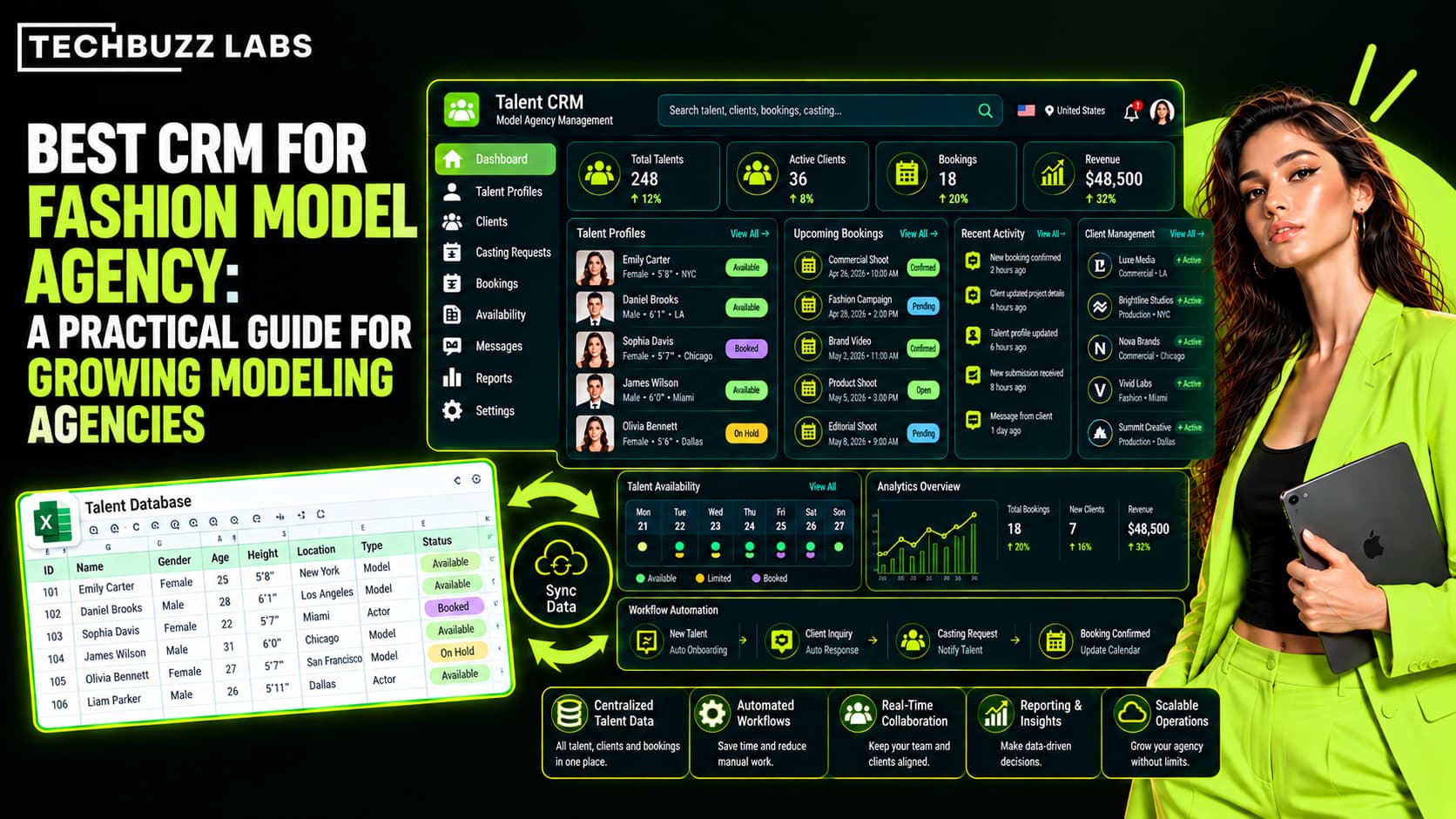
Growing a fashion modeling agency can be exciting, but growth also introduces new operational challenges. As the number of models, clients, casting opportunities, submissions, and bookings increases, the systems that worked for a small agency may no longer be enough.
Agents may spend more time searching for talent information, checking availability, updating records, and following up with clients instead of focusing on relationships and new opportunities.
The best CRM for fashion model agency operations should help solve these challenges by bringing important information and workflows into one organized platform. For a growing modeling agency, the goal is not simply to adopt CRM software but to create a system that can support the agency at its current size and as it continues to expand.
When Should a Modeling Agency Consider a CRM?
Not every new modeling agency needs sophisticated CRM software immediately. In the early stages, a small team may be able to manage its talent and clients using simple tools.
The need for a dedicated CRM often becomes more apparent when the agency starts experiencing operational friction.
For example, agents may struggle to find the latest model information, multiple people may update the same spreadsheet, client requests may be difficult to track, or important follow-ups may depend on individual reminders.
Another common sign is that the agency has enough talent and client activity that manual organization is taking too much time.
A CRM can provide structure before these problems become more difficult to manage.
Build a Centralized Model Database
A growing modeling agency needs a reliable way to organize its talent.
A CRM can create individual profiles for models containing information such as portfolio details, photographs, measurements, experience, location, skills, availability, contact information, and booking history.
The advantage is not simply having all this information in one place. The real value comes from making the information searchable and connected to other agency activities.
For example, an agent working on a fashion campaign can search the talent database according to relevant requirements instead of manually checking individual folders or spreadsheets.
As the roster expands, this centralized structure becomes increasingly valuable.
Keep Talent Information Current
A large talent database is only useful when the information inside it remains accurate.
Model availability, contact details, experience, portfolio material, and other profile information can change over time.
A CRM can provide a structured environment for updating these records and allowing authorized team members to access the latest information.
Agencies can also establish internal processes for reviewing profiles and keeping important details current.
This can reduce the risk of submitting outdated information to clients.
Manage More Clients Without Losing Organization
Growth usually means more clients as well as more talent.
A modeling agency may work with fashion brands, photographers, advertising agencies, production companies, retailers, and other businesses. Each client can have different requirements, communication history, and project activity.
A CRM can organize these relationships in individual client records.
Agents can connect client information with inquiries, casting projects, submissions, previous bookings, and communication history.
This gives the team a clearer picture of each relationship without requiring them to search through old email conversations.
Turn Client Requests Into Organized Projects
As client activity increases, managing requests through email alone can become difficult.
A CRM can turn individual client requests into structured projects or casting opportunities.
Agents can record important details such as project requirements, dates, location, talent specifications, deadlines, and client information.
The agency can then connect suitable models to the project and track what happens next.
A typical workflow may look like:
Client Request → Project Details → Talent Search → Shortlist → Availability → Submission → Client Feedback → Booking
This provides a clear structure for managing multiple opportunities at the same time.
Make Talent Shortlisting More Efficient
When a modeling agency has a small roster, manually reviewing profiles may be manageable.
As the roster grows, the process can become much more time-consuming.
Search and filtering tools can help agents narrow the talent database according to relevant criteria. Depending on the CRM, agents may be able to filter by location, experience, availability, skills, measurements, or other profile attributes.
This does not eliminate the agent's professional judgment. Instead, it helps the team reach relevant profiles more efficiently.
The final selection can still depend on the agent's knowledge of the model, client, campaign, and project requirements.
Connect Availability With Casting
One of the practical challenges of modeling is availability.
A model may be an excellent fit for a campaign but unavailable on the required dates.
A CRM can connect availability information with talent profiles and casting projects, helping agents consider scheduling requirements during the selection process.
This can reduce unnecessary back-and-forth communication and make the shortlisting process more practical.
For a growing agency managing several castings at once, having availability information connected to projects can also make daily coordination easier.
Track Submissions From Start to Finish
Once models have been shortlisted, agencies need to know what happens after submission.
Without structured tracking, agents may have to search through emails to determine which models were submitted and whether the client has responded.
A CRM can provide clear submission stages.
A project could move through statuses such as submitted, under review, shortlisted, rejected, approved, or booked.
This gives agents a better overview of active opportunities and makes follow-up easier.
It also creates a record that can be referenced when the client or model works with the agency again.
Keep Bookings Connected to the Original Project
Booking management should not exist separately from the casting process.
When a client approves a model, the CRM should ideally connect the booking to the relevant client, talent profile, and project.
This provides continuity from the initial request through the final booking.
Over time, the agency can build a useful history of previous projects and bookings.
That history can help agents understand client relationships and provide context when similar opportunities appear in the future.
Reduce the Administrative Pressure of Growth
One of the biggest problems associated with agency growth is that administrative work grows along with business activity.
More models mean more profile updates. More clients mean more communication. More castings mean more submissions and follow-ups. More bookings mean more records to maintain.
CRM automation can help reduce some of this repetitive work.
Depending on the platform, agencies may automate reminders, notifications, task assignments, status changes, and follow-up activities.
The purpose is not to remove human involvement. It is to reduce repetitive tasks so agents can spend more time on talent relationships, client service, and business development.
Improve Collaboration as the Team Expands
A growing agency may eventually have several agents, coordinators, administrators, or other team members working with the same information.
Without a centralized system, employees may maintain separate notes or files, creating inconsistencies.
A CRM can provide a shared operational environment where authorized users can access relevant information.
For example, if one agent is unavailable, another team member can review a client's project, the submitted models, and the current booking status without starting the process from the beginning.
This can make internal handoffs more organized.
Use Data to Understand Agency Activity
As the agency grows, its CRM can become a valuable source of operational data.
Managers may want to understand how many casting projects are active, how many submissions are being made, which clients generate recurring activity, how many opportunities convert into bookings, and where workflow delays occur.
Dashboards and reports can help organize this information.
The objective is not to collect data simply for the sake of reporting. The value comes from using relevant information to understand how the agency is operating and where processes may need improvement.
Plan for Future Growth
A CRM should not only solve today's problems.
Before selecting a platform, a growing modeling agency should consider where the business may be in the next few years.
The agency may eventually need more users, additional talent categories, multiple locations, advanced reporting, integrations, automation, mobile access, or AI-assisted workflows.
A scalable CRM can provide a stronger technology foundation for these future requirements.
For agencies with highly specialized processes, custom CRM development can also provide greater flexibility than a standard platform.
Custom CRM for Growing Modeling Agencies
Every modeling agency has its own workflow.
Some agencies may focus on editorial fashion, others on commercial modeling, e-commerce, advertising, runway, or multiple categories. Their client processes, talent requirements, booking workflows, and internal operations may differ.
This is where custom CRM software can become useful.
TechBuzzLabs focuses on custom technology solutions for modeling and talent agencies, including CRM systems, talent management, casting workflows, automation, and agency-specific software.
A custom platform can be designed around the agency's actual processes instead of requiring the team to completely change how it works.
How to Evaluate a CRM Before Choosing It
Growing agencies should evaluate a CRM based on real operational requirements.
Ask whether the platform can manage detailed model profiles, provide effective talent search, organize clients, manage casting projects, track availability, handle submissions, connect bookings, support automation, provide useful reporting, and control user permissions.
It is also important to consider usability.
A CRM may have many features, but if agents find it difficult to update records or locate information, adoption can become a problem.
The most useful system is one that the team can realistically use every day.
Final Thoughts
The best CRM for fashion model agency operations should provide structure without making the agency's workflow unnecessarily complicated.
For growing modeling agencies, CRM technology can connect talent profiles, client relationships, casting projects, availability, submissions, bookings, and operational data within one system.
The right platform can help an agency move away from fragmented processes and create a more organized foundation for growth.
Before choosing a CRM, agencies should first understand their current challenges, identify the workflows that need improvement, and consider the requirements they are likely to have as the business expands.
A CRM should ultimately support the agency's people and processes rather than becoming another system they have to work around.