Best CRM for Talent Agents in USA: A Practical Guide to Choosing the Right Platform
Look at how talent profiles are created and updated, how client inquiries are received, how casting briefs are organized, how talent is shortlisted, how availability is confirmed, and how bookings are tracked.
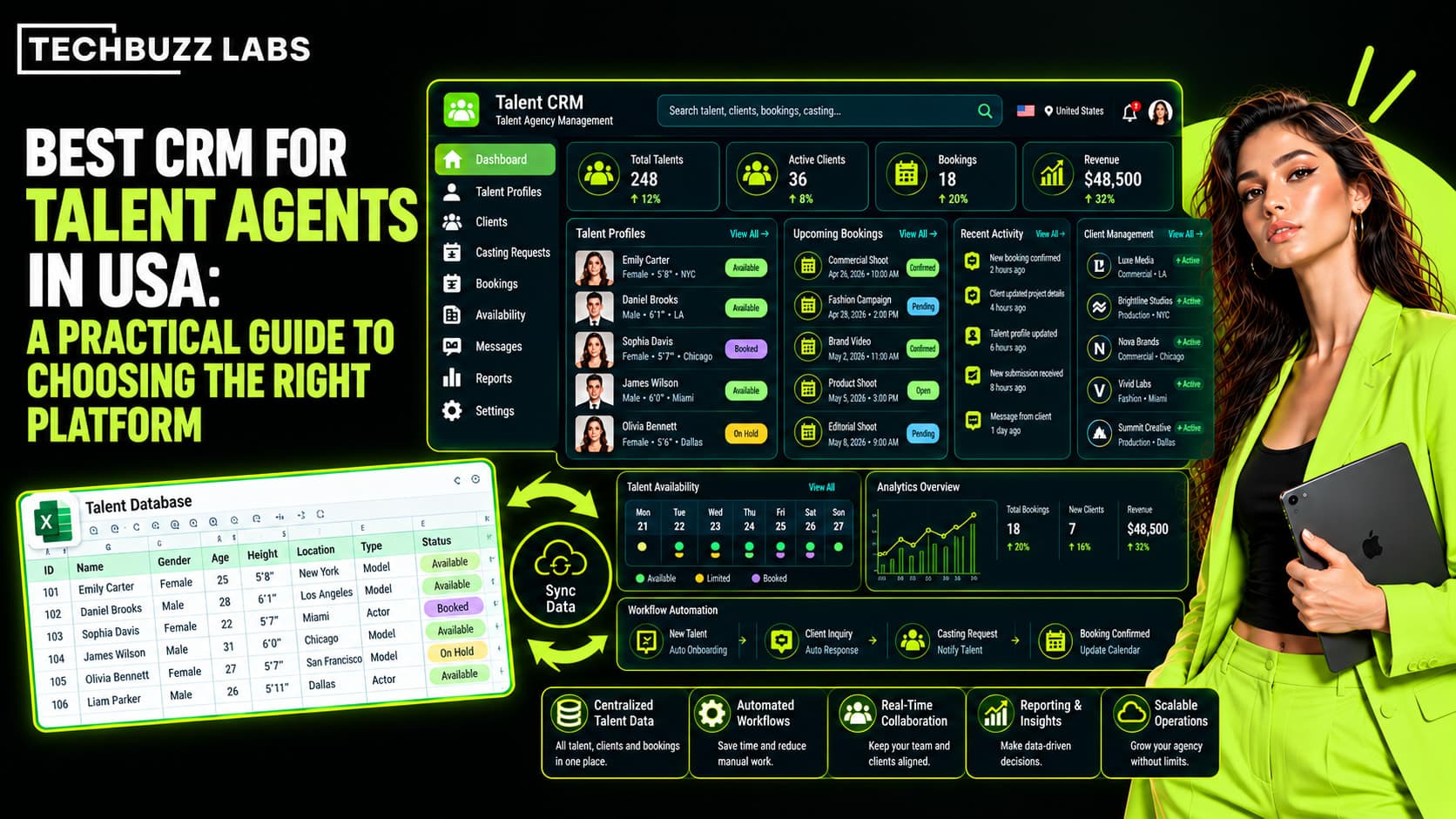
Choosing the right CRM can become an important technology decision for a growing talent agency. Agents may need to manage hundreds or thousands of talent profiles while handling client relationships, casting requests, submissions, availability, bookings, and follow-ups at the same time. A CRM that only manages basic contacts may not be enough for these requirements.
The best CRM for talent agents in USA should support the way a talent agency actually works. Instead of choosing software based only on the number of features it offers, agencies should evaluate how well the platform handles talent management, casting workflows, client communication, bookings, reporting, and future growth.
This practical guide explains the main areas agencies should consider before choosing a CRM platform.
Start With Your Agency's Current Workflow
Before comparing CRM platforms, understand how your agency currently operates.
This exercise can reveal where the agency spends the most manual time.
For example, if agents frequently move information between spreadsheets and email, the CRM should prioritize centralized data. If the biggest problem is managing casting submissions, workflow and submission tracking may be more important.
The goal is to choose software based on actual operational needs rather than simply selecting a platform because it has a long feature list.
Evaluate Talent Profile Management
Talent profiles are at the center of many agency operations.
A suitable CRM should allow agents to organize important information in structured profiles. Depending on the agency, this may include photographs, experience, skills, location, measurements, portfolio information, availability, contact details, and booking history.
The platform should also make it easy to update information when a talent's details change.
A strong search and filtering system is equally important. Agents should be able to find relevant talent without manually reviewing every profile in the database.
As the roster grows, efficient talent discovery becomes increasingly important to everyday operations.
Look at Casting and Project Management
Talent agencies should also evaluate how a CRM handles casting opportunities.
A useful platform can allow agents to create or manage casting projects, record client requirements, connect appropriate talent, track submissions, and monitor project progress.
Consider whether the software supports a workflow such as:
Client Brief → Talent Search → Shortlist → Availability → Submission → Feedback → Booking
The exact workflow will vary between agencies, but the CRM should make important stages visible and easy to manage.
Check Client Relationship Features
Talent agencies need more than talent databases. They also need organized client management.
The CRM should allow teams to maintain client records and connect them with relevant inquiries, casting projects, communication, submissions, and bookings.
This can help agents understand a client's history before responding to a new request.
For example, an agency may want to know which types of talent a client has previously booked, what projects they have worked on, and which casting requests are currently active.
A connected client record can make this information easier to access.
Examine Availability Management
Availability can directly affect whether talent is suitable for an opportunity.
A CRM should therefore make it practical to record, update, and review availability information.
When availability is connected with talent profiles and casting projects, agents can consider scheduling requirements while creating shortlists.
This can reduce unnecessary back-and-forth communication and make the selection process more organized.
Review Submission and Feedback Tracking
Another important question is what happens after talent is submitted to a client.
The CRM should ideally provide a clear way to track submissions and their current status.
For example, an agent may need to know whether a talent has been submitted, whether the client is reviewing the profile, whether the talent has been shortlisted, or whether the opportunity has resulted in a booking.
Keeping these stages organized can prevent information from becoming lost across email conversations or personal notes.
It also creates a useful historical record that teams can reference later.
Consider Booking Management
The CRM should connect casting activity with the booking process rather than treating them as completely separate activities.
Once a client approves talent, agents may need to record booking dates, project information, client details, talent information, and other relevant requirements.
A connected workflow allows the agency to maintain continuity from the original client request through to the completed booking.
This is particularly useful when agents manage multiple projects simultaneously.
Assess Automation Capabilities
Automation can be valuable when it solves repetitive operational tasks.
When evaluating a CRM, agencies should identify which processes could benefit from automation.
These may include:
Follow-up reminders
Casting status notifications
Availability requests
Task assignments
Client follow-ups
Booking updates
Internal alerts
Workflow status changes
The objective is not to automate everything. Instead, automation should reduce repetitive administrative work while keeping agents in control of important decisions and relationships.
Look at Reporting and Dashboards
A CRM should also help agency managers understand what is happening across the business.
Useful dashboards may provide visibility into active casting projects, submissions, bookings, client activity, talent availability, and workflow stages.
Before choosing a platform, consider which metrics are actually useful to the agency.
A large collection of reports is not necessarily helpful if managers cannot use the information to understand operational performance.
The better approach is to identify the questions the agency wants its CRM to answer and then evaluate whether the platform provides the necessary data.
Think About Customization
Not every talent agency follows the same process.
A modeling agency, acting agency, commercial talent agency, or multi-category agency may have different requirements. Even two agencies serving the same market can have completely different internal workflows.
This makes customization an important consideration.
Agencies should determine whether they can configure fields, workflows, user permissions, dashboards, and other components according to their requirements.
For agencies with highly specialized processes, custom CRM development may be worth considering when standard platforms cannot adequately support the workflow.
Check Scalability Before You Commit
A CRM should solve today's problems without creating new problems as the agency grows.
Consider how the platform will perform when the agency has more talent, clients, projects, users, and bookings.
Also consider whether the system can support future integrations, automation, analytics, mobile access, or AI-assisted functionality.
Choosing technology with future requirements in mind can reduce the need for major system changes later.
Don't Ignore Security and User Permissions
Talent and client databases can contain important business and personal information.
Agencies should understand how a CRM handles access controls, user permissions, data protection, backups, and account security.
Different team members may need different levels of access. For example, an administrator may require broader permissions than an agent or temporary team member.
These requirements should be considered before selecting a platform rather than after implementation.
Compare the Total Value, Not Just the Price
CRM pricing is important, but it should not be the only consideration.
A lower-cost platform may require significant manual work, additional software, or workarounds to support agency processes. A more specialized solution may provide greater operational value if it removes repetitive tasks and connects important workflows.
Agencies should therefore consider the overall value of the system, including implementation, customization, integrations, training, maintenance, and scalability.
The right question is not simply, "Which CRM costs less?"
It is, "Which CRM can support our workflow effectively at the scale we expect?"
When Custom CRM Development Makes Sense
Standard CRM software can be appropriate for agencies with relatively straightforward requirements.
Custom development becomes more relevant when an agency needs specialized workflows, unique data structures, custom dashboards, advanced integrations, or functionality that standard platforms cannot provide efficiently.
TechBuzzLabs develops custom technology solutions for talent and modeling agencies, including CRM systems, casting workflows, talent management, automation, and related agency software.
A custom approach can allow the CRM to be designed around the agency's specific processes instead of requiring the team to significantly change how it works.
Final Checklist for Choosing a Talent Agency CRM
Before making a final decision, agencies should evaluate the platform against several practical questions.
Can it manage detailed talent profiles? Can agents quickly search and filter talent? Can it organize client relationships? Can it manage casting projects? Can it track availability, submissions, feedback, and bookings? Does it support useful automation and reporting? Can it scale with the agency? Does it provide appropriate security and permissions? Can it integrate with the tools the agency already uses? And can it be customized when the agency's requirements change?
Answering these questions can make the selection process much more focused.
Final Thoughts
Choosing the best CRM for talent agents in USA is ultimately about finding a platform that fits the agency's real operational requirements.
A CRM should bring together talent management, client relationships, casting, availability, submissions, bookings, automation, and reporting in a way that makes everyday work more organized.
Agencies should therefore evaluate software based on workflow fit, usability, scalability, customization, security, and long-term value rather than simply choosing the platform with the longest feature list.
A practical evaluation process can help agencies select technology that supports their current operations while providing a foundation for future growth.