Best CRM for Talent Casting Agency: How Custom CRM Software Supports U.S. Agencies
For U.S. agencies managing growing talent databases and increasingly complex casting activity, customization can provide a way to create a connected system without forcing the entire team to work around the limitations of a standard platform.
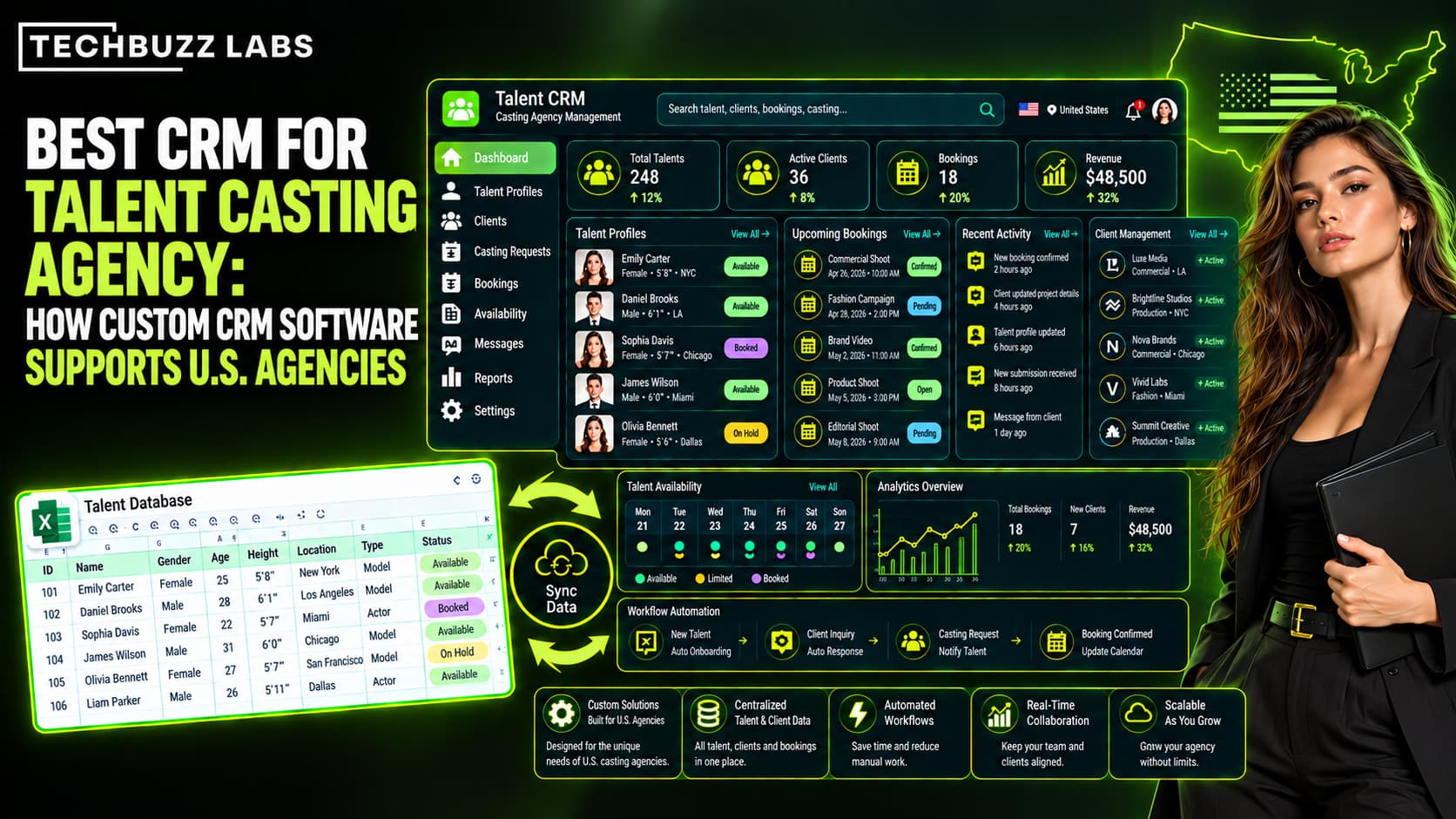
Talent casting agencies in the United States often manage complex operations that go far beyond basic contact management. Agents may need to organize large talent rosters, respond to casting briefs, check availability, prepare submissions, manage client relationships, track bookings, and coordinate information across their teams.
Generic CRM software can handle some of these activities, but agencies with specialized workflows may eventually need a system that fits the way they actually operate. Custom CRM software allows a talent casting agency to build its technology around its own processes, data structures, users, and operational requirements.
What Is Custom CRM Software for a Talent Casting Agency?
Custom CRM software is developed around the specific requirements of an organization rather than providing the same workflow to every business.
A talent casting agency may need to manage information that a conventional sales CRM was not designed to handle. This can include detailed talent profiles, portfolios, measurements, skills, availability, casting requirements, submissions, client feedback, booking information, and project history.
A custom CRM can bring these elements into a centralized platform while allowing the agency to define how information moves through its workflow.
The goal is not simply to create another database. It is to build a system around the agency's operational process.
Why Generic CRM Software May Not Fit Every Agency
Standard CRM platforms are generally designed around common business processes such as lead management, sales pipelines, customer communication, and account tracking.
A talent casting agency has additional requirements.
An agent may need to search hundreds or thousands of talent profiles based on casting criteria, check availability, submit selected talent, track client responses, and move approved talent into a booking process.
When a generic CRM does not support these processes naturally, teams may start creating workarounds using spreadsheets, external applications, manual fields, or separate databases.
Custom CRM software can address this problem by allowing the system to be structured around the agency's actual workflow.
Build Talent Profiles Around Agency Requirements
Talent profiles are one of the most important data structures in a casting agency.
A custom CRM can be designed to include the fields that matter to the agency. Depending on its specialization, this may include professional experience, portfolio information, skills, location, measurements, categories, availability, previous bookings, documents, and other relevant information.
The agency can also determine how this information should be searched and filtered.
For example, agents may need to find talent based on multiple casting requirements at once. A custom search system can be built around the criteria the team actually uses during daily casting work.
This can make a large talent database easier to work with as the agency grows.
Create an Agency-Specific Casting Workflow
Every casting agency may organize projects differently.
One agency may require several internal approval stages before submission, while another may move directly from a client brief to talent shortlisting.
Custom CRM software can reflect these differences.
A workflow might include:
Client Request → Casting Brief → Talent Search → Shortlist → Availability → Internal Review → Submission → Client Feedback → Selection → Booking
Additional stages can be added when required.
The benefit is that the CRM follows the agency's process instead of forcing employees to adapt their workflow to a predefined software structure.
Connect Clients With Their Casting History
Client management is another area where customization can provide value.
A client record can be connected with previous casting requests, submitted talent, feedback, bookings, communication, and project information.
When the same client returns with another casting request, agents can access relevant historical information from the same system.
This can provide useful context without requiring employees to search through old emails or separate project folders.
The CRM can effectively connect the relationship side of the agency with its operational casting activity.
Automate Repetitive Agency Tasks
Custom CRM development can also support agency-specific automation.
Not every task needs to be completed manually.
Depending on the workflow, automation could help with reminders, availability requests, internal notifications, submission status changes, follow-up tasks, and other repetitive activities.
For example, if a client has not responded to a submission within a defined period, the system could create an internal follow-up task.
Automation can therefore reduce routine administration while leaving important decisions to agents and managers.
Integrate the CRM With Other Systems
A growing U.S. agency may already use several digital tools.
These could include communication platforms, accounting systems, calendars, file storage, email services, websites, application forms, or other internal systems.
A custom CRM can be designed with integrations in mind.
Instead of requiring employees to manually transfer information between multiple systems, relevant data can potentially move between connected platforms.
The exact integrations will depend on the agency's technology stack, security requirements, and workflow.
Give Managers Better Operational Visibility
Custom CRM software can also provide agency-specific dashboards.
Rather than displaying generic sales metrics, dashboards can focus on information that matters to casting operations.
For example, managers may want to monitor active casting projects, pending submissions, upcoming bookings, client activity, talent availability, or projects waiting for feedback.
Because the dashboard is designed around the agency's requirements, management can prioritize the information most relevant to its operations.
Scale With the Agency
Technology requirements often change as an agency grows.
A smaller agency may initially need talent profiles, client records, and basic casting management. Later, it may require additional automation, advanced reporting, integrations, multiple user roles, or more sophisticated workflows.
Custom software can be developed with these future requirements in mind.
This does not mean every feature needs to be built immediately. Agencies can prioritize the most important operational problems first and expand the system as their requirements develop.
Security and User Permissions
Talent casting agencies handle business and personal information that should be accessible only to appropriate users.
A custom CRM can include role-based permissions based on how the agency operates.
For example, agents, managers, administrators, and other users may require different levels of access.
The agency can define which information different users can view or modify.
Security requirements should be considered from the beginning of development rather than treated as an afterthought.
When Should a U.S. Agency Consider Custom CRM Software?
Custom development is not automatically necessary for every agency.
A standard CRM may be sufficient when an agency has relatively simple requirements and its existing workflow fits the available software.
Custom development becomes more relevant when an agency experiences specific limitations, such as complex casting workflows, specialized talent data, multiple disconnected systems, extensive manual administration, unique reporting requirements, or difficulty scaling an existing platform.
The decision should be based on operational requirements rather than the assumption that custom software is always better.
How TechBuzzLabs Supports Custom Talent Casting Systems
TechBuzzLabs focuses on custom systems for talent and casting agencies, including talent profiles, availability, bookings, and client requests within a searchable platform built around an agency's workflow.
Its approach is centered on replacing disconnected spreadsheets, messaging workflows, and manual administration with a custom operational system.
For an agency considering custom CRM development, the first step should be identifying the processes that currently create the most administrative work or information gaps. Those requirements can then guide the structure of the software.
How to Evaluate a Custom CRM Project
Before beginning development, agencies should clearly define what the system needs to accomplish.
Important questions include:
Which agency processes should the CRM manage?
What information needs to be stored for each talent profile?
How should agents search and filter talent?
What stages should a casting project have?
How should availability be handled?
How should submissions and feedback be tracked?
Which client activities should be connected to casting projects?
What should happen when talent is booked?
Which repetitive tasks should be automated?
Which existing tools need integrations?
What information should different users be allowed to access?
What reporting does management require?
Answering these questions before development can help prevent unnecessary features and keep the project focused on real operational needs.
Final Thoughts
Custom CRM software can give U.S. talent casting agencies an opportunity to build technology around the way their teams actually work.
Instead of treating talent management, casting, client relationships, availability, submissions, and bookings as disconnected activities, a custom system can connect them within one operational workflow.
The value of customization is not simply having more features. It is having the right structure, automation, integrations, permissions, and workflows for the agency's specific requirements.
For agencies that have outgrown spreadsheets or are struggling with the limitations of generic CRM platforms, custom CRM software can provide a scalable foundation for managing talent and casting operations as the business develops.