Best CRM for Talent Casting Agency: How to Manage Talent, Casting, and Clients
Depending on the agency's requirements, profiles may include professional photographs, portfolio information, location, experience, skills, measurements, categories, availability, previous work, and booking history.
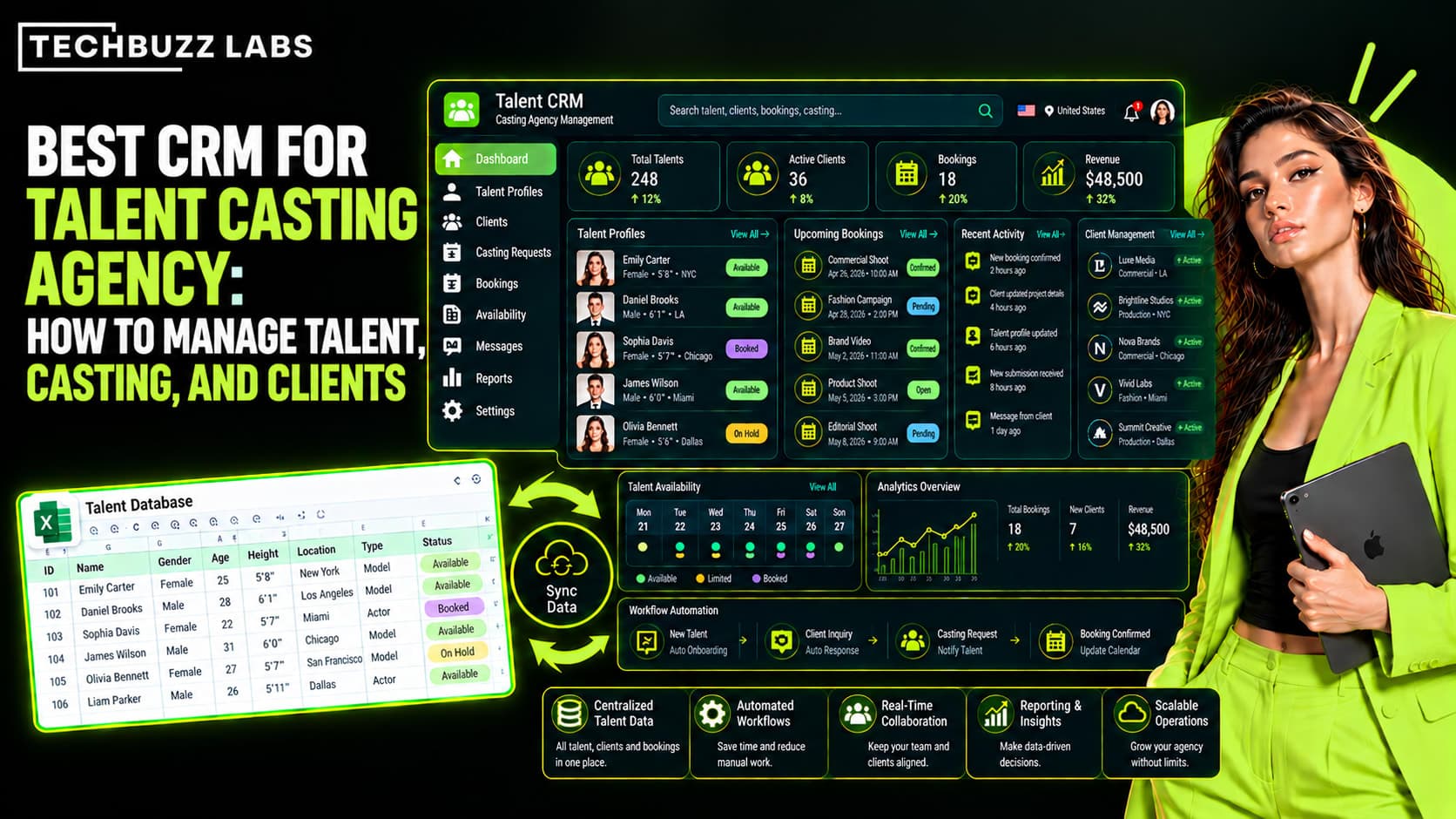
Managing a talent casting agency involves three connected responsibilities: finding and organizing talent, handling casting opportunities, and maintaining strong client relationships. When these areas are managed through separate spreadsheets, emails, folders, and messaging platforms, important information can become difficult to track.
A CRM for talent casting agencies can bring these activities together in one organized system. Instead of managing talent, casting projects, and clients as separate processes, agencies can connect them through a shared workflow. For U.S. agencies handling a growing roster and multiple client requests, this approach can make daily operations easier to coordinate.
Why Talent, Casting, and Clients Need to Work Together
Talent management and client management are closely connected to the casting process.
A client may send a project brief requiring specific talent. The agency then needs to identify suitable people, check availability, prepare submissions, communicate with the client, collect feedback, and potentially arrange a booking.
If each stage is stored separately, agents may have to repeatedly enter the same information or search through different systems.
A specialized CRM can connect the complete process:
Talent Profile → Client Request → Casting Project → Talent Shortlist → Submission → Client Feedback → Selection → Booking
This gives agents a clearer view of how each casting opportunity moves through the agency.
Managing Talent in a Centralized CRM
Talent profiles are the foundation of a casting agency's database.
The important factor is not simply storing this information but making it searchable and useful.
For example, if a client needs talent for a commercial campaign in Los Angeles with specific experience and availability, an agent should be able to filter the talent database instead of manually reviewing hundreds of profiles.
A structured talent database can also make it easier for multiple agents to access consistent information.
Managing Casting Opportunities
Every casting opportunity has its own requirements, deadlines, and workflow.
A CRM can create a dedicated record for each casting project. Agents can store information such as the client, project type, location, dates, talent requirements, submission deadline, and current status.
This creates a central reference point for the entire team.
Instead of asking which spreadsheet contains a particular casting or searching through long email threads, agents can open the relevant project and review its current information.
Casting stages can also be structured according to the agency's process. For example, an opportunity might move from new request to talent search, shortlist, submission, client review, selection, and booking.
Connecting Talent With Casting Requirements
One of the most useful functions of a talent casting CRM is connecting the talent database with active casting projects.
Agents can search the roster using relevant criteria and create a shortlist for a particular client request.
The CRM can then maintain the relationship between the casting project and the selected talent.
This is useful because the same talent may be considered for multiple projects at the same time. Without structured records, it can become difficult to remember which talent was submitted where and what happened after the submission.
A connected CRM creates a historical record around each opportunity.
Managing Client Relationships
Talent casting agencies do not only manage people on their roster. They also manage relationships with brands, advertising agencies, production companies, photographers, retailers, entertainment businesses, and other clients.
A CRM can provide each client with an organized record containing contact details, previous projects, communication history, casting requests, submissions, and bookings.
This gives agents useful context when a client returns with a new project.
For example, an agent may review previous casting activity before responding to a new request. The agency can understand what types of talent the client has previously requested and which projects have already been completed.
Tracking Client Requests From Start to Finish
Client requests should not disappear into an inbox after they arrive.
A CRM can turn a client inquiry into a structured casting opportunity.
The agent can record the requirements, assign the project internally, search for suitable talent, create a shortlist, check availability, and prepare submissions.
Once the client responds, the feedback can remain connected to the same project.
This creates better continuity between communication and operational work.
Instead of having one system for client conversations and another for casting activity, the agency can keep the important information connected.
Submission and Feedback Management
Submitting talent is only one stage of the casting process. Agencies also need to know what happens after submission.
A CRM can help agents track:
Which talent was submitted
Which casting the submission belongs to
When the submission was made
Whether the client has responded
Which talent has been shortlisted
Whether additional information was requested
Whether the client selected someone
This reduces the risk of losing track of submissions when multiple casting projects are active at the same time.
It also creates a useful history that agents can reference when working with returning clients or talent.
Managing Availability and Bookings
Talent availability can directly affect casting decisions.
A person may match the client's requirements but already have another commitment during the project dates. Keeping availability connected to talent profiles can help agents identify potential scheduling issues earlier.
When talent is selected, the CRM can then carry relevant information into the booking stage.
Booking records may include project details, dates, client information, selected talent, status, and other agency-specific requirements.
This creates continuity instead of forcing agents to recreate information after every successful casting.
Improving Team Collaboration
Talent casting often involves multiple team members.
One agent may handle a client request, another may search the talent database, while someone else follows up with the client or manages booking details.
When information is stored in one centralized CRM, team members can work from the same records.
This can reduce unnecessary internal communication such as repeatedly asking who contacted the client, which talent was submitted, or whether availability has been confirmed.
A shared system can therefore support better coordination as the agency grows.
Using CRM Data for Agency Visibility
A CRM can also provide a broader view of agency activity.
Managers can review active casting projects, client activity, submissions, bookings, pending responses, and other operational information through dashboards or reports.
Over time, structured records can help agencies understand patterns in their business.
For example, agencies may be able to identify which clients generate frequent casting requests, which types of opportunities are most active, or where projects commonly remain pending.
The value comes from turning everyday agency activity into organized information that can be reviewed when needed.
What Should Agencies Look for in a Talent Casting CRM?
There is no single CRM that is automatically suitable for every agency. The right platform depends on the agency's workflow, roster size, client base, casting volume, team structure, and growth plans.
Before choosing software, agencies should evaluate whether it can handle the complete process rather than focusing only on individual features.
Important areas to examine include talent profile management, advanced search, casting project management, client records, availability tracking, submissions, feedback, booking management, automation, reporting, permissions, integrations, security, and customization.
The system should also be practical for everyday users. A platform with extensive functionality may still create problems if agents find it difficult to use.
How TechBuzzLabs Can Help
TechBuzzLabs focuses on technology solutions for modeling and talent agencies, including CRM, casting management, talent management, and workflow automation.
For agencies with specialized processes, a custom CRM can be structured around the way their teams actually manage talent, clients, casting opportunities, submissions, and bookings.
Rather than forcing an agency to adapt completely to a generic workflow, custom software can be designed around its operational requirements.
Final Thoughts
Managing talent, casting, and clients effectively requires more than a basic contact-management system. These three areas are closely connected, and the CRM should reflect that relationship.
A specialized talent casting CRM can create a centralized workflow where agents can manage talent profiles, organize casting opportunities, track client requests, monitor submissions, record feedback, and continue selected opportunities through booking.
For U.S. talent casting agencies, the goal should be to choose technology that supports their actual workflow and provides room for future growth.
When talent, casting, and client information remain connected, agencies can spend less time searching for information and more time managing the relationships and opportunities that drive their business.