Best CRM for Talent Casting Agency: How to Streamline Casting Workflows
Without a centralized system, agents may have to search different files for talent information, check availability separately, look through emails for client feedback, and manually update project statuses.
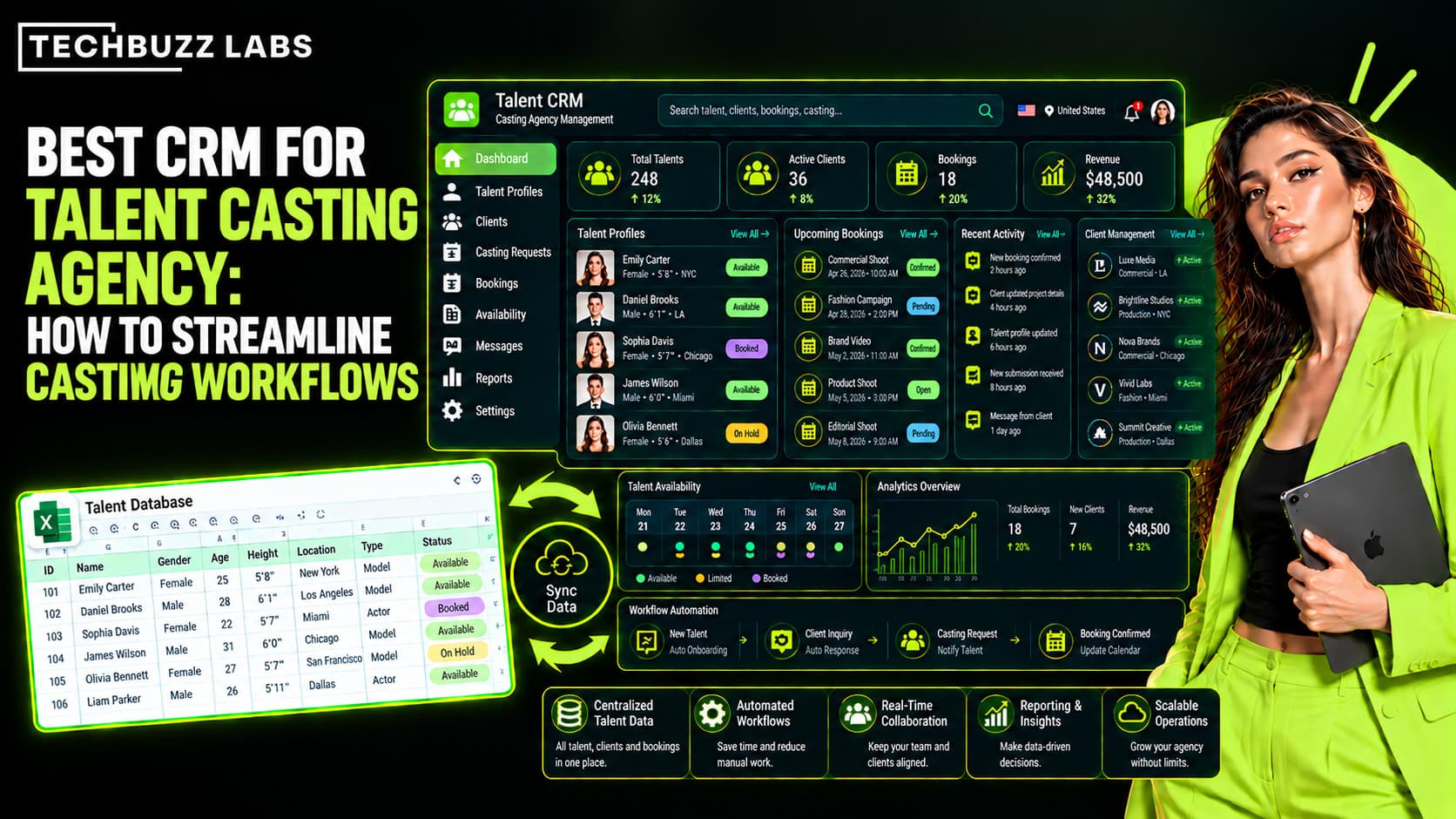
For a talent casting agency, speed and organization can directly affect how efficiently a team handles new opportunities. A single casting request can require agents to review client requirements, search a large talent database, check availability, prepare submissions, collect feedback, and coordinate the next steps.
When these activities are managed through spreadsheets, email threads, messaging apps, and disconnected tools, the casting workflow can become difficult to control. A CRM designed for talent casting agencies can bring these stages into one connected environment, helping teams manage casting projects with greater visibility and less repetitive administration.
What Makes a Casting Workflow Difficult to Manage?
A casting workflow usually involves several moving parts.
A client may provide a brief with specific requirements, dates, location, and project details. The agency then needs to identify suitable talent and determine who is actually available. After that, agents prepare submissions, communicate with the client, monitor responses, and update the casting status.
The difficulty increases when an agency manages multiple casting opportunities simultaneously.
A casting CRM can connect these activities so the team can follow each opportunity through a structured workflow.
Start With a Centralized Casting Pipeline
One of the first steps toward streamlining casting is creating a centralized pipeline.
Instead of treating every casting as a collection of emails and messages, the CRM can create a dedicated project record containing the relevant information.
Depending on the agency's workflow, stages might include:
New Request → Brief Review → Talent Search → Shortlist → Availability → Submission → Client Review → Selection → Booking
The exact stages can be customized, but the important principle is that every casting has a visible status.
Agents can quickly see which opportunities are new, which require talent searches, which are waiting for client feedback, and which are approaching booking.
Organize Client Briefs Efficiently
A casting workflow begins with understanding what the client actually needs.
A CRM can provide structured fields for client briefs, allowing agencies to record project requirements rather than relying entirely on unstructured messages.
Information may include project type, location, dates, talent category, experience requirements, appearance requirements, submission deadlines, and other relevant details.
Keeping the brief connected to the casting project gives agents a consistent reference point while searching for talent.
It can also reduce the risk of overlooking important requirements when a project is handled by multiple team members.
Speed Up Talent Discovery
Once the brief is organized, agents need to find suitable talent quickly.
A centralized talent database can make this process more efficient by allowing agents to search and filter profiles using relevant criteria.
Instead of opening individual folders or manually reviewing a large roster, agents can narrow the database to potentially suitable candidates.
The value of this approach increases as the agency's talent pool grows. A structured database gives agents a practical way to work with large amounts of talent information without turning every casting into a manual research task.
Check Availability Before Submission
Finding a suitable talent profile is only part of the process.
The talent also needs to be available for the casting or project dates.
A CRM can connect availability information with talent profiles and casting opportunities. This allows agents to consider scheduling information before preparing a submission.
For agencies managing several active projects, this can help reduce unnecessary availability checks and prevent avoidable scheduling conflicts.
It also gives the team a clearer picture of which talent can realistically be considered for an opportunity.
Simplify Shortlisting
After searching the database, agents can create a focused shortlist for the casting.
A structured shortlist allows the team to separate potentially suitable talent from the larger database while keeping the candidates connected to the specific project.
Agents can review profile information, availability, previous activity, and other relevant details before preparing the final submission.
This creates a more organized transition between talent discovery and client presentation.
Make Submissions Easier to Track
Submitting talent to a client should not be the end of the workflow.
The agency needs to know which people were submitted, when they were submitted, and what happened afterward.
A CRM can maintain a submission history connected to the casting project.
Agents can potentially track whether a submission is:
Awaiting client review
Shortlisted
Requesting additional information
Not selected
Approved
Moving toward booking
This visibility becomes particularly useful when agents are handling multiple projects for different clients at the same time.
Keep Client Feedback Connected to the Casting
Client feedback is another stage where information can easily become scattered.
A client may approve certain talent, request alternatives, ask for additional materials, or change project requirements.
When feedback is stored alongside the casting project, agents can see the current status without searching through separate communication channels.
This can also help when another team member takes over the project. Instead of relying on verbal updates, the agent can review the project record and understand what has already happened.
Automate Repetitive Workflow Tasks
Not every casting activity requires manual intervention.
Certain repetitive tasks can potentially be automated through CRM workflows.
For example, a system could create reminders for submission deadlines, notify agents when client feedback is overdue, send availability requests, or update internal task statuses.
Automation should support the agency's workflow rather than replace professional judgment.
Agents still make the important decisions about talent selection, client communication, negotiations, and bookings. The purpose of automation is to reduce routine administrative steps that consume time.
Connect Casting With Booking
A streamlined casting workflow should continue beyond client selection.
When a client chooses talent, the information should ideally move into the booking stage without requiring agents to recreate the project from scratch.
The original client, casting, talent, dates, and relevant project information can remain connected.
This creates continuity between the initial request and the final booking.
It also gives the agency a historical record of how the opportunity progressed from casting request to completed project.
Improve Team Coordination
Casting teams often divide responsibilities.
One agent may communicate with the client, another may search talent, and another may manage submissions or bookings.
A centralized CRM gives everyone access to the same project information according to their permissions.
This can reduce internal questions such as whether talent has already been submitted, whether availability was confirmed, or whether the client has responded.
Better visibility can make handoffs easier and help prevent duplicate work.
Use Workflow Data to Find Bottlenecks
A CRM can also help agencies identify where their casting workflow slows down.
For example, management may discover that certain projects spend too much time waiting for availability confirmations or client responses.
With structured records and reporting, agencies can examine the workflow and determine where process changes or automation could help.
This turns the CRM from a simple database into an operational tool.
TechBuzzLabs has also discussed using CRM data to identify casting workflow bottlenecks and improve agency operations.
Choose a CRM That Fits the Agency's Workflow
The right CRM should reflect the way an agency actually handles casting.
Before selecting software, agencies should consider whether the system supports their specific casting stages, talent database structure, availability process, submission workflow, client communication, booking process, reporting requirements, and team permissions.
Customization can become particularly important when an agency has a specialized workflow that does not fit neatly into a generic CRM.
A system built around the agency's process can reduce the need for employees to create manual workarounds.
How TechBuzzLabs Supports Casting Workflows
TechBuzzLabs develops custom systems for talent and casting agencies, with solutions designed around agency-specific workflows. Its platform positioning includes centralized management of talent profiles, availability, bookings, and client requests.
For agencies that have outgrown spreadsheets, WhatsApp conversations, and disconnected tools, a custom CRM can bring casting operations into one searchable system.
The objective is to connect the workflow rather than simply add another software tool to the agency's technology stack.
Final Thoughts
Streamlining a talent casting workflow requires more than storing talent profiles in a database. Agencies need a connected process that moves from client brief to talent discovery, availability, shortlisting, submission, feedback, selection, and booking.
A specialized CRM can help organize these stages, reduce repetitive administrative work, improve team visibility, and create a consistent record for every casting opportunity.
For growing U.S. talent casting agencies, the key is to choose a system that matches the agency's actual workflow and can adapt as its talent roster, client base, and casting volume increase.
When the right information is connected at every stage, agents can spend less time managing scattered data and more time focusing on talent, clients, and the opportunities that matter to the agency.