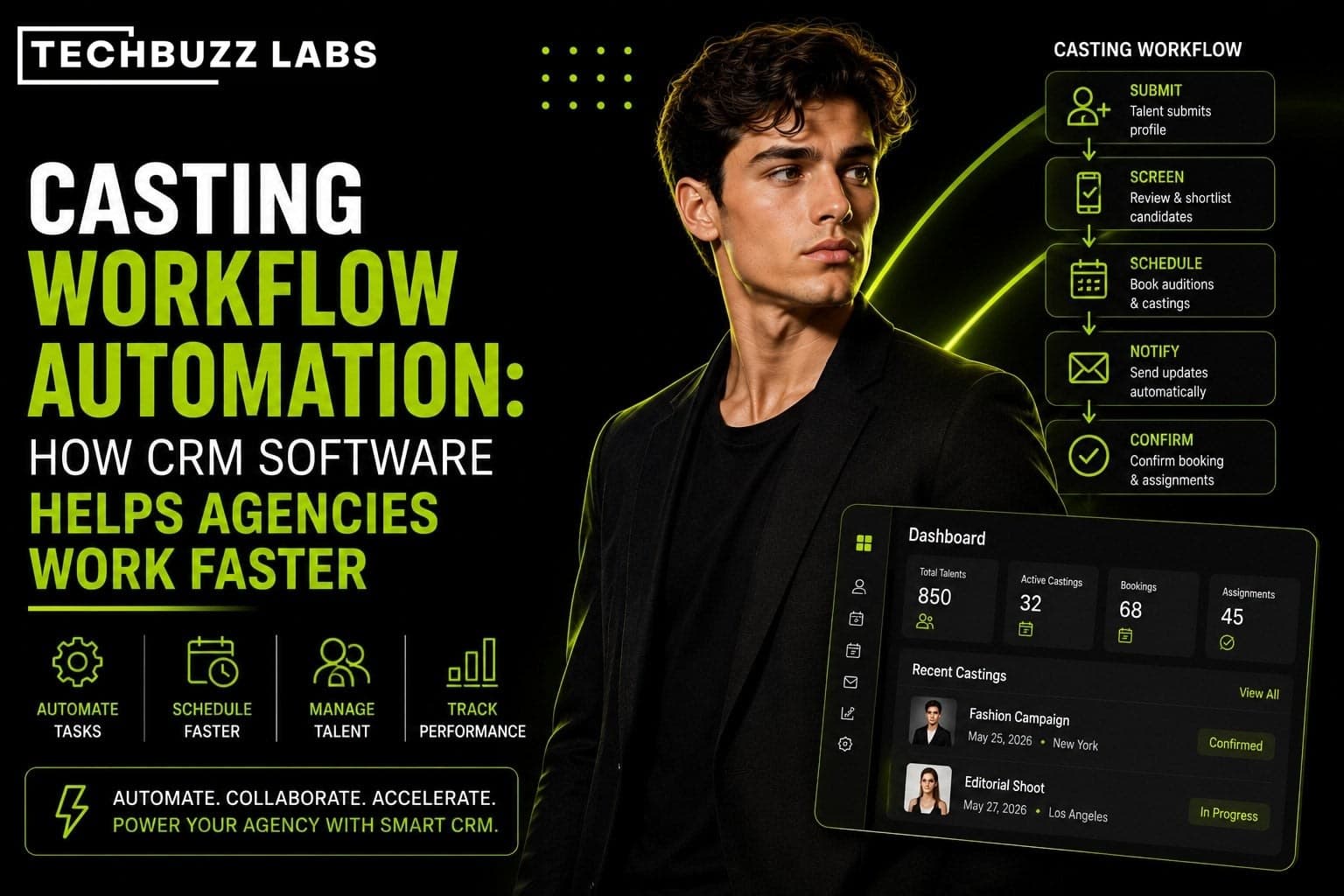
Casting Workflow Automation: How CRM Software Helps Agencies Work Faster
Instead of manually completing every step, a CRM can help agencies organize information and trigger specific actions based on workflow rules.
The modeling and talent industry moves quickly. Agencies may receive casting requests from brands, advertising companies, photographers, production teams, and retailers while simultaneously managing dozens or hundreds of models. Agents need to review requirements, identify suitable talent, send submissions, communicate with clients, manage availability, and coordinate bookings.
When these tasks are handled manually through spreadsheets, emails, phone calls, and separate applications, the casting process can become slow and difficult to manage. Casting workflow automation offers a more efficient approach by using CRM software to organize repetitive tasks and connect different stages of the casting process.
For modeling and talent agencies in the USA, CRM-powered automation can reduce administrative work, improve response times, and help teams manage more casting opportunities. TechBuzzLabs recognizes the growing role of technology in modern modeling operations and how digital tools can help agencies build faster and more organized workflows.
What Is Casting Workflow Automation?
Casting workflow automation means using software to automate or simplify repetitive activities involved in finding and booking talent.
For example, when a new casting opportunity is added, the system can help agents identify suitable models, send casting notifications, track submissions, and remind staff about upcoming deadlines.
Automation does not mean removing agents from the process. Instead, it allows agents to spend less time on repetitive administrative tasks and more time making professional decisions.
Why Is Automation Important for Modeling Agencies?
Speed matters in the modeling industry. Clients may need talent quickly, and casting deadlines can sometimes be very short.
If an agency takes too long to respond to a client request, the opportunity may go to another agency.
CRM software can help agencies access model information quickly and organize client requirements in one place. This allows agents to spend less time searching through spreadsheets and more time reviewing suitable talent.
For agencies operating in major U.S. markets such as New York, Los Angeles, Miami, Chicago, and San Francisco, faster workflows can be particularly valuable in competitive casting environments.
Centralized Talent Information
One of the foundations of automated casting is a centralized talent database.
A CRM can store model profiles containing information such as photographs, measurements, experience, skills, location, availability, contact information, and previous bookings.
When a new casting request arrives, agents can search and filter this database instead of manually reviewing individual files.
This can make it much easier to create a shortlist of relevant models.
Automated Casting Notifications
Communication is an important part of every casting workflow. Agents may need to contact multiple models about a new opportunity.
CRM software can help automate certain notifications and reminders. Once a casting is created, selected models can receive relevant information about the project, including deadlines, locations, requirements, and submission instructions.
Automated reminders can also help ensure that models and agency staff do not miss important deadlines.
However, agencies should continue using personalized communication when a project requires individual attention.
Faster Model Matching
Finding the right talent is one of the most time-consuming parts of casting.
A CRM with advanced search and filtering can help agents narrow their database according to project requirements. Filters might include location, availability, experience, modeling category, measurements, or other relevant criteria.
Instead of reviewing hundreds of profiles manually, an agent can create a smaller list of potentially suitable talent.
This can significantly reduce the time required to respond to client requests.
Automating Client Follow-Ups
Client follow-ups are another area where automation can save time.
After sending model submissions, agents may need to follow up with clients to request feedback or confirm whether talent has been selected.
A CRM can create reminders based on specific dates or workflow stages. This reduces the chance that a promising opportunity will be forgotten.
Automated follow-ups can be especially useful when agents are managing several casting projects at the same time.
Streamlining Booking Workflows
Casting does not end when a client chooses a model. The agency then needs to coordinate the booking.
A CRM can connect the casting record with booking information, allowing agents to track dates, locations, clients, rates, availability, and project status.
This creates a smoother transition from casting to booking.
For agencies handling multiple projects simultaneously, connected workflows can reduce duplicate data entry and make it easier for team members to understand the current status of each project.
Reducing Manual Data Entry
Manual data entry can consume a significant amount of an agent's time. Entering the same client or model information into several spreadsheets and systems also increases the risk of mistakes.
CRM software can centralize information so that data only needs to be entered or updated in one primary location.
For example, when a model's contact information or availability changes, the updated information can be available to authorized team members throughout the system.
This can improve accuracy and reduce repetitive administrative work.
Tracking the Casting Pipeline
A CRM can also provide a visual overview of the casting process.
Agencies can organize opportunities into different stages, such as:
New Casting → Talent Shortlist → Submissions Sent → Client Review → Selected → Booked
This gives agents and managers a clear view of where each project stands.
It also makes it easier to identify opportunities that require immediate attention.
Using Data to Improve Agency Performance
Automation creates another valuable benefit: data.
A CRM can help agencies track casting activity, submissions, bookings, client relationships, and other performance indicators.
Managers can use this information to identify trends. For example, they may discover which clients generate the most bookings, which types of castings are most successful, or where delays commonly occur.
These insights can help agencies improve their processes over time.
Choosing the Right CRM for Casting Automation
Not every CRM is designed for modeling and talent agencies. Before choosing a platform, agencies should evaluate features such as talent management, advanced search, casting workflows, client management, scheduling, availability tracking, communication, booking management, reporting, and security.
Ease of use is also important. Agents should be able to adopt the system without extensive technical training.
The software should also be scalable so that it can support the agency as the number of models, clients, and casting projects increases.
How TechBuzzLabs Fits Into the Technology Shift
The increasing use of CRM and automation demonstrates how technology is changing the modeling industry. TechBuzzLabs focuses on technology solutions for modern modeling operations, where CRM platforms, casting management tools, and automation can help agencies organize their workflows.
For agencies looking to modernize their operations, understanding how automation works can help them identify repetitive tasks that could be simplified through technology.
Conclusion
Casting workflow automation can help modeling and talent agencies work faster by reducing repetitive administrative tasks and connecting important stages of the casting process.
CRM software can centralize talent profiles, automate notifications, simplify model searches, organize client follow-ups, track casting stages, and connect successful castings with bookings.
For agencies in the USA, these capabilities can create faster response times and more organized operations in a competitive industry.
Technology does not replace the expertise of professional agents or casting directors. Instead, it gives them better tools to manage information and spend more time on the human side of talent management. With the right CRM strategy and technology-focused solutions such as TechBuzzLabs, agencies can build efficient workflows that support both current operations and long-term growth.