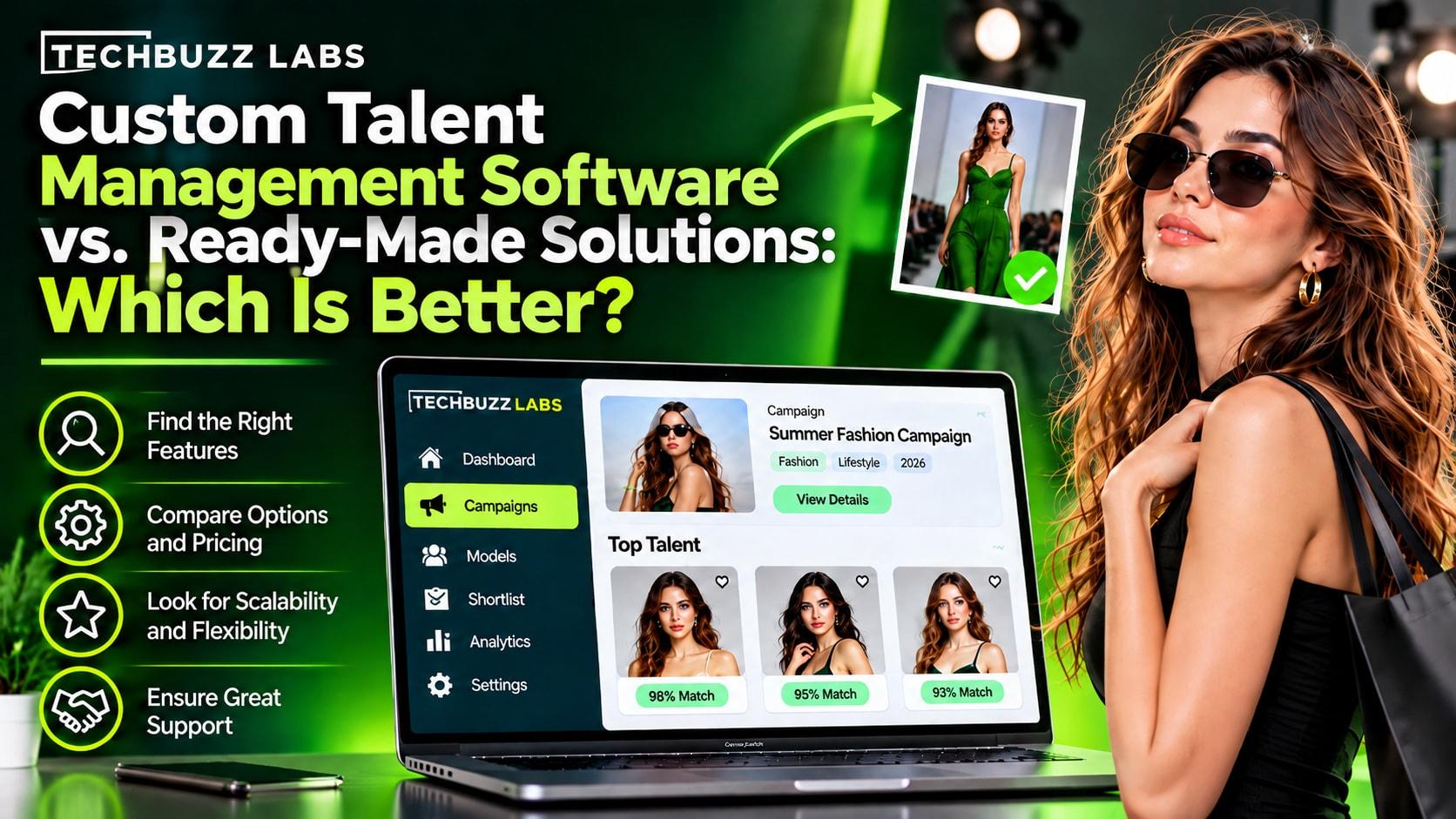
Custom Talent Management Software vs. Ready-Made Solutions: Which Is Better?
But which option is better for your agency? The answer depends on your budget, operational needs, team size, and long-term growth plans.
Choosing the right talent management software is an important decision for modeling agencies, talent agencies, and casting businesses. As agencies grow, managing talent profiles, client relationships, casting projects, bookings, and communication through disconnected tools can create unnecessary work.
Two common options are available: ready-made talent management software and custom-built solutions. Ready-made platforms offer pre-developed features that agencies can start using quickly, while custom software is developed around specific business requirements.
What Is Ready-Made Talent Management Software?
Ready-made talent management software is a pre-built platform designed to serve multiple businesses. Agencies typically subscribe to a monthly or annual plan and receive access to existing features.
Depending on the provider, these platforms may include:
Talent database management
Model and talent portfolio storage
Casting and booking management
Client relationship management
Availability tracking
Scheduling and notifications
Reporting and analytics
The biggest advantage is convenience. Agencies can often configure an existing platform and begin managing their operations without waiting for a complete software development project.
For small and growing agencies with standard requirements, ready-made software can be a practical starting point.
What Is Custom Talent Management Software?
Custom talent management software is developed specifically for an agency's workflows and business requirements. Instead of adapting operations to a pre-existing platform, the agency works with a development team to create a system that supports its processes.
A custom solution may include:
Centralized talent and model databases
Advanced portfolio management
Custom talent search and filtering
AI-assisted talent matching
Casting project management
Client portals and submission tracking
Booking calendars and availability management
Automated notifications and workflows
Custom dashboards and reporting
For example, a modeling agency managing thousands of profiles may need specialized filters for location, measurements, experience, portfolio categories, and availability. If existing platforms cannot support these requirements effectively, custom development may provide greater flexibility.
Custom vs. Ready-Made Talent Management Software: Key Differences
Both options can help agencies improve operations, but they differ in several important areas.
Comparison factorReady-made softwareCustom softwareInitial costUsually lowerUsually higherImplementationGenerally fasterRequires development timeCustomizationLimited to available settingsBuilt around specific needsFeaturesPre-developedSelected and developed for the agencyIntegrationsDepends on vendor supportCan be designed for required systemsMaintenanceUsually managed by providerRequires an ongoing maintenance planScalabilityDepends on platform and pricing tiersCan be planned around growthControlVendor controls product roadmapGreater control over development roadmap
The important point is that neither option automatically delivers better performance. The right choice depends on how well the software supports your actual business processes.
Benefits of Ready-Made Talent Management Software
1. Lower Initial Investment
Ready-made platforms generally require a subscription rather than a large upfront development investment. This makes them attractive to smaller agencies with limited technology budgets.
2. Faster Implementation
Since the software has already been developed, agencies can usually configure existing features, import their data, train employees, and start using the platform more quickly.
3. Existing Features and Support
Established providers may offer customer support, product documentation, regular updates, and integrations with commonly used business tools.
4. Less Technical Responsibility
The software provider typically handles infrastructure, platform updates, and core maintenance. This reduces the need for an agency to manage its own development team.
However, agencies should carefully review subscription limits, customization restrictions, data export options, and additional fees before selecting a provider.
Benefits of Custom Talent Management Software
1. Designed Around Agency Workflows
Custom software can support the specific way an agency manages talent, clients, projects, and bookings. This can reduce manual workarounds and unnecessary steps.
2. Greater Flexibility
Agencies can prioritize the features they actually need. For example, a casting company may require a detailed submission approval workflow, while a modeling agency may prioritize digital portfolios and talent availability.
3. Customized Integrations
A custom platform can be designed to connect with the agency's existing systems, depending on the available APIs and technical requirements. This can help reduce duplicate data entry and disconnected records.
4. Better Control Over Future Development
As the agency grows, it may need additional features, reporting capabilities, or workflow improvements. With a custom solution, the development roadmap can be planned around those changing requirements.
Custom development also brings responsibility for maintenance, hosting, security, and future improvements. These ongoing costs should be included in the investment decision.
Which Option Is More Cost-Effective?
Cost is one of the biggest factors when comparing custom and ready-made software.
Ready-made platforms generally have lower initial costs, but recurring subscriptions can increase as an agency adds employees, expands storage, or upgrades to higher plans.
Custom software requires a larger initial investment because it involves planning, design, development, testing, and deployment. After launch, the agency must also budget for hosting, maintenance, security updates, and enhancements.
Instead of comparing only the starting prices, calculate the total cost of ownership over three to five years.
Include:
Subscription and licensing fees
Development and implementation expenses
Data migration
Third-party integrations
Training and onboarding
Hosting and infrastructure
Maintenance and technical support
Future feature upgrades
For a small agency with standard requirements, ready-made software may remain more affordable. For a larger agency with complex workflows, extensive workarounds, and growing subscription expenses, custom development may offer better long-term value.
When Should Your Agency Choose Custom Software?
Custom talent management software may be the better option when:
Existing platforms cannot support your casting or booking workflows.
Your agency manages a large and complex talent database.
You need specialized portfolio management features.
Multiple systems need to share information.
Your team spends significant time on repetitive manual tasks.
You want greater control over future software development.
On the other hand, ready-made software is usually more suitable when your agency needs standard talent management features, wants to launch quickly, and has a limited initial budget.
Why TechBuzz Labs Can Help With Custom Agency Software
For agencies that need more flexibility than standard platforms provide, TechBuzz Labs offers a custom software development approach focused on business requirements.
A tailored talent management platform can bring talent databases, digital portfolios, client communication, casting operations, booking workflows, and reporting into one connected system.
The development process should begin with understanding the agency's existing operations, identifying workflow challenges, and prioritizing essential features. This helps ensure the final platform addresses real business needs rather than adding unnecessary functionality.
Final Verdict: Custom or Ready-Made Talent Management Software?
There is no universal winner in the comparison between custom and ready-made talent management software.
Ready-made solutions are a strong choice for agencies that need affordable, established features and faster implementation. Custom software is more suitable for businesses with specialized workflows, complex integrations, and long-term requirements that existing platforms cannot adequately support.
Some agencies may also benefit from a hybrid approach: using ready-made tools for standard business functions while developing custom features for specialized talent management and casting operations.
Before making your decision, evaluate your current challenges, compare long-term costs, and test how each option fits your daily workflow. The best solution is the one that helps your agency operate efficiently today while supporting its growth tomorrow.