Choosing a Top CRM Software Company for Casting, Talent, and Client Management
This is why choosing the right CRM software company has become an important decision for agencies in the USA. A CRM designed around agency workflows can connect casting, talent management, and client management in one centralized system.

For modern modeling and talent agencies, managing talent and clients requires more than spreadsheets, email threads, and separate databases. Agencies need to organize model profiles, casting opportunities, client relationships, availability, submissions, bookings, and communications while responding quickly to new opportunities.
For agencies operating in competitive markets such as New York, Los Angeles, Miami, Chicago, and San Francisco, the right technology can help reduce administrative work and create a more organized workflow. TechBuzzLabs focuses on technology solutions for modeling and talent agencies, including CRM, casting, talent management, and workflow automation.
What Should a CRM Software Company Offer?
Not every CRM is designed for the specific needs of modeling and talent agencies. Traditional CRMs often focus primarily on sales contacts and customer relationships. An agency CRM needs to go further by connecting clients with talent, castings, availability, submissions, and bookings.
Before choosing a CRM software company, agencies should evaluate whether the platform supports their complete workflow rather than simply offering a large number of generic features.
1. Centralized Talent Management
A strong CRM should provide a centralized database for managing talent.
Model profiles may contain photographs, portfolio materials, experience, skills, location, availability, and other relevant professional information. Keeping these details in one searchable system makes it easier for agents to find appropriate talent when a client sends a request.
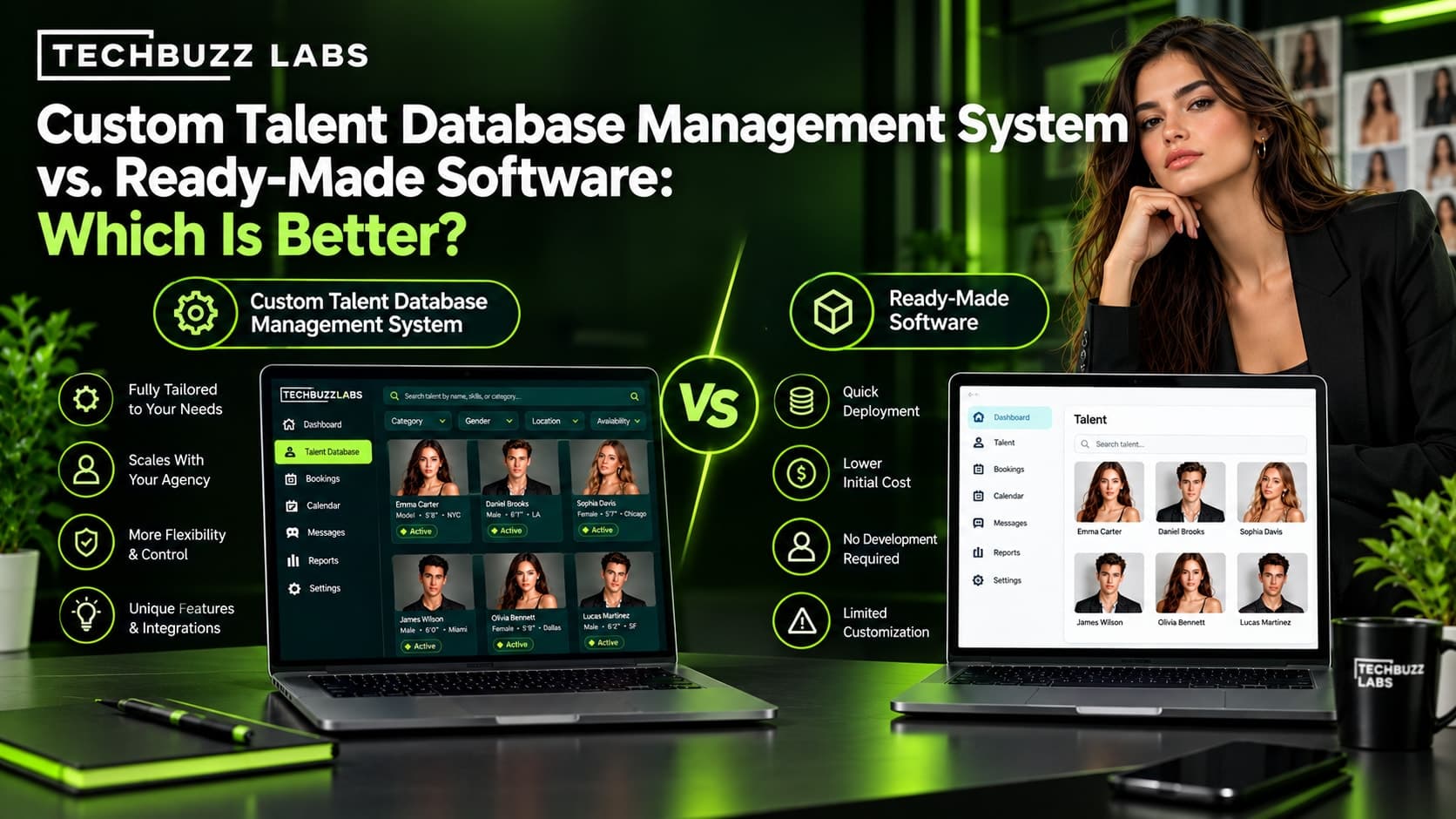
As an agency grows from dozens of models to hundreds or thousands, centralized talent management becomes increasingly valuable. TechBuzzLabs highlights centralized model profiles and searchable talent databases as important components of modern modeling CRM systems.
2. Advanced Talent Search
A large database is only useful when agents can quickly find the right people.
The CRM should provide search and filtering capabilities that allow agents to narrow talent according to relevant requirements.
For example, a client may need commercial models located in Los Angeles who are available on specific dates and have relevant experience.
Instead of manually reviewing every profile, agents can use structured data to create a more focused shortlist.
This can help agencies respond faster to casting requests and improve the efficiency of their talent-management process.
3. Integrated Casting Management
Casting should be closely connected to the talent database.
When a client submits a casting request, agents may need to record project requirements, identify suitable models, check availability, prepare submissions, and monitor client responses.
A CRM with casting functionality can keep these activities connected.
The workflow can move from:
Client Request → Talent Search → Submission → Shortlist → Selection → Booking
This reduces the need to duplicate information across separate spreadsheets or applications. Modern casting software can connect talent profiles, casting opportunities, submissions, client communication, and bookings in one workflow.
4. Client Relationship Management
A CRM should also provide strong tools for managing agency clients.
Modeling agencies may work with fashion brands, advertising companies, photographers, production teams, retailers, and other businesses.
A centralized client record can contain contact information, previous projects, communication history, preferences, and booking activity.
When a returning client sends a new request, agents can review previous interactions before responding. This creates better context and can help agencies build stronger long-term relationships.
5. Availability Management
Availability is one of the most important factors when matching talent with casting opportunities.
A model may fit a client's requirements perfectly but already be booked for the requested dates.
A suitable CRM should connect availability information with talent profiles, castings, and bookings.
This allows agents to check relevant scheduling information before making submissions and can help reduce scheduling conflicts.
For agencies managing talent across multiple U.S. markets, centralized availability can make coordination considerably easier.
6. Submission and Booking Management
The process should not stop when an agent finds suitable talent.
A CRM should make it easier to prepare submissions and track what happens afterward.
Agents should be able to see which models were submitted, which were shortlisted, which received client approval, and which ultimately became bookings.
Once a model is selected, the booking should remain connected to the original casting and client records.
This creates a continuous workflow instead of forcing agents to start a new record every time a casting moves forward.
7. Workflow Automation
Automation is another feature agencies should consider when evaluating CRM companies.
Agents regularly perform repetitive tasks such as sending casting notifications, requesting availability, following up with clients, creating reminders, and updating project statuses.
CRM automation can help handle selected routine activities.
For example, the system could remind an agent to follow up when a client has not responded or notify a team member about an upcoming casting deadline.
This allows agents to spend more time on talent development, client relationships, negotiations, and other high-value work. TechBuzzLabs has also highlighted workflow automation as a way CRM technology can help agencies work faster.
8. Reporting and Analytics
A modern CRM should help agencies understand their performance, not just store information.
Useful reporting can include casting activity, submissions, bookings, client activity, and conversion rates.
Agency managers can use this data to identify trends and operational bottlenecks.
For example, an agency could determine which clients generate the most repeat bookings or which types of casting opportunities have the highest success rates.
These insights can support better business decisions and help agencies improve their workflows over time.
9. Security and Access Control
Modeling agencies handle personal and professional information, including photographs, contact details, measurements, contracts, and client data.
Security should therefore be an important consideration when choosing a CRM software company.
Agencies should evaluate features such as user permissions, authentication, access controls, backups, and appropriate data-management practices.
Different team members may also require different levels of access. A system should allow agencies to control who can view or modify particular information.
10. Scalability and Customization
The CRM should be able to grow with the agency.
A platform that works for a small roster may become difficult to manage when the agency expands its talent pool, client base, and number of casting projects.
Scalability allows the system to accommodate more users, talent profiles, clients, and workflows as the business grows.
Customization is equally important because every agency operates differently. A modeling agency may have different requirements from a commercial talent agency or an agency representing actors and influencers.
The best CRM software company should therefore provide technology that can adapt to an agency's actual workflow.
Why TechBuzzLabs Is Relevant
TechBuzzLabs focuses on technology solutions for modeling and talent agencies, with an emphasis on CRM, casting management, talent management, automation, and connected agency workflows.
Its recent resources highlight how centralized technology can connect model profiles with casting opportunities, client requests, availability, submissions, and bookings.
For agencies that have outgrown spreadsheets and disconnected tools, this type of centralized approach can provide a more organized foundation for managing daily operations.
Instead of using separate systems for talent, casting, and client relationships, agencies can look for technology that brings these workflows together.
Conclusion
Choosing a top CRM software company for casting, talent, and client management should be based on how well the technology fits the agency's complete workflow.
Important features include centralized talent profiles, advanced search, casting management, client relationship management, availability tracking, submissions, booking management, automation, reporting, security, and scalability.
For U.S. modeling and talent agencies, the right CRM can help teams respond to clients faster, organize growing talent pools, reduce repetitive administrative work, and maintain better visibility across active projects.
The goal is not simply to replace spreadsheets with another software platform. The goal is to create a connected system where talent, casting, clients, and bookings can work together.
With technology solutions from TechBuzzLabs, modern agencies can explore a more centralized and scalable approach to managing the complete journey from talent discovery and casting to client selection and final booking.