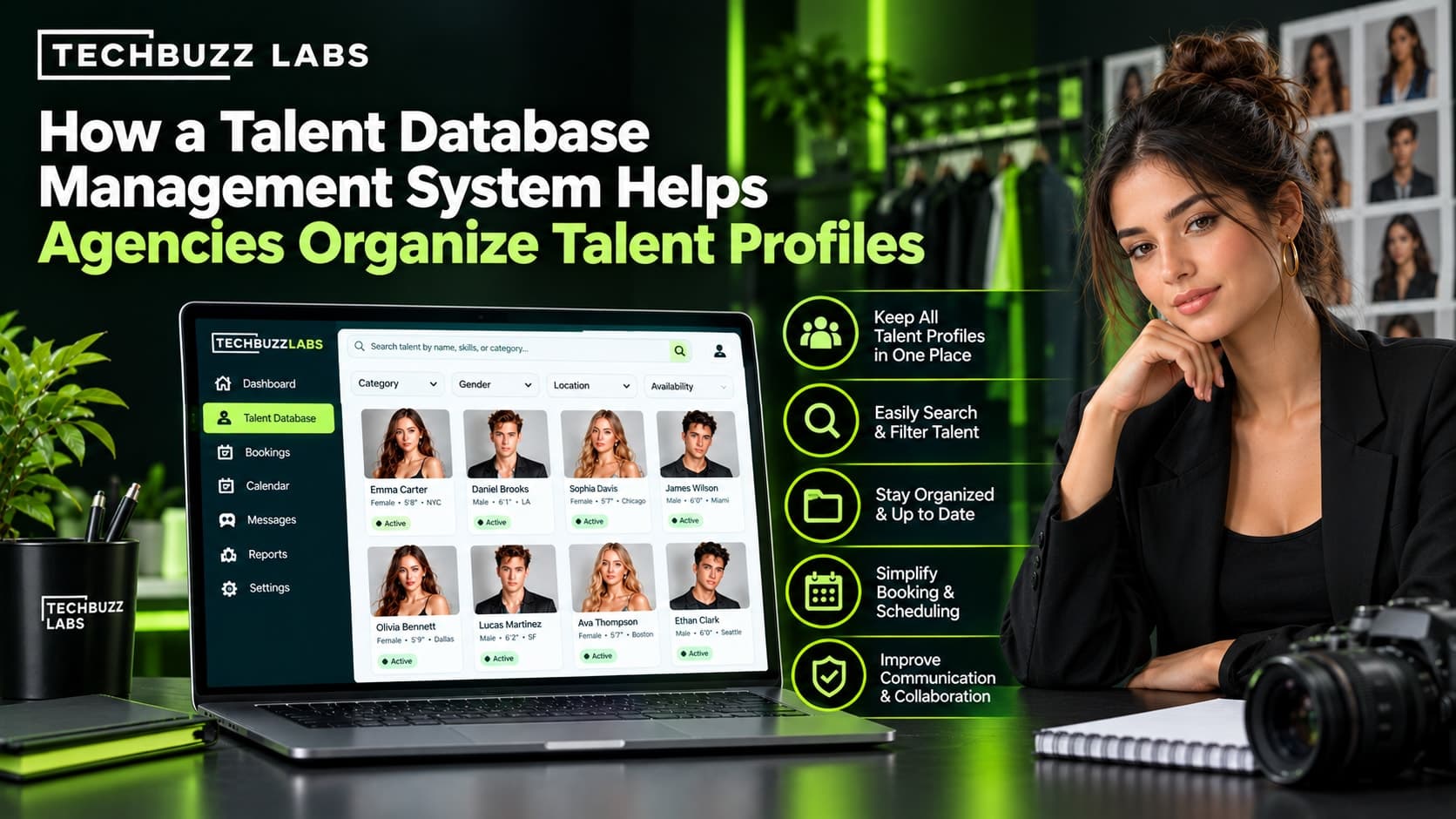
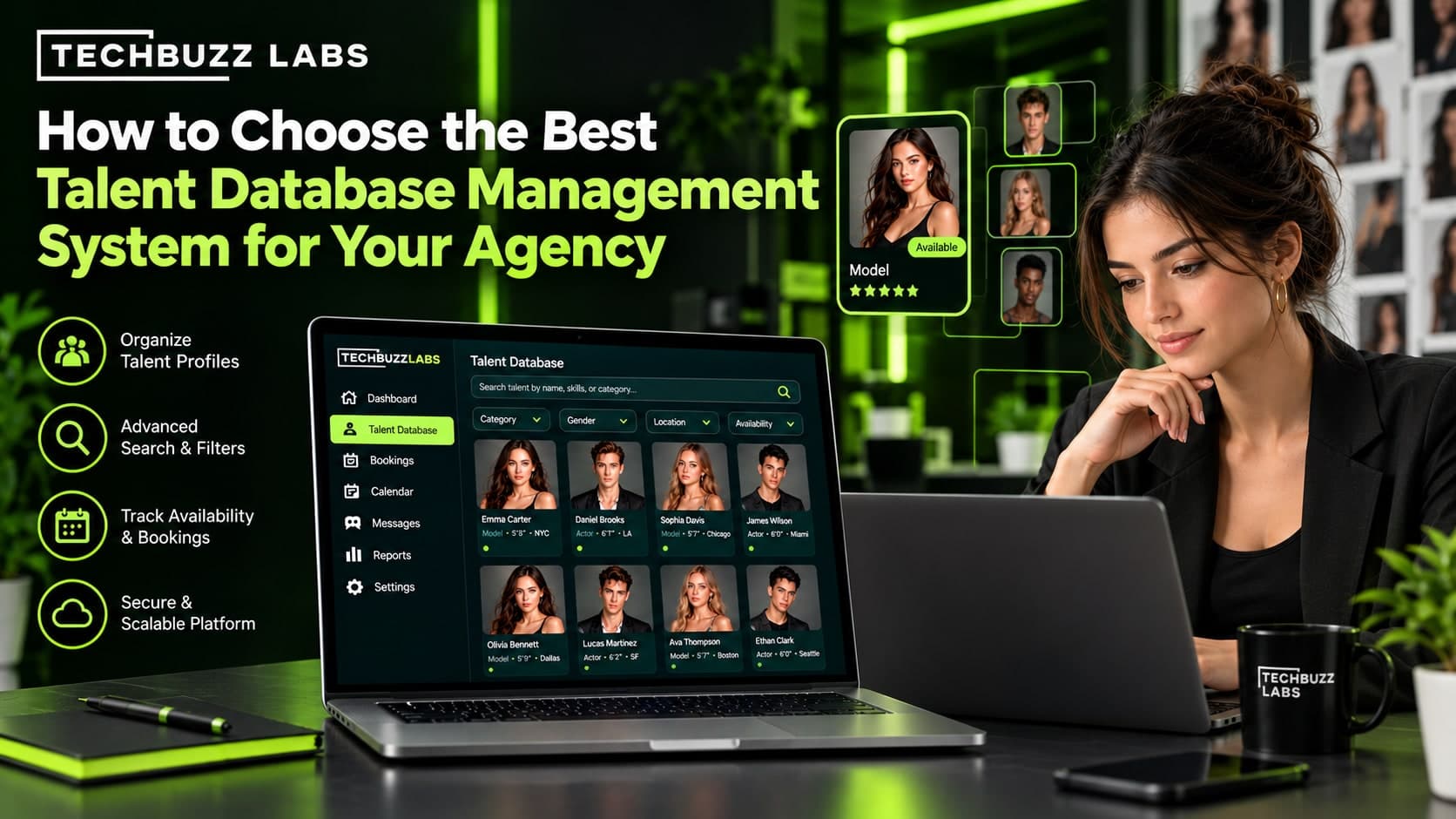
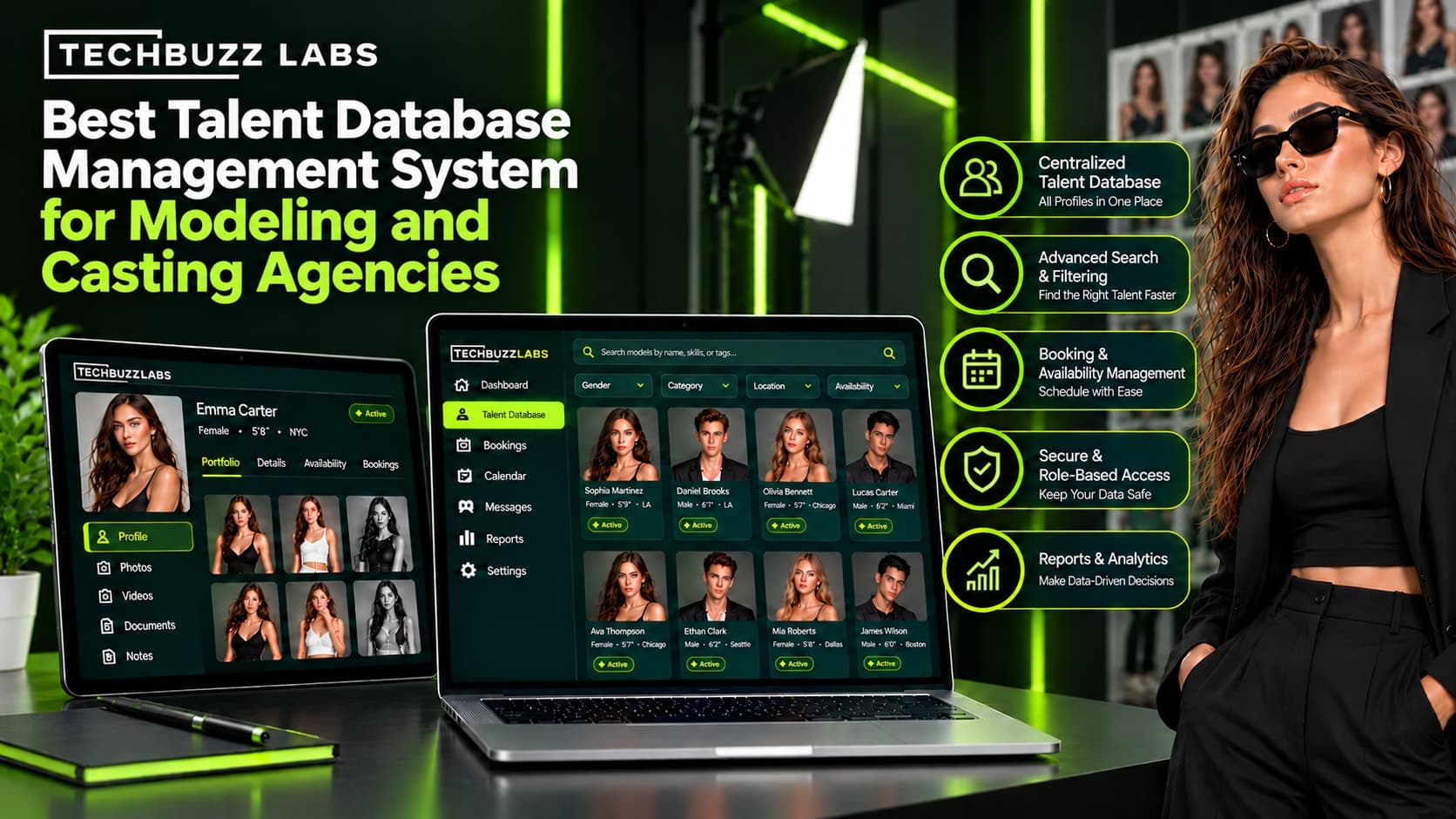
Custom Talent Database Management System vs. Ready-Made Software: Which Is Better?
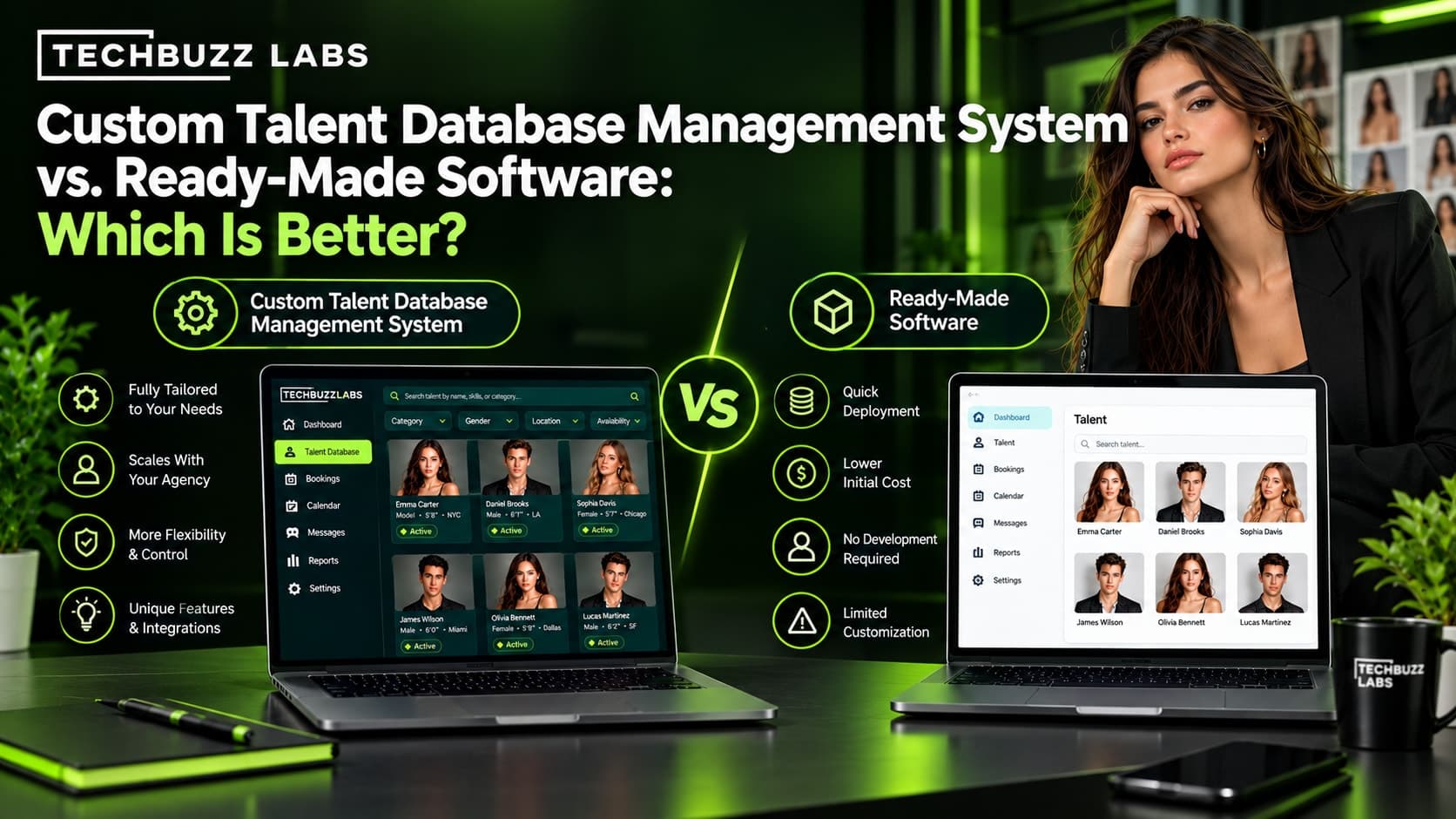
Both options offer advantages. Ready-made software can provide essential features quickly, while custom software can be designed around an agency’s specific requirements. The better choice depends on your workflow, budget, team size, technical needs, and long-term business goals.
Talent and modeling agencies in the USA depend on accurate talent profiles, organized portfolios, efficient casting workflows, and reliable client communication. As an agency grows, managing these activities through spreadsheets, shared folders, and disconnected applications can become difficult. A dedicated talent database management system can help centralize information and improve daily operations.
However, agencies face an important decision: should they invest in a custom talent database management system or choose ready-made software?
In this guide, we compare both options to help modeling, casting, and talent agencies make an informed decision.
What Is a Custom Talent Database Management System?
A custom talent database management system is software developed or tailored to meet an agency’s individual operational requirements. Instead of relying entirely on predefined features, an agency can determine how its talent records, search filters, casting activities, and booking processes should work.
Depending on the project scope, a custom system may include:
Centralized model, actor, and talent profiles
Portfolio photographs, videos, resumes, and documents
Advanced search and filtering options
Talent availability and booking records
Casting briefs, submissions, and approval stages
Client relationship management (CRM)
Automated notifications and follow-up reminders
Custom reports and performance dashboards
Integrations with calendars, email, and other business tools
For example, a modeling agency representing commercial, fashion, and fitness models may need different profile fields and search criteria for each category. Custom software can be designed to support these requirements within one system.
The main advantage is flexibility. However, custom development requires planning, investment, testing, and ongoing maintenance.
What Is Ready-Made Talent Database Software?
Ready-made talent database software is a prebuilt product designed for multiple businesses or agencies. Depending on the provider, it may offer tools for managing talent profiles, portfolios, client information, casting projects, bookings, and communication.
Agencies typically subscribe to the platform and configure its available settings to match their operations.
Common advantages include:
Faster implementation
Lower initial investment in many cases
Prebuilt features and workflows
Vendor-managed software updates
Established support and documentation
Subscription-based pricing options
Ready-made software can be a practical choice for small or growing agencies with straightforward requirements. Instead of commissioning a development project, the team can begin organizing its data using features already available.
The main limitation is that the agency must work within the platform’s capabilities. Some products offer extensive customization, while others provide only basic configuration.
Custom vs. Ready-Made Talent Database Software
The following comparison highlights the main differences agencies should evaluate.
FactorCustom talent databaseReady-made softwareInitial costGenerally higherOften lowerImplementationRequires planning and developmentUsually fasterWorkflow flexibilityDesigned around specific requirementsDepends on available configurationFeaturesSelected according to business needsPredefined feature setIntegrationsCan be tailored to supported technical requirementsDepends on existing integrationsMaintenanceRequires an agreed maintenance planUsually managed by the vendorUpdatesPlanned through the development arrangementReleased according to the provider’s roadmapScalabilityCan be designed around growth plansDepends on product capabilities and pricing tiersTechnical controlDepends on contracts, architecture, and ownership termsDepends on vendor policies and subscription terms
Neither option is automatically better. The right choice depends on how well the software supports your agency’s actual work.
Benefits of a Custom Talent Database Management System
1. Built Around Your Agency’s Workflow
Every talent agency has its own way of organizing profiles, responding to client requests, reviewing submissions, and confirming bookings.
A ready-made platform may require employees to follow predefined steps. Custom software can be designed around the agency’s preferred process.
For example, a casting project might move from a client brief to talent search, shortlist creation, submission, feedback, approval, and booking confirmation. A custom system can connect these stages and display the information relevant to each team member.
This can reduce unnecessary workarounds and make information easier to access.
2. Flexible Talent Profiles and Search
Talent databases often contain much more than names and contact details. Agencies may need to organize professional experience, measurements, skills, location, portfolio links, availability, representation details, and booking history.
Custom software can include the fields and search filters that matter most to the agency.
For instance, a casting team could search for talent by location, experience, category, availability, and campaign-specific requirements. The exact search capabilities would depend on the system’s design.
3. Connected Casting and Client Management
Talent information becomes more useful when it connects with casting projects and client relationships.
A custom platform can link talent profiles with client records, previous submissions, feedback, booking history, and communication notes. This helps authorized team members understand the status of an opportunity without searching through several applications.
4. Tailored Integrations and Reporting
Agencies may use separate tools for calendars, email, accounting, file storage, or communication. Custom development can support specific integrations where suitable APIs and technical access are available.
Agencies can also request reports that reflect their operational priorities, such as booking activity, submission outcomes, talent availability, or client engagement.
However, custom integrations and reporting add to project scope and may require ongoing maintenance.
Benefits of Ready-Made Talent Database Software
1. Faster Setup
Ready-made platforms have already been developed, so agencies can often begin using them after configuration and data migration. This is useful for businesses that need an organized database without waiting for a complete development cycle.
2. Lower Initial Investment
Many ready-made products use monthly or annual subscriptions. This can make the initial financial commitment more manageable than funding a custom development project.
However, agencies should review per-user fees, premium features, onboarding, storage limits, integration charges, and potential subscription increases before choosing a provider.
3. Established Features
A suitable ready-made product may already provide searchable profiles, portfolio management, booking calendars, client records, and standard workflows.
Agencies should test these features against real tasks rather than assuming that a long feature list means the platform will fit their needs.
4. Vendor-Managed Updates
The provider generally handles platform updates and core maintenance. This reduces the need for the agency to manage the software’s underlying technical infrastructure directly.
The trade-off is that the agency may have limited control over update schedules, product changes, and future feature priorities.
Which Option Is Better for Your Agency?
The best choice depends on your current challenges and future plans.
Choose ready-made software if:
Your agency has relatively standard database and booking requirements.
You need a solution quickly.
Your budget favors subscription-based software.
Existing features meet most of your needs.
You prefer vendor-managed updates and support.
Consider custom software if:
Your agency has specialized talent categories or complex profile requirements.
Your casting and booking workflows require frequent workarounds in existing tools.
You need specific approval stages, reports, or integrations.
Several disconnected systems are creating duplicate data and administrative work.
Your long-term operational needs justify the development and maintenance investment.
There is also a middle option: select ready-made software that supports configuration, integrations, or selective customization. This may provide sufficient flexibility without requiring a fully custom platform.
How to Compare the Total Cost of Ownership
Initial price alone does not tell you which solution offers better value.
For ready-made software, consider subscription fees, user licenses, onboarding, premium features, integrations, data storage, and the cost of moving to another platform if your needs change.
For custom software, consider discovery and planning, design, development, testing, data migration, hosting, security updates, support, and future enhancements.
Also account for the operational cost of manual work. If employees spend significant time updating duplicate records, searching for portfolios, or coordinating casting decisions across disconnected tools, those tasks may contribute to the total cost of your current process.
Before committing, request a clear breakdown of costs and responsibilities. For custom development, clarify software ownership, source-code access, documentation, third-party licensing, maintenance arrangements, and post-launch support.
Security and Data Management Matter
Talent databases may contain personal contact information, portfolio images, professional documents, availability details, and client records. Protecting this information should be a priority regardless of which software model you choose.
Evaluate both options for:
Role-based permissions and access controls
Secure authentication
Appropriate data backup and recovery procedures
Clear data export and deletion processes
Vendor security practices and incident procedures
Secure sharing of portfolios and client-facing information
For agencies operating in the United States, applicable privacy obligations may vary by state, the type of information collected, and the agency’s activities. Confirm relevant legal and contractual requirements before selecting a platform.
Custom software does not guarantee better security, just as ready-made software is not automatically less secure. Security depends on implementation, configuration, maintenance, and governance.
How TechBuzz Labs Can Help Agencies Evaluate Custom Solutions
TechBuzz Labs works in technology and software solutions, including areas relevant to custom CRM, talent management, and agency workflows. For modeling and casting agencies exploring a tailored talent database, the starting point should be a clear understanding of daily operations.
An agency can identify which information needs to be centralized, how talent should be searched, which casting stages need tracking, and how client and booking records should connect. These requirements can then be compared against available ready-made platforms.
If existing products cannot support essential workflows efficiently, a custom solution may be worth evaluating. TechBuzz Labs can be considered as part of that assessment when exploring software options for agency operations.
The objective should be to solve defined business problems rather than build unnecessary features. A phased approach—starting with essential database and workflow capabilities and adding functionality when needed—can help keep the project focused.
Final Thoughts
Choosing between a custom talent database management system and ready-made software is a strategic decision for modeling, talent, and casting agencies.
Ready-made software is often the better starting point for agencies that need standard features, faster implementation, and a manageable initial investment. Custom software may offer greater value when specialized workflows, tailored integrations, or specific reporting requirements exceed the capabilities of existing platforms.
Before making a decision, document your requirements, test realistic workflows, compare total ownership costs, and evaluate security, support, and data portability.
The best solution is not necessarily the one with the most features. It is the one that helps your agency manage talent information accurately, coordinate casting and bookings efficiently, and support future growth without adding unnecessary complexity.