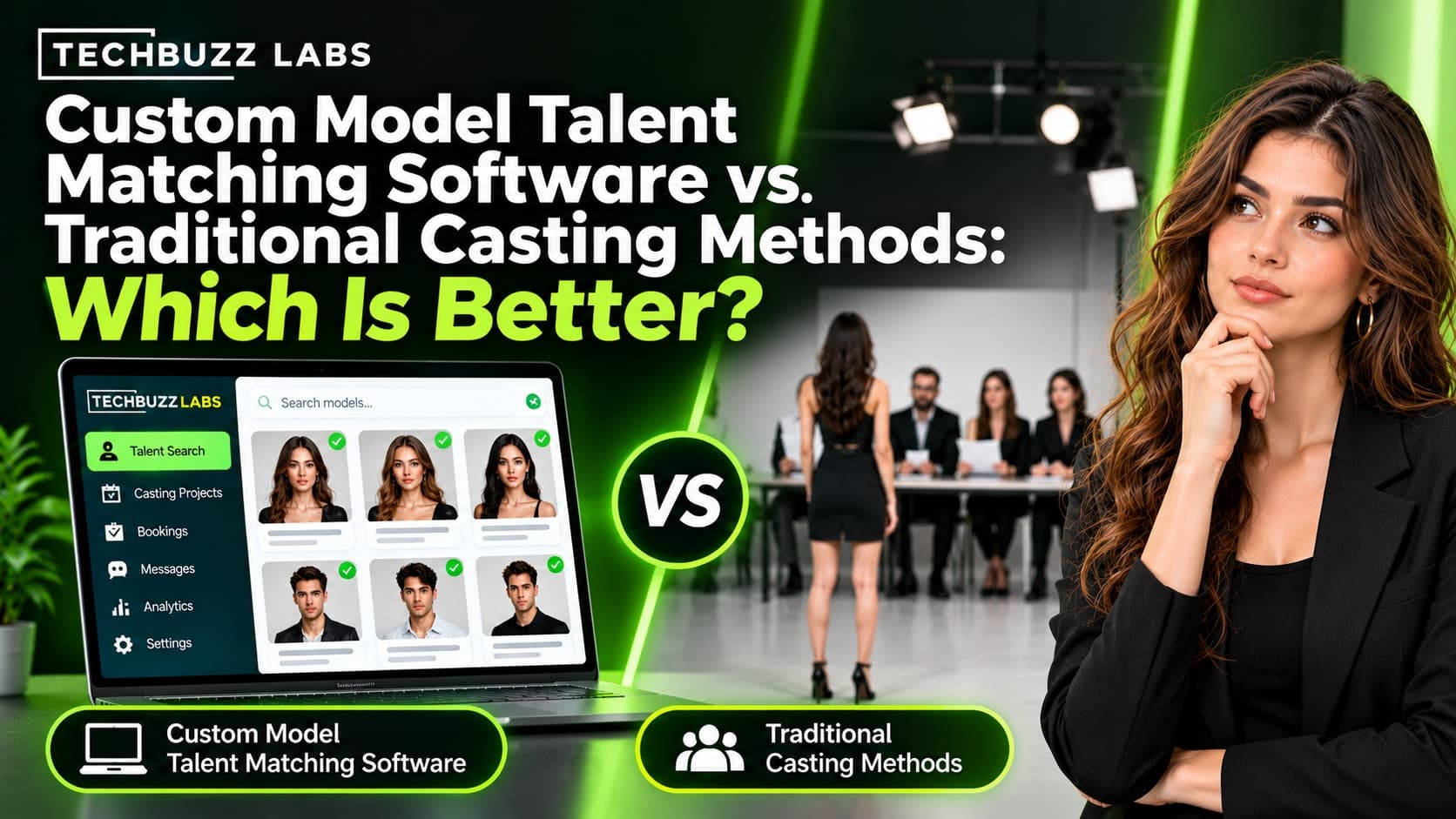
Custom Model Talent Matching Software vs. Traditional Casting Methods: Which Is Better?
Let's compare both approaches and explore which option makes more sense for modern modeling agencies.
Finding the right models for a casting project is a critical responsibility for modeling agencies. Whether an agency is working on a fashion campaign, commercial photoshoot, runway event, or brand promotion, selecting suitable talent requires careful planning and efficient communication.
Traditionally, agencies have relied on spreadsheets, email conversations, phone calls, and manually organized portfolios to manage casting activities. These methods can work for smaller operations, but they often become difficult to manage as talent databases and client requirements grow.
Custom model talent matching software offers a more centralized approach. It can connect model profiles, casting requirements, portfolio information, submissions, and booking records in one platform.
But does custom software offer enough value to replace traditional casting methods? The answer depends on an agency's size, workflow, budget, and long-term goals.
What Are Traditional Casting Methods?
Traditional casting methods involve manually identifying, reviewing, and contacting models for individual projects. Agency employees typically use spreadsheets, email, phone calls, shared folders, and calendar applications to organize the process.
A typical traditional casting workflow includes:
Receiving a casting brief from a client.
Reviewing the requirements manually.
Searching through model profiles and portfolios.
Contacting potential candidates to check availability.
Preparing and sharing model submissions.
Collecting client feedback.
Confirming the final selection and booking.
This approach offers direct communication and personal control. Experienced agents can evaluate talent based on their industry knowledge and understanding of client expectations.
However, managing every stage manually can become time-consuming when an agency handles multiple projects simultaneously.
What Is Custom Model Talent Matching Software?
Custom model talent matching software is a digital platform developed around a modeling agency's specific talent management and casting requirements.
Unlike generic tools, custom software can be designed to support the agency's existing workflows. It may combine talent profiles, portfolio management, search and filtering, casting submissions, availability tracking, and booking coordination.
Depending on the project requirements, a custom platform may include:
Centralized talent database management.
Advanced model search and filtering.
Digital portfolio organization.
Casting brief management.
Candidate shortlists and submissions.
Availability and booking calendars.
Client feedback tracking.
Workflow automation and reporting.
Role-based access and permissions.
The main advantage is that agencies can prioritize features that solve their actual operational challenges rather than relying entirely on predefined software functions.
1. Talent Search: Manual Searching vs. Advanced Filtering
With traditional casting methods, employees often search through spreadsheets, folders, and saved portfolio files to find suitable candidates.
This can work when an agency represents a small number of models. However, searching through hundreds of profiles for every new project can create delays.
Custom talent matching software can organize model records in a searchable database. Staff can apply filters based on relevant information such as modeling category, location, experience, skills, and recorded availability.
For example, an agency receiving a fitness campaign request in Los Angeles can narrow its search to suitable talent profiles instead of reviewing its entire database.
Better option: Custom software is generally more efficient for agencies managing large or frequently changing talent databases.
2. Portfolio Management: Separate Files vs. Centralized Records
Traditional methods often require agencies to store model photographs and professional details across different folders, cloud drives, and email attachments.
This creates the risk of using outdated photographs or sharing incomplete information.
A custom platform can keep portfolio images and model details connected to individual talent profiles. Authorized staff can update photographs, revise information, and prepare relevant digital presentations from one location.
This makes it easier to maintain accurate records and share suitable portfolio materials with clients.
Better option: Custom software offers stronger organization when portfolio updates and sharing are frequent.
3. Casting Submissions: Repetitive Preparation vs. Structured Workflows
Preparing candidate submissions manually can involve collecting photographs, formatting presentations, checking profile details, and sending individual emails.
For agencies managing several casting opportunities, these tasks can consume significant staff time.
Custom model talent matching software can connect selected candidates with specific casting projects. Depending on its features, the system may support digital shortlists, shareable profiles, submission statuses, and client feedback records.
Staff can track whether a model has been submitted, shortlisted, approved, or rejected.
Better option: Custom software is more suitable for agencies that regularly manage multiple casting projects and need consistent submission tracking.
4. Availability and Booking: Manual Follow-Ups vs. Connected Scheduling
Traditional casting often requires agents to contact models individually to confirm availability. Booking details may then be recorded separately in calendars or spreadsheets.
This can create communication delays and increase the possibility of scheduling conflicts.
A custom platform can connect talent profiles with availability and booking records. Staff can review relevant scheduling information before recommending candidates or confirming assignments.
For example, an agency coordinating a commercial photoshoot in New York can check recorded availability before submitting its shortlist.
Better option: A centralized system is generally more practical for agencies managing frequent bookings and complex schedules.
5. Communication: Disconnected Conversations vs. Centralized Project Information
Traditional workflows often involve email threads, phone calls, and messaging applications. Important client decisions or model updates can become difficult to locate later.
Custom software can centralize casting notes, submission statuses, booking updates, and follow-up tasks.
Some platforms also provide notifications, client portals, and communication histories. These features help agency teams understand project progress without searching through multiple channels.
Better option: Custom software provides better visibility when several employees, clients, and models are involved in the same project.
6. Cost: Low Initial Spending vs. Long-Term Investment
Traditional casting methods usually have lower initial technology costs. Agencies can begin with spreadsheets, email, calendars, and existing storage tools.
Custom software requires a larger initial investment because it involves planning, design, development, testing, and implementation.
There may also be ongoing expenses for hosting, maintenance, security updates, technical support, and future improvements.
However, agencies should consider the total operational cost of manual processes too. Staff time spent searching for profiles, preparing submissions, updating records, and coordinating bookings can add up.
The right comparison should consider both software expenses and the potential value of improved efficiency.
Better option: Traditional methods may suit smaller agencies with limited budgets, while custom software may provide greater long-term value for agencies with recurring operational challenges.
7. Flexibility and Scalability
Traditional methods are flexible in the sense that employees can create their own spreadsheets, folders, and processes. However, maintaining consistency becomes harder as the agency expands.
Ready-made software may offer useful standard features, but it may not support every specialized workflow.
Custom software can be developed around an agency's specific requirements. As the business grows, additional capabilities may be introduced, such as new talent categories, multiple office locations, client portals, integrations, and advanced reporting.
Better option: Custom software is generally more adaptable for agencies with specialized processes and long-term expansion plans.
Custom Software vs. Traditional Casting: Quick Comparison
Business requirementTraditional methodsCustom softwareTalent searchMostly manualSearchable database and filtersPortfolio managementSeparate files and foldersCentralized profilesCasting submissionsManually preparedStructured digital workflowsAvailability trackingManual communicationConnected scheduling featuresClient feedbackEmail and messagesCentralized project recordsReportingManual spreadsheetsConfigurable dashboardsInitial costUsually lowerUsually higherScalabilityBecomes harder to manageCan be designed for growth
When Should a Modeling Agency Invest in Custom Software?
Custom model talent matching software is not necessary for every agency. A smaller business with a limited talent roster and occasional casting requests may continue using traditional methods without major difficulties.
However, custom development becomes worth considering when:
The agency manages hundreds of model profiles.
Employees spend too much time searching for talent.
Portfolio information is frequently outdated or duplicated.
Multiple casting projects are handled simultaneously.
Booking conflicts and communication delays occur regularly.
Existing tools cannot support the agency's workflows.
The business plans to expand its talent categories or locations.
Before starting development, agency owners should identify their biggest challenges and define which features would deliver measurable operational value.
TechBuzz Labs helps businesses explore custom software solutions designed around their operational needs. For modeling and talent agencies, a tailored platform can bring portfolio management, talent matching, casting submissions, and booking coordination into one organized system.
Conclusion
Custom model talent matching software and traditional casting methods both have a place in the modeling industry. Traditional methods can be practical for smaller agencies with simple requirements and limited casting activity.
However, agencies managing larger talent databases, frequent client requests, and complex booking workflows may benefit from a centralized custom platform.
Custom software can improve talent search, portfolio organization, submission tracking, availability management, and communication. Although it requires a greater initial investment, it can support more organized operations as an agency grows.
Ultimately, the better option is the one that fits the agency's current needs, available resources, and future business goals. For agencies experiencing the limitations of manual casting, custom model talent matching software may be a valuable step toward more efficient talent management.