How CRM Software Helps Agencies Manage Model Submissions and Client Feedback
This process may involve reviewing talent profiles, checking availability, selecting photographs, confirming experience, and sending information to the client.

For modern modeling agencies in the USA, managing model submissions and client feedback is a critical part of the casting process. Agencies may receive multiple casting requests every day, each with different requirements, deadlines, locations, and client expectations. At the same time, agents need to coordinate with models, prepare submissions, track responses, and move selected talent toward bookings.
When these activities are handled through spreadsheets, emails, messaging apps, and separate folders, important information can easily become difficult to track. CRM software for modeling agencies can simplify this process by bringing talent profiles, casting opportunities, submissions, client communication, and feedback into one centralized system.
For agencies looking to modernize their operations, TechBuzzLabs provides technology solutions focused on modeling and talent management, CRM, casting, and agency workflow automation.
Why Model Submission Management Matters
Model submissions are often the bridge between a casting opportunity and a potential booking. When a client sends a request, an agent needs to identify suitable models and present their profiles professionally.
This process may involve reviewing talent profiles, checking availability, selecting photographs, confirming experience, and sending information to the client.
If the process is managed manually, agents can spend significant time gathering information and tracking which models were submitted to which clients.
CRM software can centralize this information and make the submission process more structured.
1. Centralize Model Profiles
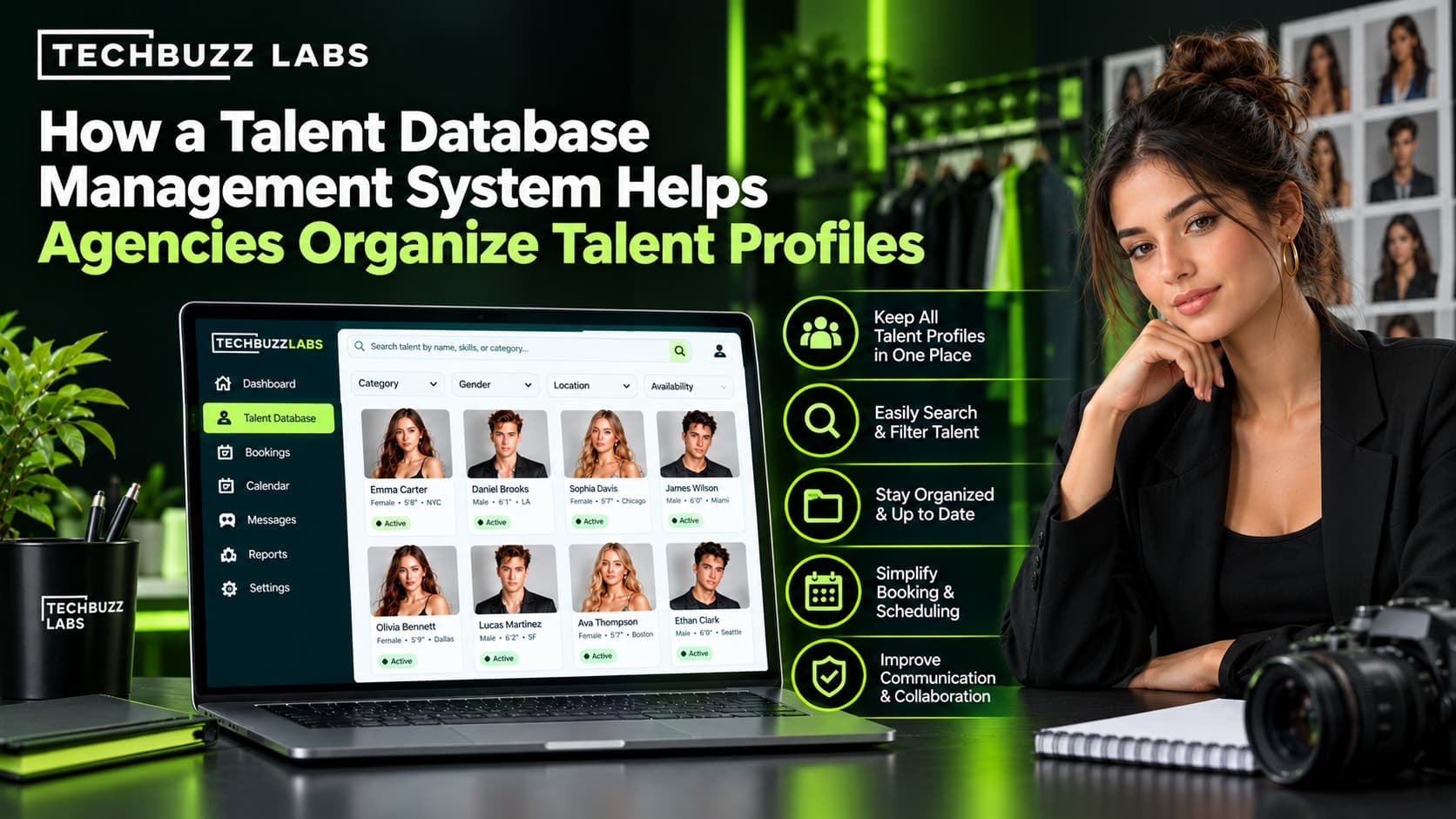
A CRM can provide each model with a digital profile containing important professional information.
Depending on the agency's workflow, profiles may include photographs, portfolio materials, experience, skills, location, availability, measurements, and other relevant details.
When all of this information is stored in one place, agents do not need to search through multiple folders every time they prepare a submission.
Keeping profiles organized can also help agencies provide clients with more accurate and up-to-date information.
2. Find Suitable Models Faster
When a casting request arrives, speed can be important.
A client may need models with particular characteristics, experience, skills, or availability. Instead of manually reviewing the entire talent database, agents can use CRM search and filtering tools to identify relevant candidates.
For example, an agent working with a Los Angeles client may search for available commercial models in the area who match the campaign requirements.
This can shorten the time between receiving a casting request and preparing a submission.
3. Connect Models With Casting Opportunities
A modern CRM can associate individual models with specific casting opportunities.
This allows agents to see which talent has been considered or submitted for a particular project.
A structured workflow might look like:
Casting Request → Talent Search → Model Selection → Submission → Client Feedback → Booking
Connecting these stages helps agents maintain a clear record of what has happened and what needs to happen next.
4. Simplify the Submission Process
Preparing submissions manually can involve repetitive work.
Agents may need to collect photographs, portfolio links, professional information, and availability before sending a client a shortlist.
When this information is already stored in a CRM, agents can access the relevant data without repeatedly searching for it.
This can reduce duplicate work and help agencies create more consistent submissions.
The result is a workflow where agents can spend more time evaluating talent and communicating with clients rather than organizing files.
5. Track Submission Status
After a submission is sent, the process does not stop.
A client may review the profiles, request additional options, shortlist certain models, reject others, or select one or more candidates.
A CRM can help agencies track these different stages.
For example, a model's status could move from:
Selected for Submission → Submitted → Under Review → Shortlisted → Selected → Booked
Having these statuses in one system gives agents a quick overview of active opportunities.
6. Keep Client Feedback Organized
Client feedback is one of the most important pieces of information in the casting process.
Clients may provide specific comments about why they prefer certain models or request additional talent that better matches their requirements.
If this feedback is buried in email conversations, it can be difficult for other team members to access.
CRM software can associate feedback with the relevant client and casting opportunity.
This gives agents a clearer record of what the client wants and how the casting is progressing.
7. Reduce Communication Gaps
Modeling agencies often have multiple agents working with the same clients and talent.
Without centralized information, one agent may not know what another agent has already communicated.
A CRM provides authorized team members with access to shared records.
For example, an agent taking over a project can review the casting details, submitted models, client responses, and current status without asking another team member to explain everything from the beginning.
This can improve collaboration and reduce unnecessary communication.
8. Manage Client Follow-Ups
Sometimes a client does not respond immediately after receiving model submissions.
Without a tracking system, follow-ups can easily be forgotten.
CRM software can provide reminders for agents to follow up with clients after a submission.
An agency can establish follow-up workflows based on its own processes.
This helps ensure that important opportunities do not disappear simply because a follow-up was missed.
9. Connect Feedback to Future Castings
Client feedback can become valuable information beyond a single project.
Suppose a client repeatedly prefers a particular type of commercial talent or has specific preferences regarding experience, appearance, or location.
An organized CRM can help agencies retain relevant client information for future interactions.
When that client submits another casting request, agents can review previous activity and use that context when preparing new submissions.
This can make future casting processes more efficient and personalized.
10. Move Selected Models Toward Booking
The ultimate objective of many model submissions is a successful booking.
Once a client selects a model, the agency may need to confirm availability, dates, location, rates, contracts, and other project details.
A connected CRM can link the successful submission with the booking workflow.
Instead of creating a completely new record, agents can move the opportunity forward from casting to booking.
This creates a smoother process:
Casting → Submission → Client Approval → Booking
It also provides a clearer history of the project.
11. Automate Repetitive Tasks
CRM technology can also help agencies automate selected repetitive activities.
Agents may regularly send submission confirmations, availability requests, follow-up reminders, and internal notifications.
Automation can reduce the amount of manual work required for these tasks.
For example, a CRM could remind an agent to follow up with a client after a submission has been waiting for several days.
This allows agents to focus more on talent management and client relationships.
12. Improve Agency Reporting
Another advantage of CRM technology is the ability to analyze submission and feedback data.
Agency managers can monitor metrics such as the number of casting requests, models submitted, shortlisted candidates, successful bookings, and client activity.
These insights can help agencies understand which parts of their workflow are working well.
For example, if an agency discovers that certain types of submissions consistently result in shortlists, managers can use that information to improve future casting strategies.
How TechBuzzLabs Supports Modern Modeling Agencies
TechBuzzLabs focuses on technology solutions for modeling and talent agencies, including CRM, casting management, talent management, and workflow automation.
For agencies that have outgrown spreadsheets and disconnected applications, centralized technology can bring model profiles, casting opportunities, client information, submissions, feedback, and bookings together.
This connected approach can help agencies create a more organized workflow while reducing the amount of time agents spend searching for information and manually updating multiple systems.
For growing U.S. agencies, technology designed around agency workflows can also provide a foundation that is easier to scale as the talent roster and client base expand.
Best Practices for Managing Model Submissions
Even with CRM software, agencies should maintain clear processes.
Model profiles should be updated regularly so clients receive accurate information. Agents should also keep casting requirements organized and record client feedback consistently.
It is equally important to avoid sending irrelevant talent simply to respond quickly. The quality of a submission matters just as much as speed.
A strong process combines accurate talent data, relevant submissions, organized feedback, and timely follow-ups.
Conclusion
Managing model submissions and client feedback can become challenging as a modeling agency grows. Spreadsheets, emails, and disconnected files may work for a small operation, but they can become inefficient when agencies manage larger talent pools and more casting opportunities.
CRM software can simplify the process by centralizing model profiles, organizing casting opportunities, tracking submissions, recording client feedback, managing follow-ups, and connecting successful submissions with bookings.
For modeling agencies in the USA, this can lead to faster workflows, better team collaboration, improved client communication, and greater visibility across casting projects.
With technology solutions from TechBuzzLabs, agencies can explore a centralized approach to managing talent, submissions, client feedback, and bookings. By connecting these workflows, agencies can spend less time on administrative tasks and more time building talent and client relationships.