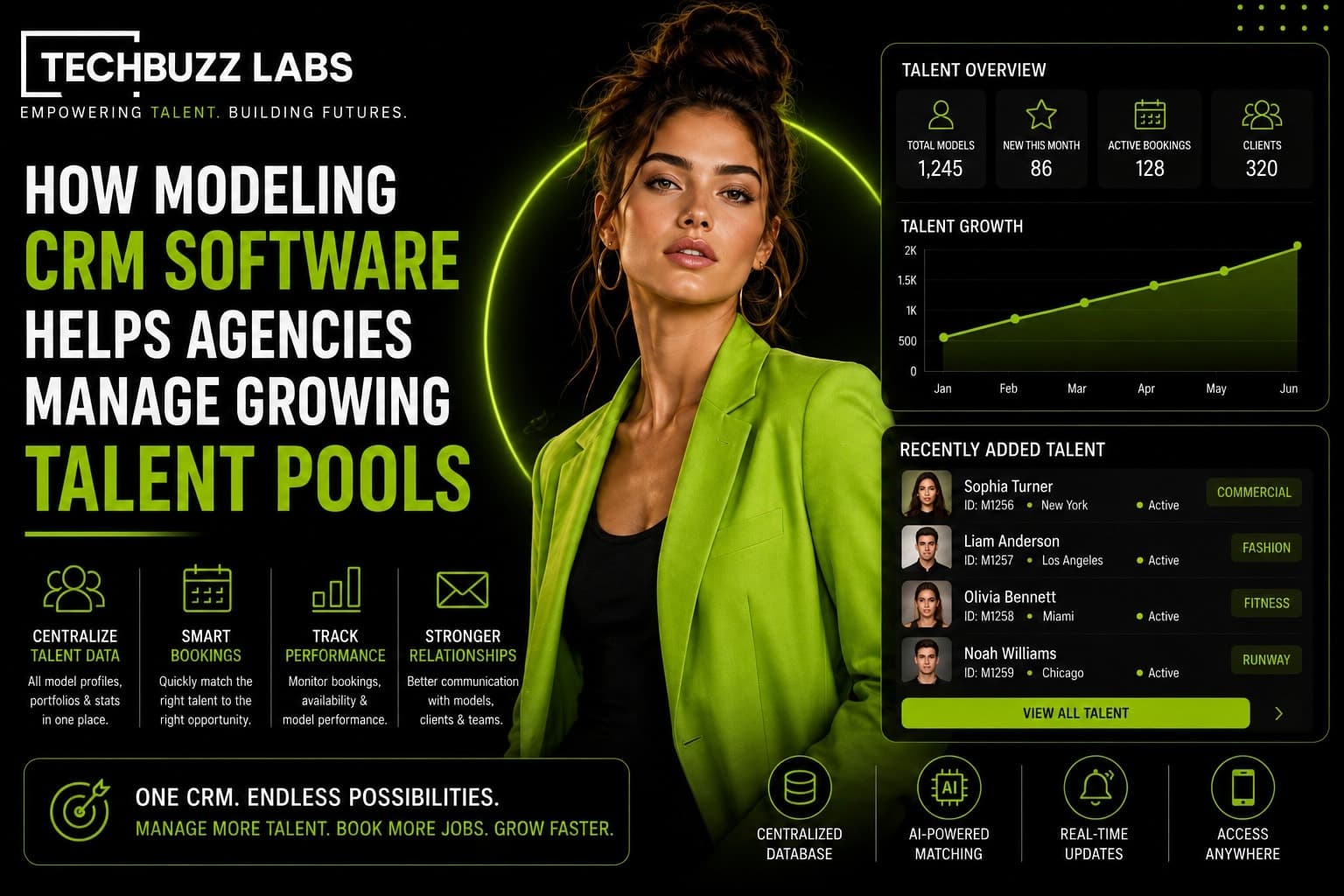
How Modeling CRM Software Helps Agencies Manage Growing Talent Pools
When this information is spread across multiple spreadsheets and folders, agents may struggle to find the right information quickly.
As a modeling agency grows, managing talent becomes increasingly complex. A small agency may be able to keep model information in spreadsheets, email folders, and shared documents. However, when the talent pool reaches hundreds or thousands of models, these traditional methods can become difficult to maintain.
Modeling agencies need to manage portfolios, measurements, locations, availability, experience, casting opportunities, bookings, and communications while also maintaining strong relationships with clients. Modeling CRM software provides a centralized way to organize this information and make everyday agency operations more efficient.
For modeling agencies in the USA, particularly those operating in competitive markets such as New York, Los Angeles, Miami, Chicago, and San Francisco, an organized talent management system can help agencies respond to opportunities faster. TechBuzzLabs highlights the growing role of CRM technology in helping modern modeling agencies manage talent and scale their operations.
What Is Modeling CRM Software?
Modeling CRM software is a specialized digital system that helps agencies manage relationships and information related to models, clients, castings, and bookings.
Unlike a basic spreadsheet, a CRM can connect different types of information. A model's profile can be linked to casting opportunities, client submissions, availability, previous bookings, and communication records.
This creates a centralized database that agents can search and update as needed.
The result is a more connected workflow where important information is easier to access.
Why Growing Talent Pools Become Difficult to Manage
A growing talent pool is positive for an agency, but it also creates operational challenges.
Every new model adds more information that needs to be organized and maintained. Agencies may need to store photographs, videos, measurements, skills, experience, contact information, location, availability, contracts, and booking history.
When this information is spread across multiple spreadsheets and folders, agents may struggle to find the right information quickly.
Outdated records can also create problems. A model may change locations, update measurements, become unavailable, or gain new experience. If the agency does not update all relevant files, agents could end up working with inaccurate information.
A CRM can provide a centralized solution.
Centralizing Model Profiles
One of the most important benefits of modeling CRM software is centralized talent management.
Each model can have an individual digital profile containing relevant professional information. Agents can update the profile when new photographs, measurements, experience, or availability information becomes available.
Instead of searching through different folders, agents can access the model's information from one location.
This becomes especially valuable when an agency has a large roster.
Faster Talent Search
A growing database is only useful if agents can find the right talent quickly.
Modeling CRM software can provide search and filtering tools that allow agents to narrow down the talent pool based on relevant criteria.
For example, a client may request models who are:
Located in Los Angeles
Available on specific dates
Experienced in commercial campaigns
Suitable for a particular modeling category
Instead of manually reviewing hundreds of profiles, an agent can use CRM filters to create a more relevant shortlist.
This can help agencies respond to clients faster.
Better Casting Management
Casting opportunities can generate a significant amount of administrative work.
Agents need to review project requirements, identify suitable models, check availability, prepare submissions, communicate with talent, and track client responses.
A modeling CRM can connect these activities.
For example, an agency can create a casting record and associate relevant models with the opportunity. The team can then track which models were shortlisted, submitted, selected, or not selected.
This creates greater visibility throughout the casting process.
Managing Model Availability
Availability is critical when managing a large talent pool.
A model who looks perfect for a project may already be booked or unavailable. Without an organized availability system, agents may spend considerable time confirming schedules manually.
CRM software can help agencies maintain current availability information and connect it to casting and booking records.
This can reduce unnecessary communication and help agents identify available talent more efficiently.
Improving Client Relationships
A growing talent pool often means a growing client base.
CRM software can store client information, communication history, previous projects, preferences, and booking records.
When a client requests talent for a new campaign, agents can review the client's history and recommend models based on previous work and current requirements.
This can make client interactions more personalized and help agencies develop long-term business relationships.
Automating Repetitive Tasks
Large talent pools create repetitive administrative tasks.
Agents may need to send casting notifications, confirm availability, send reminders, update project statuses, and follow up with clients.
CRM automation can streamline some of these activities.
For example, when a new casting opportunity is created, selected models can receive relevant notifications. The system can also create reminders for agents when a client follow-up is due.
Automation does not replace the agent's judgment. Instead, it reduces the amount of routine work required to manage a growing talent database.
Improving Team Collaboration
Large agencies often have multiple agents working with the same models and clients.
If information exists in personal spreadsheets or individual notes, team members may not have access to the latest updates.
A centralized CRM gives authorized employees access to shared information.
An agent can see a model's recent bookings, availability, casting activity, and relevant notes without relying entirely on another team member.
This can improve collaboration and reduce communication gaps.
Supporting Agency Growth
One of the biggest advantages of a CRM is scalability.
An agency may begin with a small group of models and eventually expand into multiple cities or markets. As the talent pool grows, the agency needs systems that can handle increasing amounts of information without creating unnecessary administrative work.
A scalable CRM provides a structured foundation for this growth.
For U.S. agencies, this can be especially useful when expanding from one local market into larger modeling centers such as New York or Los Angeles.
Using Data to Improve Decisions
CRM software can also help agencies understand their own performance.
Managers can analyze information such as casting activity, booking rates, client relationships, and talent performance.
These insights can help answer important questions. Which clients generate the most bookings? Which types of casting opportunities are most successful? Which markets are producing growth?
Using organized data can help agencies make more informed business decisions.
The Role of TechBuzzLabs
Technology is becoming an important part of modern modeling agency management. TechBuzzLabs focuses on the intersection of technology and the modeling industry, including CRM platforms, casting management software, automation, and digital talent management.
For agencies managing a growing talent pool, the right technology can help turn a large database into a useful operational resource. Instead of simply storing information, a CRM can help agents search, organize, analyze, and act on that information.
Conclusion
Modeling CRM software helps agencies manage growing talent pools by centralizing information and connecting important workflows. From model profiles and availability to casting, client management, bookings, and communication, a CRM can provide a single system for managing the agency's growing operations.
For modeling agencies in the USA, this can mean faster talent searches, better organization, fewer manual tasks, improved collaboration, and stronger client relationships.
As an agency grows, managing talent effectively becomes just as important as discovering new talent. By adopting the right CRM technology and maintaining accurate data, agencies can build scalable workflows that support long-term growth.
With the continued development of CRM, automation, and AI technologies, platforms and technology-focused resources such as TechBuzzLabs can help modern modeling agencies understand how digital tools can improve the way they manage talent and run their businesses.