How One Founder Used Bubble to Replace $3000 a Month in SaaS Subscriptions With One Custom App
In 2026, businesses are spending more money than ever on software subscriptions. CRMs, booking tools, workflow apps, communication systems, dashboards, and project management platforms often create expensive operational stacks.
In 2026, businesses are spending more money than ever on software subscriptions.
CRMs, booking tools, workflow apps, communication systems, dashboards, and project management platforms often create expensive operational stacks.
One founder realized something important.
Most of these tools solved connected problems separately.
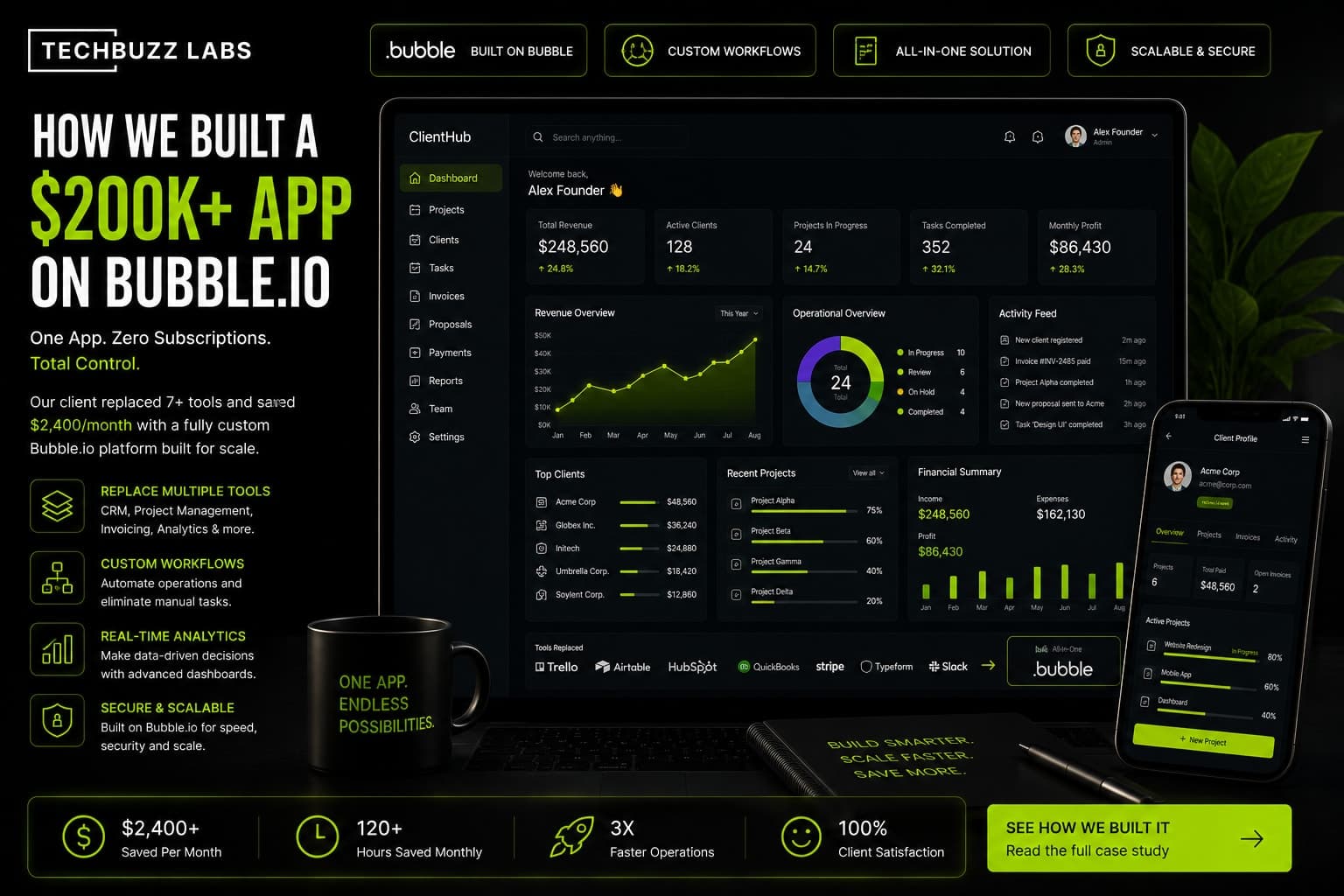
Instead of paying for multiple disconnected platforms, the founder decided to build one centralized operational system using Bubble.
The goal was simple.
Reduce software costs while improving workflow efficiency.
The Problem With Subscription Stacking
Many startups subscribe to multiple platforms over time.
Each tool solves one problem temporarily.
But eventually teams manage:
Separate dashboards
Disconnected workflows
Multiple subscriptions
Repeated data entry
Fragmented communication
This creates operational inefficiency.
Monthly costs also grow rapidly.
For this founder, software expenses reached over $3000 every month.
The Bubble Solution
Using Bubble, the founder built a custom business application that combined:
CRM management
Project tracking
Client communication
Internal dashboards
Task management
Automated workflows
Reporting systems
Instead of managing multiple tools, everything operated inside one centralized platform.
The biggest advantage was workflow alignment.
The app matched the business process exactly instead of forcing the business to adapt to generic software.
Why No Code Is Changing Business Operations
No code platforms such as Bubble are transforming how startups build operational systems.
Businesses no longer need massive engineering teams for internal applications.
Modern founders can build highly functional systems much faster and more affordably.
This is especially valuable for startups trying to scale efficiently.
The Result
The founder reduced operational costs dramatically while improving internal visibility and team productivity.
More importantly, the company gained flexibility.
Instead of depending on multiple external tools, workflows could now evolve internally as the business grew.
This is why many startups in the USA and Europe are increasingly investing in custom no code systems.
The Future of Operational Software
Businesses are becoming more selective about software spending.
Instead of paying for dozens of subscriptions, many companies now prefer centralized systems tailored around their exact operations.
This trend is accelerating rapidly in 2026.
And no code development is making it more accessible than ever.