How Talent Agencies Can Improve Client Response Times With CRM Software
Clients often approach talent agencies because they need professional support finding the right people for a project. Whether the requirement involves models for an advertising campaign, commercial production, fashion shoot, e-commerce project.

In the fast-moving U.S. talent and modeling industry, client response time can have a direct impact on business opportunities. Brands, advertising agencies, production companies, photographers, and casting professionals often work with tight deadlines and need agencies to provide suitable talent quickly. When an agency takes too long to respond, clients may move on to another agency or choose talent through a different channel.
Managing client requests quickly can become challenging when agencies rely on spreadsheets, email inboxes, messaging apps, and separate databases. Agents may need to search for talent, check availability, review client requirements, prepare submissions, and follow up with multiple people before sending a response.
CRM software can simplify these processes by bringing important agency information into one centralized system. For modern talent agencies, a well-organized CRM can help improve response times while also making talent management, casting, client communication, and booking workflows more efficient.
Why Client Response Time Matters for Talent Agencies
Clients often approach talent agencies because they need professional support finding the right people for a project. Whether the requirement involves models for an advertising campaign, commercial production, fashion shoot, e-commerce project, or promotional event, the agency is expected to respond with relevant options.
A slow response can create several problems. The client may miss a project deadline, lose confidence in the agency, or contact another talent provider.
Fast responses, however, do not mean sending information without checking accuracy. Agencies need to provide suitable talent and reliable availability while responding efficiently. CRM technology can help achieve this balance by organizing the information agents need.
1. Keep Client Information in One Centralized System
A CRM allows agencies to organize client information in one location.
Instead of searching through emails and separate contact lists, agents can access client profiles containing contact details, previous projects, communication history, casting requests, and booking information.
When an existing client sends a new request, the agent can quickly review previous interactions and understand the client's relationship with the agency.
This can reduce the time spent looking for background information and help agents provide more informed responses.
2. Organize the Talent Database
One of the biggest reasons client responses can be delayed is the time required to find suitable talent.
A growing modeling agency may represent hundreds or even thousands of models. Searching through spreadsheets or folders manually can take considerable time.
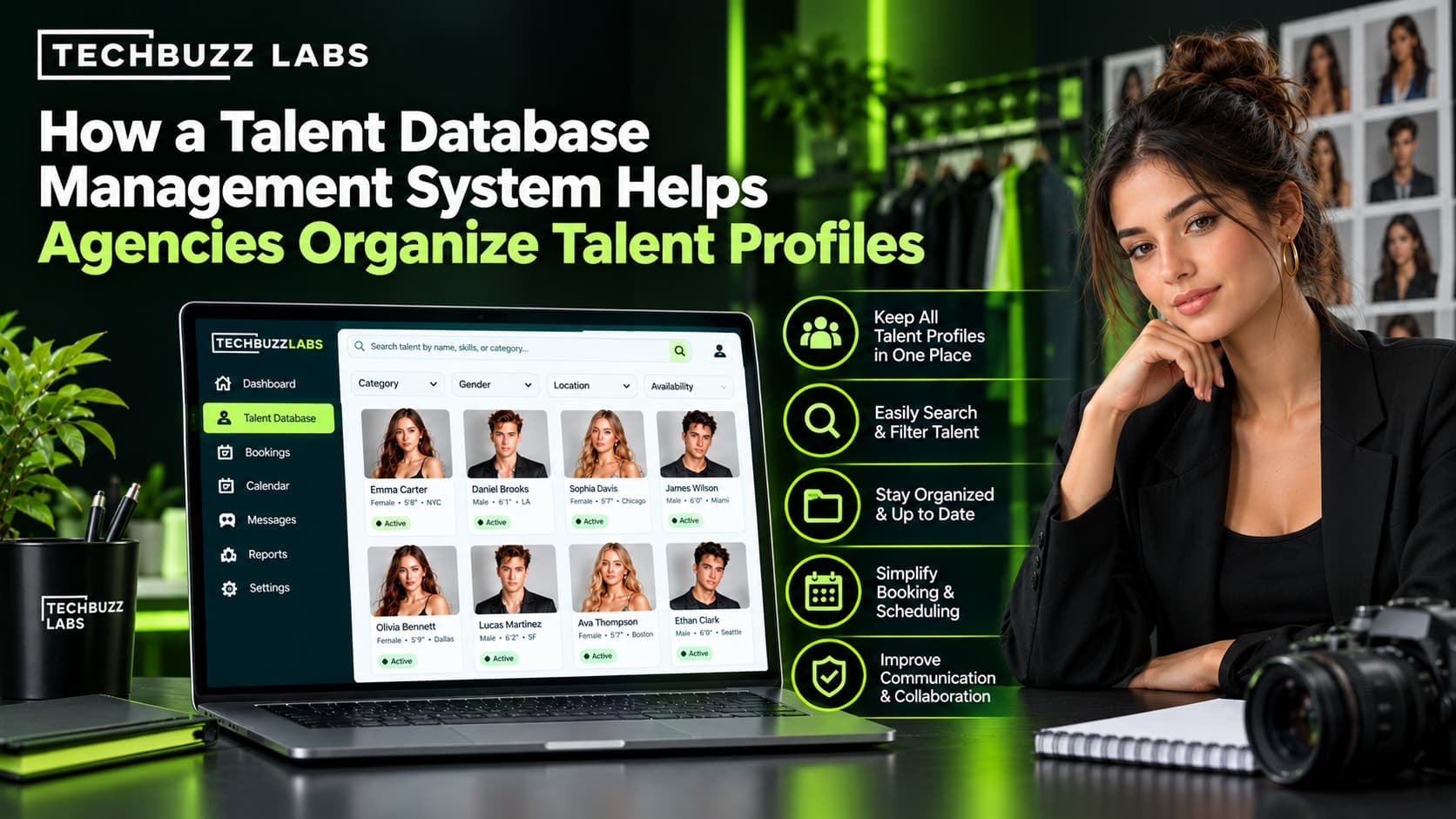
CRM software can centralize talent profiles and organize important information such as photographs, portfolios, experience, skills, locations, categories, and availability.
With structured talent records, agents can search for relevant candidates without manually reviewing the entire roster.
3. Use Advanced Search and Filtering
A centralized database becomes even more useful when agents can quickly filter talent.
For example, a client in Los Angeles may need commercial models who are available for a campaign on specific dates. An agent can use relevant search criteria to narrow the database and identify potential candidates.
Depending on the software, agencies may be able to filter talent by location, category, experience, availability, skills, or other agency-specific requirements.
Faster searches allow agents to move from a client request to a relevant shortlist more efficiently.
4. Connect Availability With Talent Profiles
Finding the right talent is only part of the process. Agents also need to know whether the model is available.
When availability is maintained separately, agents may have to contact several models before they can confidently respond to the client.
A CRM can connect availability information with talent profiles, casting opportunities, and bookings.
This gives agents better visibility into schedules and can reduce unnecessary back-and-forth communication.
For agencies operating in major U.S. markets such as New York, Los Angeles, Miami, Chicago, and Atlanta, centralized availability management can be particularly useful.
5. Manage Casting Requests More Efficiently
CRM software can also help agencies organize incoming casting requests.
Agents can record important details such as project requirements, client information, location, dates, deadlines, talent category, and casting status.
Instead of leaving this information buried inside an email thread, the agency can associate it with a specific casting record.
A typical workflow might be:
Client Request → Talent Search → Availability Check → Submission → Client Feedback → Booking
Having these stages connected gives agents a clearer understanding of what needs to happen next.
6. Speed Up Model Submissions
Preparing model submissions can take time when information is scattered across multiple platforms.
Agents may need to find photographs, portfolio links, measurements, experience, and other professional details before sending options to a client.
With CRM software, these details can be connected to individual talent profiles.
Agents can select appropriate models and associate them with the relevant casting opportunity. This reduces repetitive data entry and allows teams to prepare submissions more efficiently.
Faster submissions can be especially valuable when clients have short casting deadlines.
7. Use Communication Templates
CRM technology can also help agents save time when handling routine communication.
Agencies often send similar types of messages for casting requests, availability checks, submissions, follow-ups, and booking confirmations.
Reusable templates can help agents create these communications faster while still allowing them to personalize messages for each client or project.
The objective is not to make communication generic. Instead, templates can reduce repetitive writing so agents can focus on the details that matter to each client.
8. Automate Follow-Up Reminders
A client may not respond immediately after receiving a submission.
Without an organized follow-up process, an agent may forget to check back.
CRM software can provide reminders or workflow automation for follow-ups.
For example, an agent can receive a notification when a submission has been waiting for a response or when a casting deadline is approaching.
This can help agencies maintain consistent communication without relying entirely on manual calendars or memory.
9. Improve Team Collaboration
Client response times can also be affected by internal communication.
Several agents may work with the same client or talent. If information is stored in personal inboxes and individual spreadsheets, one team member may have to wait for another person to provide an update.
A centralized CRM allows authorized employees to access shared information.
An agent taking over a client request can review the casting details, submitted talent, client feedback, and current status without starting the process again.
This can help agencies maintain continuity and respond to clients even when individual team members are unavailable.
10. Prioritize Urgent Client Requests
Not every casting request has the same deadline.
CRM software can help agencies organize opportunities according to project dates, submission deadlines, client priorities, or casting status.
Agents can then identify which requests require immediate attention.
For example, a casting deadline within 24 hours may need to be handled before a project with a submission deadline several weeks away.
Prioritizing opportunities can help agencies manage workloads while ensuring urgent client requests receive timely attention.
11. Track Client Response Performance
CRM software can also provide useful information about agency performance.
Managers can monitor casting activity, submissions, client interactions, and bookings to identify where delays occur.
If talent searches consistently take too long, the agency may need to improve its database organization or filtering system. If follow-ups are frequently missed, automated reminders may help.
This data-driven approach allows agencies to improve response times by identifying specific workflow problems.
How TechBuzzLabs Supports Modern Agency Workflows
TechBuzzLabs focuses on technology solutions for modeling and talent agencies, including CRM, casting management, talent management, and workflow automation.
For agencies managing large talent pools and multiple clients, centralized technology can connect the information agents need to respond to requests more efficiently.
Instead of managing talent profiles, client records, casting opportunities, availability, submissions, and bookings through disconnected tools, agencies can create a more unified workflow.
This can help reduce the time agents spend searching for information and allow them to focus more on client relationships and talent management.
Best Practices for Improving Client Response Times
CRM software can provide the technology, but agencies also need clear internal processes.
Talent profiles should be kept accurate and updated. Client requirements should be recorded consistently, and agents should know who is responsible for handling incoming requests.
Agencies should also establish clear response priorities and follow-up procedures.
Most importantly, speed should never come at the expense of accuracy. Sending unsuitable talent or incorrect availability information may create a poor client experience.
The strongest approach combines speed, accuracy, relevance, and consistent communication.
Conclusion
For talent and modeling agencies in the USA, improving client response times can help strengthen relationships and increase the ability to compete for time-sensitive opportunities.
CRM software can improve response times by centralizing client information, organizing talent profiles, simplifying searches, connecting availability with castings, streamlining submissions, automating follow-ups, and improving team collaboration.
Instead of spending valuable time searching through disconnected systems, agents can access the information they need from a centralized platform and move client requests through the agency workflow more efficiently.
As U.S. talent agencies continue to manage larger rosters and increasingly demanding clients, CRM technology can become an important part of modern agency operations.
With solutions from TechBuzzLabs, agencies can explore a more connected approach to CRM and talent management, helping teams respond to clients faster while keeping casting, talent, and booking workflows organized.