The Complete Model Onboarding Process: How CRM Software Can Help Agencies
The process can include collecting personal and professional information, reviewing portfolios, completing contracts, organizing profiles, discussing agency expectations, and preparing the model for future castings and bookings.
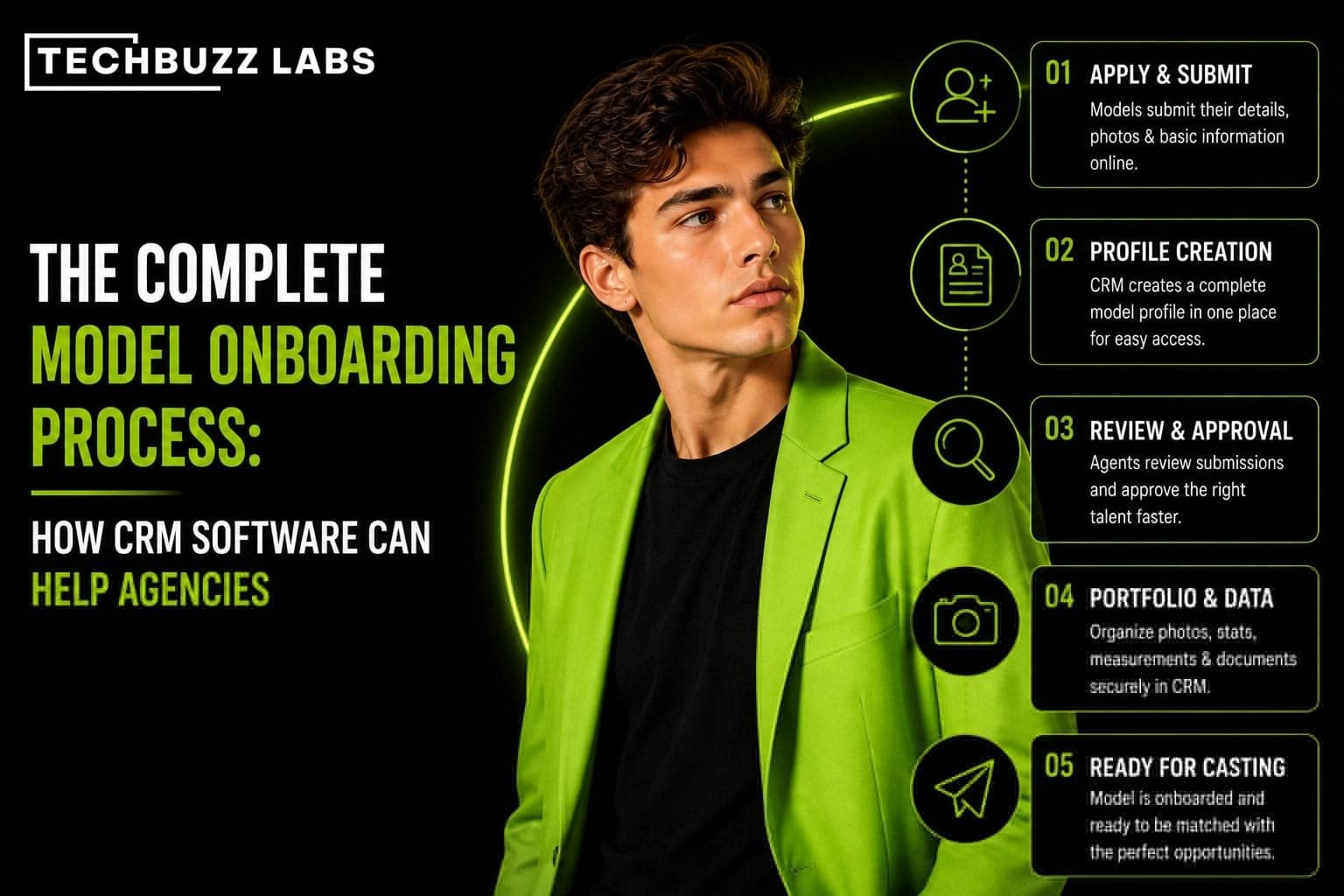
Bringing a new model into a modeling agency involves much more than signing an agreement. Agencies need to collect professional information, review portfolios, organize photographs, verify availability, manage contracts, explain expectations, and introduce new talent to the agency's workflow. When an agency represents a large number of models, handling all these tasks manually can become time-consuming.
This is where CRM software for modeling agencies can make the onboarding process more organized. A CRM can centralize model information, automate repetitive tasks, and give agents a clear view of each model's onboarding progress.
For modeling agencies in the USA, especially those working in competitive markets such as New York, Los Angeles, Miami, and Chicago, a structured onboarding process can help create a professional experience from the beginning. TechBuzzLabs highlights how modern technology can help agencies streamline talent management and build more efficient operations.
What Is Model Onboarding?
Model onboarding is the process of bringing a new model into an agency and preparing them for professional representation.
A well-organized onboarding process ensures that the agency has the information it needs while helping the model understand how the agency works.
Step 1: Collect Model Information
The first stage is gathering essential information about the new model.
Depending on the agency's requirements, this may include:
Full name and contact details
Location
Measurements
Modeling experience
Skills
Languages
Social media or professional links
Portfolio photographs
Videos
Availability
Previous work
A CRM can provide structured forms or profile fields that allow agencies to collect this information consistently.
Instead of receiving details through scattered emails and messages, agents can keep everything connected to the model's profile.
Step 2: Review the Portfolio
The agency should review the model's portfolio and professional materials before completing the onboarding process.
Agents may evaluate photographs, videos, previous campaigns, experience, and overall suitability for the agency's market.
A CRM can store portfolio information alongside the model's profile, allowing agents to access relevant materials when considering the model for future castings.
Keeping these assets organized also makes it easier to update the profile when new professional work becomes available.
Step 3: Complete Contracts and Documentation
Contracts and other documentation are important parts of professional model representation.
Agencies may need to collect agreements, identification or eligibility documents where appropriate, tax-related information, and other required paperwork depending on their business practices and applicable laws.
A CRM or connected document-management workflow can help track which documents have been received and which still require attention.
This reduces the risk of losing paperwork in email attachments or physical folders.
Agencies should ensure that any contracts and document-handling procedures comply with applicable U.S. laws and regulations.
Step 4: Create the Model's CRM Profile
Once the initial information has been collected, the agency can create a complete model profile inside its CRM.
The profile can bring together information such as photographs, measurements, experience, skills, location, availability, and professional notes.
This becomes the central record that agents can use when searching for talent for casting opportunities.
A standardized profile structure also makes it easier for agencies to maintain consistent information across their entire roster.
Step 5: Organize Categories and Skills
Modeling agencies may represent talent across different categories, including fashion, editorial, commercial, lifestyle, fitness, beauty, and other specialties.
A CRM can use categories, tags, and searchable fields to organize talent according to their professional characteristics.
For example, an agent looking for commercial talent in Los Angeles could filter the database based on location and category.
This can make the talent discovery process faster as the agency's roster grows.
Step 6: Track Availability
Availability should be established early in the onboarding process.
Agents need to know where models are based and when they may be available for castings, fittings, shoots, and other assignments.
A CRM can connect availability information to casting and booking records.
Keeping this information updated helps agents avoid recommending models who are unavailable and reduces unnecessary back-and-forth communication.
Step 7: Introduce the Agency's Workflow
Onboarding should also explain how the agency operates.
New models may need information about communication procedures, casting notifications, booking expectations, schedules, professional conduct, and how they should update their availability.
A CRM can help agencies organize onboarding tasks and provide reminders for agents to complete important steps.
This creates a consistent experience for every new model.
Step 8: Prepare the Model for Casting Opportunities
Once the model's profile is complete, the agency can begin considering them for relevant opportunities.
Agents can search the CRM database when clients submit casting requirements.
Instead of reviewing every model manually, agents can use relevant filters such as location, experience, category, availability, and other agency-defined criteria.
This allows newly onboarded models to become part of the agency's active talent pool more efficiently.
Step 9: Automate Follow-Ups and Onboarding Tasks
Onboarding can involve many small administrative tasks.
For example, an agency may need to remind a model to submit missing information, request updated photographs, confirm documents, or schedule an onboarding meeting.
CRM automation can create reminders and trigger certain communications based on the model's onboarding status.
A simple workflow could look like:
Application → Review → Documents → Profile Complete → Onboarding → Active Talent
This gives agents a clear understanding of where each new model is in the process.
Step 10: Keep Information Updated
Onboarding should not be considered a one-time activity.
Models' careers change over time. They may gain new experience, update their portfolios, move to another city, change availability, or develop new skills.
A CRM makes it easier to maintain these records over time.
Regular data updates ensure that agents are working with accurate information when responding to client requests.
Benefits of CRM-Based Model Onboarding
Using CRM software can provide several advantages for modeling agencies.
First, it creates consistency. Every model can follow a standardized onboarding process.
Second, it improves organization by keeping information in one central location.
Third, automation can reduce administrative workload.
Fourth, centralized data can make it easier for agents to search and match talent with relevant casting opportunities.
Finally, a structured onboarding system can provide a more professional experience for both models and agency staff.
The Role of TechBuzzLabs
Technology is becoming increasingly important in modern modeling agency management. TechBuzzLabs focuses on the connection between technology and the modeling industry, including CRM software, casting management, automation, and model management solutions.
For agencies growing their talent pools, implementing a structured digital onboarding process can help them manage new models efficiently while maintaining accurate information across their operations.
Conclusion
The model onboarding process is an important foundation for a successful agency relationship. From collecting information and reviewing portfolios to completing documentation, creating profiles, tracking availability, and preparing models for castings, every stage needs to be organized.
CRM software can simplify this process by centralizing model information, tracking onboarding progress, automating reminders, and connecting new talent with the agency's wider casting and booking workflows.
For U.S. modeling agencies, adopting a structured CRM-based onboarding process can reduce administrative work and make it easier to manage a growing roster. With the right technology and consistent processes, agencies can create a smoother experience for new models while building a stronger foundation for long-term growth.
As the modeling industry continues to adopt digital tools, technology-focused platforms such as TechBuzzLabs demonstrate how CRM and automation can help agencies modernize talent management and operate more efficiently.