The Future of Talent Management Systems for Modeling and Talent Agencies
For a modeling agency, this can include model profiles, photographs, measurements, skills, experience, location, availability, casting history, bookings, and client interactions.
The modeling and talent industry is becoming increasingly digital. Agencies that once relied on spreadsheets, email threads, shared folders, and manual scheduling are now looking for smarter ways to manage growing talent pools and client relationships. As the number of models, casting opportunities, and bookings increases, traditional systems can become difficult to maintain.
The future of talent management systems is moving toward connected platforms that combine talent databases, CRM functionality, casting management, automation, analytics, and artificial intelligence. For modeling and talent agencies in the USA, these technologies can help teams work faster while creating a more organized experience for models and clients.
TechBuzzLabs is part of this technology shift, offering custom platforms designed around the workflows of talent and casting agencies. Its solutions bring profiles, availability, bookings, and client requests into a searchable platform while supporting automation and AI applications.
What Is a Talent Management System?
A talent management system is software that helps agencies organize and manage information about the talent they represent.
Instead of keeping information in separate spreadsheets and folders, a modern system can connect these records in one centralized platform.
This makes it easier for agents to find suitable talent, respond to casting requests, manage bookings, and maintain accurate information.
Why Traditional Agency Systems Are Changing
Spreadsheets can be useful for smaller agencies, but they become harder to manage as an agency grows.
A large talent pool can generate thousands of individual records. Agents may need to update availability, organize new portfolio images, track castings, communicate with clients, and coordinate bookings simultaneously.
Manual processes can create delays and increase the risk of outdated information.
Modern talent management systems are designed to reduce this operational friction. TechBuzzLabs notes that agencies still using spreadsheets, shared folders, PDF comp cards, and manual availability checks can spend significantly more time preparing talent submissions than agencies using centralized systems.
Centralized Talent Profiles Will Become Standard
One major trend is the development of comprehensive digital talent profiles.
Instead of storing model information across multiple locations, agencies can maintain a single profile containing relevant professional information and portfolio materials.
Agents can then search and filter profiles according to project requirements.
For example, a U.S. client looking for commercial models in Los Angeles could require specific availability, experience, and skills. A centralized system can make it easier for agents to identify potentially suitable talent without manually reviewing the entire database.
Real-Time Availability and Booking Management
Availability is one of the most important parts of talent management.
A model may be suitable for a casting but unavailable because of another booking. If availability information is outdated, agents can waste valuable time contacting talent who cannot accept the project.
Future talent management platforms will increasingly connect availability, castings, holds, and bookings.
This can give agents a clearer view of schedules and help reduce conflicts.
For agencies working across U.S. markets such as New York, Los Angeles, Miami, Dallas, and Chicago, centralized scheduling can become particularly valuable.
Automation Will Reduce Administrative Work
Automation will also play a major role in the future of talent management.
Agents perform many repetitive tasks, including sending casting notifications, requesting availability, creating reminders, updating booking statuses, and following up with clients.
Modern systems can automate many of these steps.
For example, when a casting opportunity is created, the platform could identify relevant talent, notify selected models, track responses, and remind agents about approaching deadlines.
This allows agents to spend more time on relationship building and professional decision-making instead of repetitive administration.
AI-Powered Talent Matching
Artificial intelligence could become one of the most important developments in talent management.
AI can potentially analyze structured information within a talent database and help agents identify models who match specific casting requirements.
Instead of manually reviewing hundreds of profiles, agents could use AI-assisted recommendations to create an initial shortlist.
AI could consider factors such as location, availability, experience, skills, category, and previous project information.
However, AI should support human judgment rather than replace it. Agents and casting professionals still need to evaluate factors that may not be captured in structured data, including personality, professionalism, creative suitability, and client preferences.
Smarter Client Management
Future talent management systems will also become more connected to client relationships.
A modern agency may need to manage brands, photographers, advertising agencies, retailers, production companies, and other clients.
CRM functionality can help agencies maintain communication history, project information, booking records, and client preferences.
When a client returns with a new campaign, agents can use this information to provide more relevant recommendations and faster responses.
This can help agencies build stronger long-term relationships.
Client Portals and Faster Talent Submissions
Another important development is the use of client-facing portals.
Instead of sending large numbers of photographs through email, agencies can potentially provide clients with secure digital access to selected talent.
Clients can review profiles, provide feedback, and communicate decisions through a centralized workflow.
TechBuzzLabs highlights features such as digital talent profiles, real-time availability tracking, automated submissions, and client sharing portals as components of modern talent management systems.
This can significantly reduce the time required to prepare and manage submissions.
Better Analytics and Business Intelligence
Future systems will not only store information; they will help agencies understand it.
Analytics can provide insights into casting activity, booking rates, client performance, talent activity, and operational efficiency.
Agency managers could use this information to identify trends and make better business decisions.
For example, an agency could determine which clients generate the most bookings or which types of casting opportunities produce the strongest results.
This turns the talent management system into a business intelligence tool rather than simply a database.
Data Security Will Become More Important
As agencies move more operations online, data security will become increasingly important.
Talent agencies may manage photographs, contact information, measurements, contracts, schedules, and other professional records.
Future systems will need appropriate access controls, secure data storage, backups, and responsible data-management practices.
Agencies should also evaluate how technology providers handle and protect their information before adopting a platform.
The Role of TechBuzzLabs
TechBuzzLabs focuses on building technology around real business workflows rather than forcing agencies to adapt to generic software. Its talent and casting solutions are designed to bring profiles, availability, bookings, and client requests together while supporting automation, role-based access, data migration, and AI applications.
This approach is particularly relevant for agencies that have outgrown spreadsheets and disconnected tools but need a system designed around their specific operations.
Conclusion
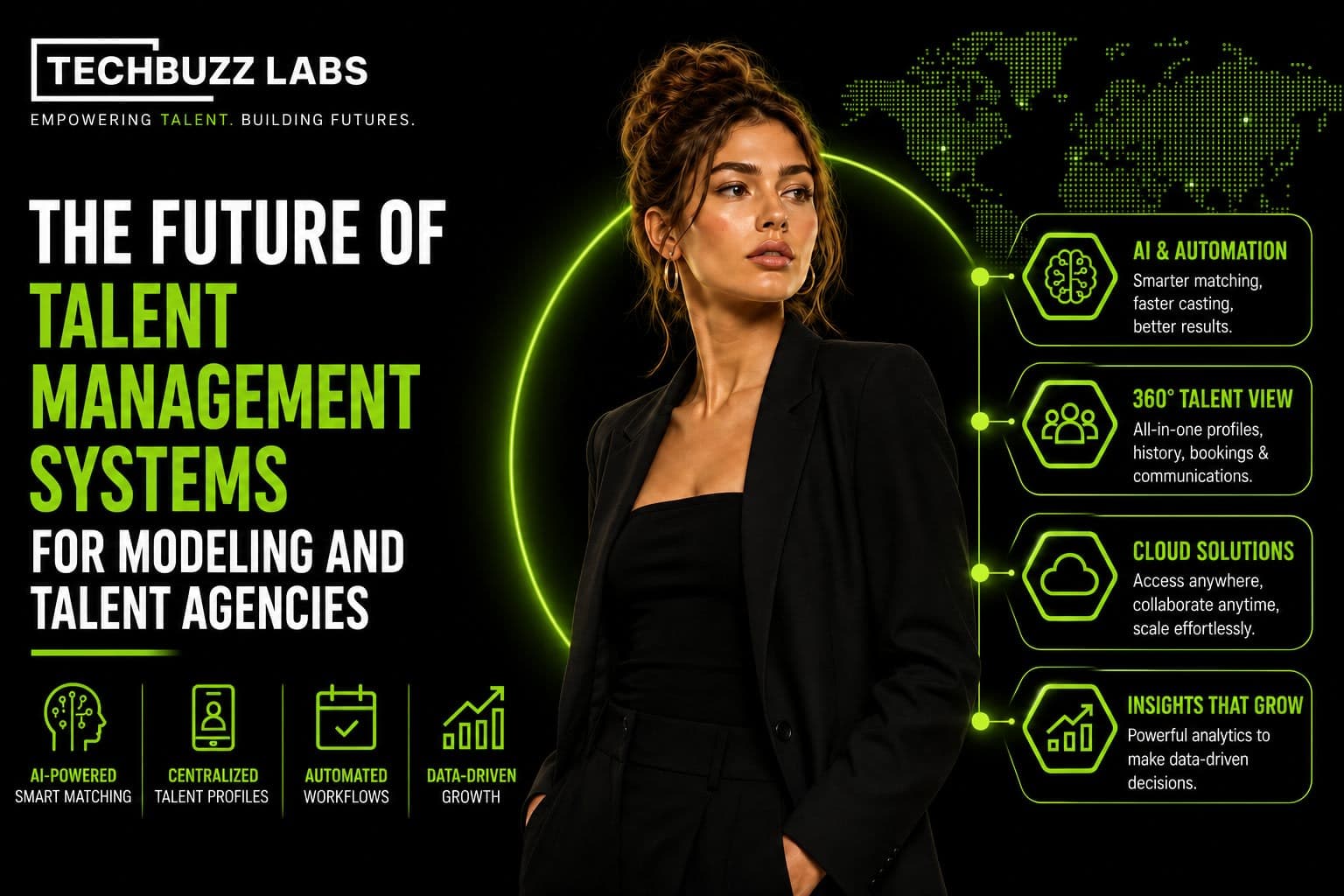
The future of talent management systems for modeling and talent agencies will be shaped by centralized data, automation, AI, real-time availability, client portals, and advanced analytics.
For agencies in the USA, these technologies can make it easier to manage growing talent pools, respond to casting opportunities faster, reduce administrative work, and improve client relationships.
However, technology will not replace the human side of talent management. Successful agencies will continue to rely on experienced agents who understand models, clients, creative requirements, and industry relationships.
The strongest future model is therefore a combination of human expertise and intelligent technology. As agencies continue moving away from spreadsheets and manual workflows, platforms such as TechBuzzLabs can help create more connected, scalable, and efficient systems for the modern modeling and talent industry.