The Role of AI in Matching Models With Casting Opportunities
A client might request models based on criteria such as location, experience, availability, modeling category, skills, or other project requirements.
The modeling industry is becoming increasingly technology-driven. As agencies build larger talent pools and receive more casting requests, finding the right model for each opportunity can become a time-consuming process. Agents may need to review hundreds of profiles, check availability, compare experience, and communicate with multiple models before creating a shortlist.
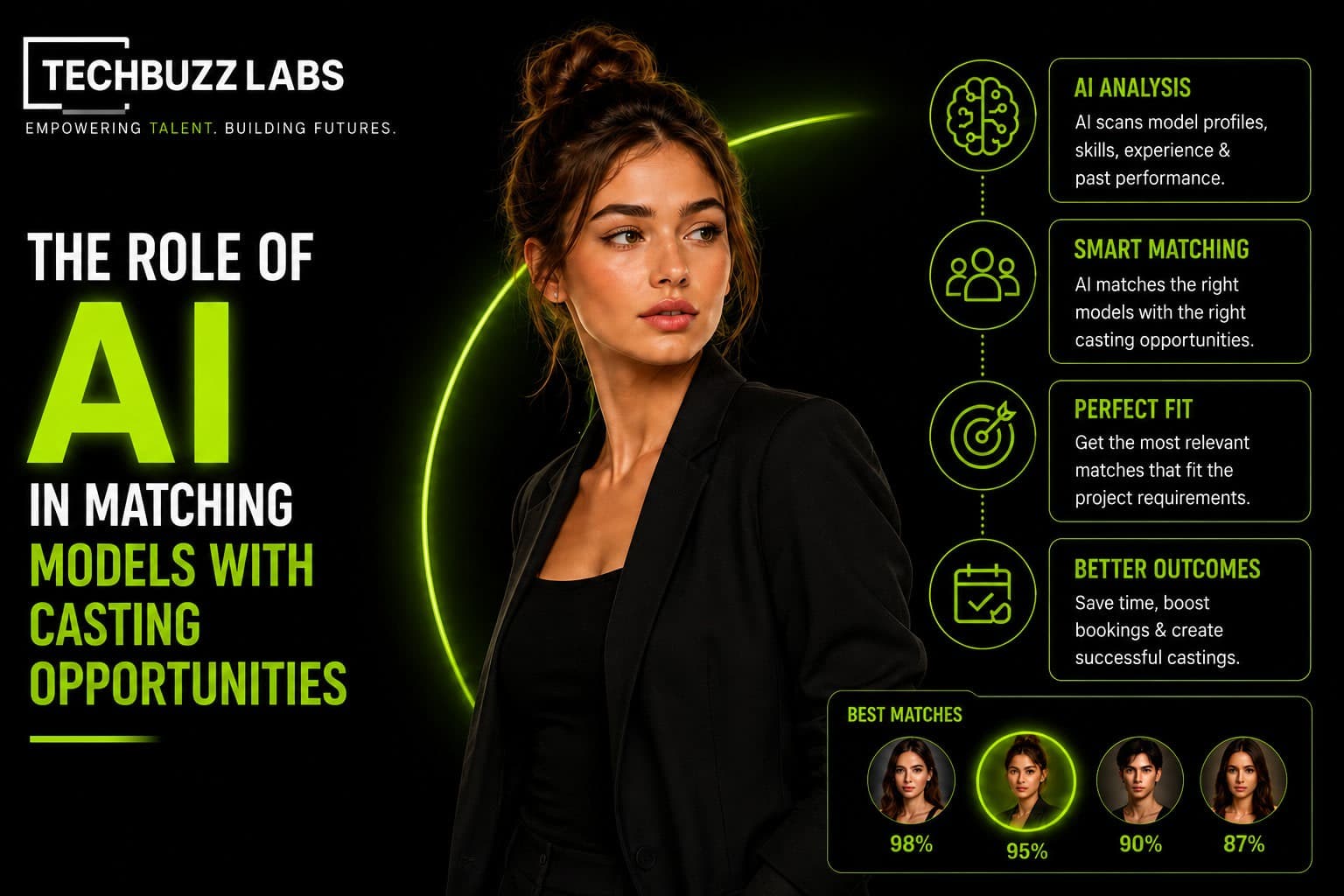
Artificial intelligence (AI) could help make this process faster and more organized. By working alongside CRM software and casting management systems, AI can analyze structured talent information and help agents identify models who may be suitable for specific opportunities.
For modeling agencies in the USA, particularly those operating in major markets such as New York, Los Angeles, Miami, and Chicago, AI-assisted matching could become an important tool for managing large talent databases. TechBuzzLabs highlights the growing role of technology in modern modeling operations and how AI and CRM solutions can support more efficient agency workflows.
What Is AI Model Matching?
AI model matching refers to using artificial intelligence to compare information about models with the requirements of a casting opportunity.
Instead of an agent manually reviewing the entire talent database, an AI-powered system can analyze available information and identify profiles that potentially match the defined requirements.
The AI does not need to make the final casting decision. Instead, it can provide agents with a shortlist that helps them begin the evaluation process more efficiently.
How AI Uses CRM Data
For AI matching to work effectively, the underlying CRM needs well-organized and accurate information.
A modeling CRM may contain details such as:
Model profiles
Location
Availability
Modeling categories
Professional experience
Skills
Portfolio information
Previous bookings
Casting history
When a new casting opportunity is added, AI tools can potentially compare the requirements with relevant information stored in the CRM.
The better the data is organized and maintained, the more useful AI-assisted searches can become.
Faster Talent Discovery
One of the biggest potential benefits of AI is speed.
A large modeling agency may have hundreds or thousands of profiles. Reviewing every profile manually for each casting request can take significant time.
AI-assisted matching can help narrow the database to potentially relevant candidates.
For example, if a client needs commercial models in Los Angeles for a campaign with specific dates, an AI system could help identify profiles that match the location, category, and availability requirements.
Agents can then review the suggested profiles and make the final decision.
Matching Based on Multiple Criteria
Traditional searches may require agents to apply several filters manually.
AI can potentially consider multiple data points at the same time.
For example, a casting may require:
Location + Availability + Experience + Modeling Category + Skills
An AI-powered system can analyze these criteria together and prioritize profiles that appear most relevant.
This can make large talent databases easier to navigate.
Helping Agencies Respond Faster
Speed can be important when working with casting opportunities.
Clients may contact several agencies at the same time, and agencies that can respond quickly may have an operational advantage.
AI-assisted matching can reduce the time agents spend searching for potential talent.
Instead of starting with an entire database, agents can begin with a smaller group of potentially relevant profiles and focus their professional judgment on those candidates.
AI Can Learn From Agency Data
Over time, AI systems may be able to identify patterns within agency data.
For example, an agency might have information about previous casting submissions, successful bookings, client preferences, and project categories.
With appropriate data and privacy controls, AI could help identify patterns that agents may find useful.
An agency might discover that certain clients frequently request specific types of talent or that particular experience is commonly associated with certain project categories.
These insights could support better decision-making.
Improving Client Recommendations
AI-assisted CRM systems could also help agents make more relevant client recommendations.
Suppose a returning client is looking for talent for a new advertising campaign. The CRM may contain information about the client's previous projects and bookings.
An AI system could potentially help agents identify models whose profiles align with the new requirements and relevant historical patterns.
The agent can then review those recommendations and decide which talent should actually be presented to the client.
Supporting Model Availability
Availability is one of the most important factors in casting.
A model may fit a client's requirements perfectly but be unavailable on the requested dates.
When availability information is maintained within a CRM, AI tools can potentially use it as part of the matching process.
This can help agents avoid recommending talent who cannot participate in the project and reduce unnecessary communication.
However, availability data needs to be updated regularly to remain reliable.
AI Should Support Human Judgment
While AI can improve efficiency, it should not replace professional agents or casting directors.
Model casting involves factors that may not be fully represented by structured data. Professionalism, personality, communication skills, creative suitability, and client relationships can all influence a casting decision.
AI should therefore be treated as an assistant rather than the final decision-maker.
Agents should review AI-generated recommendations and apply their own expertise before presenting models to clients.
Avoiding Bias in AI Casting
AI-powered casting also creates important ethical considerations.
If an AI system is trained on historical data that contains biases, its recommendations could potentially reproduce those patterns.
Agencies should regularly review how AI tools are being used and avoid relying on inappropriate or discriminatory criteria.
Technology should help agencies discover talent based on legitimate professional requirements rather than make assumptions about individuals.
Transparency and human oversight are important when AI becomes part of the casting process.
The Importance of Data Privacy
Modeling agencies manage sensitive professional and personal information, including photographs, contact details, measurements, availability, and booking history.
Before adopting AI-powered casting technology, agencies should understand how their data is stored, processed, and protected.
Access controls, secure systems, responsible data practices, and appropriate privacy policies should be part of the technology strategy.
U.S. agencies should also consider the privacy and legal requirements relevant to their operations and the locations in which they work.
The Role of TechBuzzLabs
The growing use of AI demonstrates how technology is changing the modeling industry. TechBuzzLabs focuses on the intersection of modeling and technology, including CRM software, casting management systems, automation, and digital talent management.
For agencies with growing talent pools, AI-assisted matching can become one component of a broader technology strategy. When combined with accurate CRM data and efficient casting workflows, AI can help agents spend less time searching and more time evaluating talent and developing client relationships.
Conclusion
AI can play an important role in matching models with casting opportunities by helping agencies search large talent databases, analyze multiple criteria, consider availability, and identify potentially relevant candidates.
For modeling agencies in the USA, these capabilities could make casting workflows faster and more organized as talent pools continue to grow.
However, AI should support human expertise rather than replace it. The strongest approach combines accurate CRM data, intelligent technology, and experienced agents who understand the creative and professional requirements of the modeling industry.
As AI, automation, and CRM technology continue to develop, agencies that adopt these tools thoughtfully can create more efficient casting workflows while maintaining the human relationships that remain at the heart of successful talent management. TechBuzzLabs reflects this shift toward smarter technology solutions for the modern modeling industry.