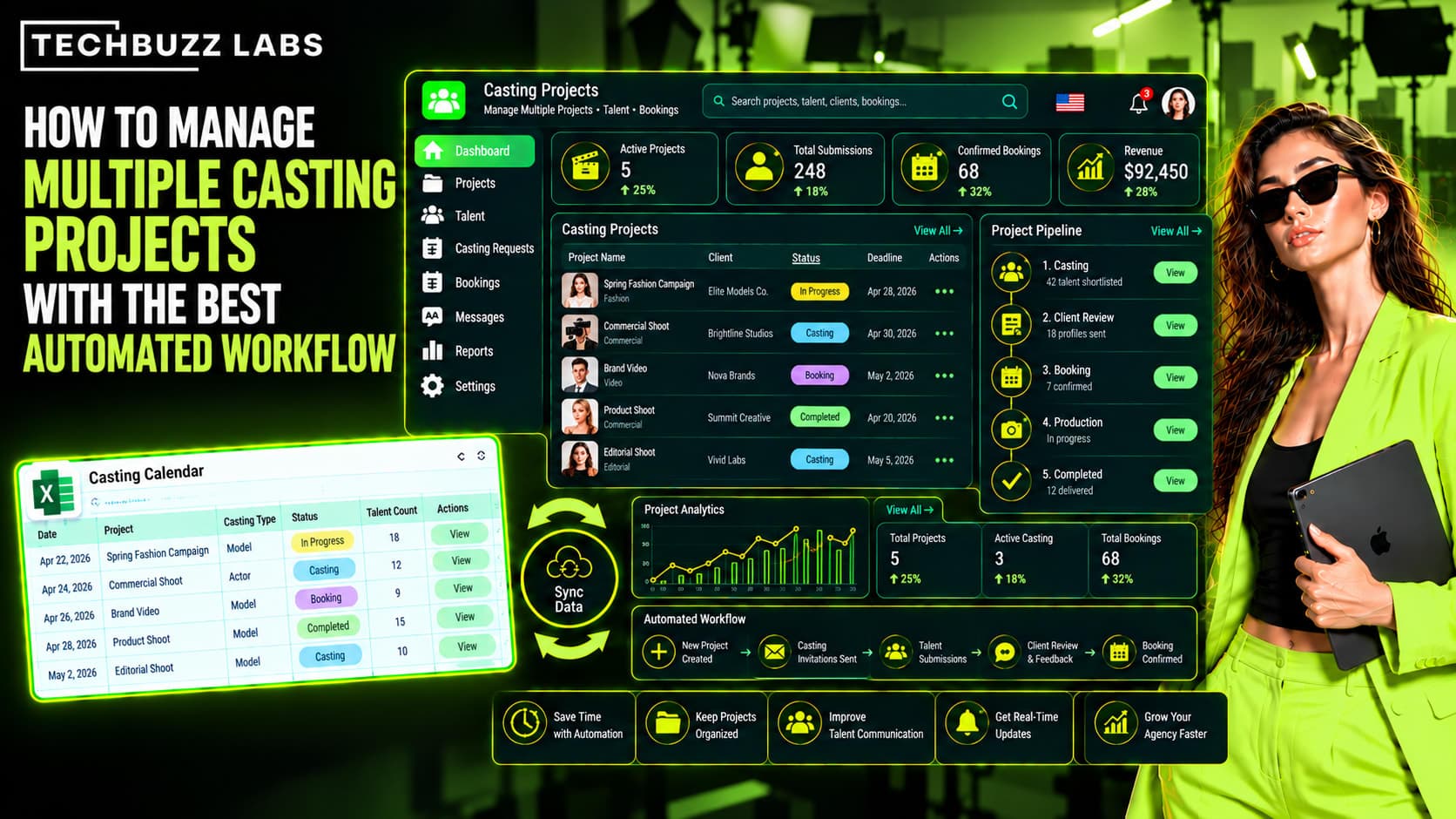
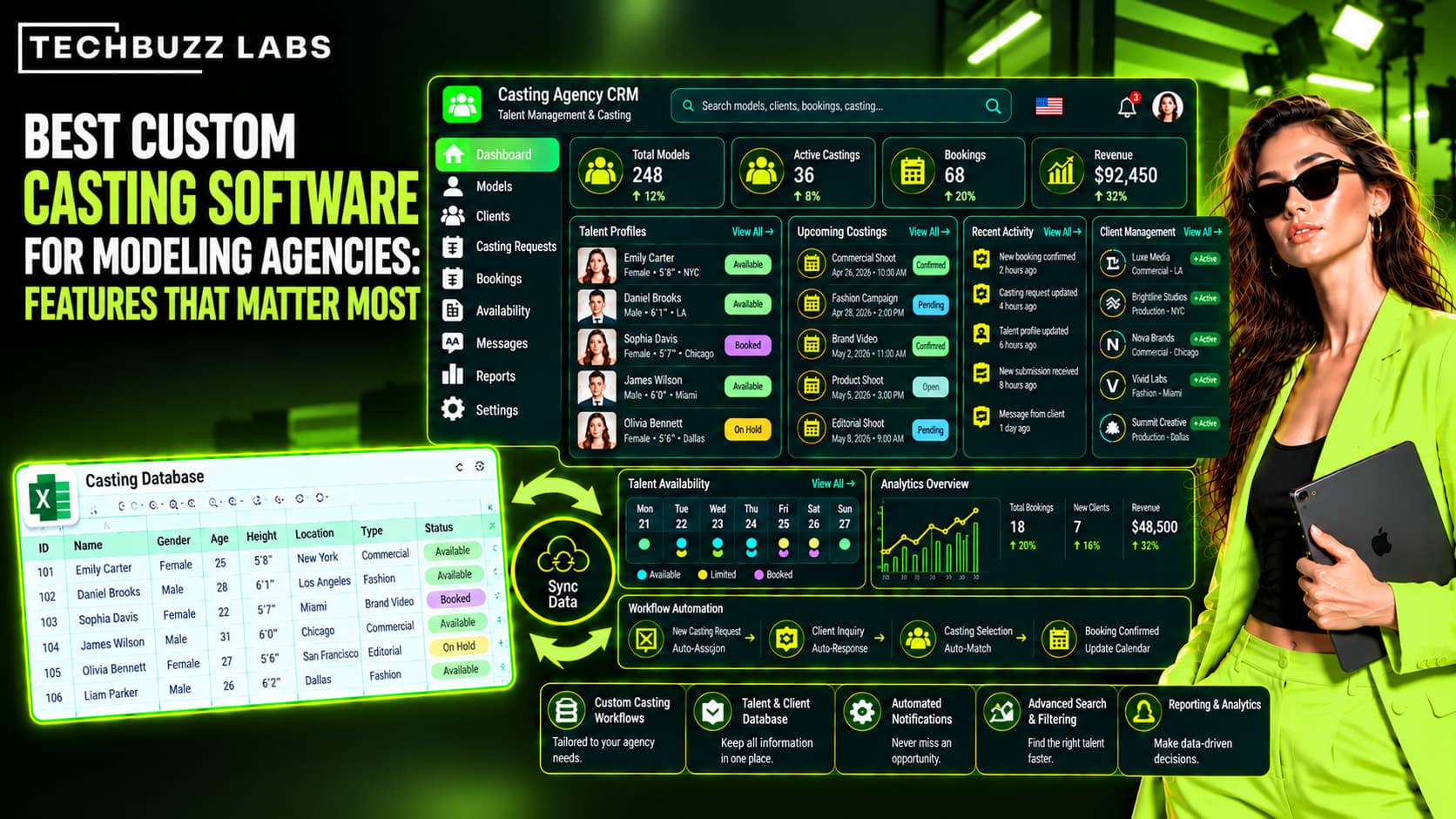
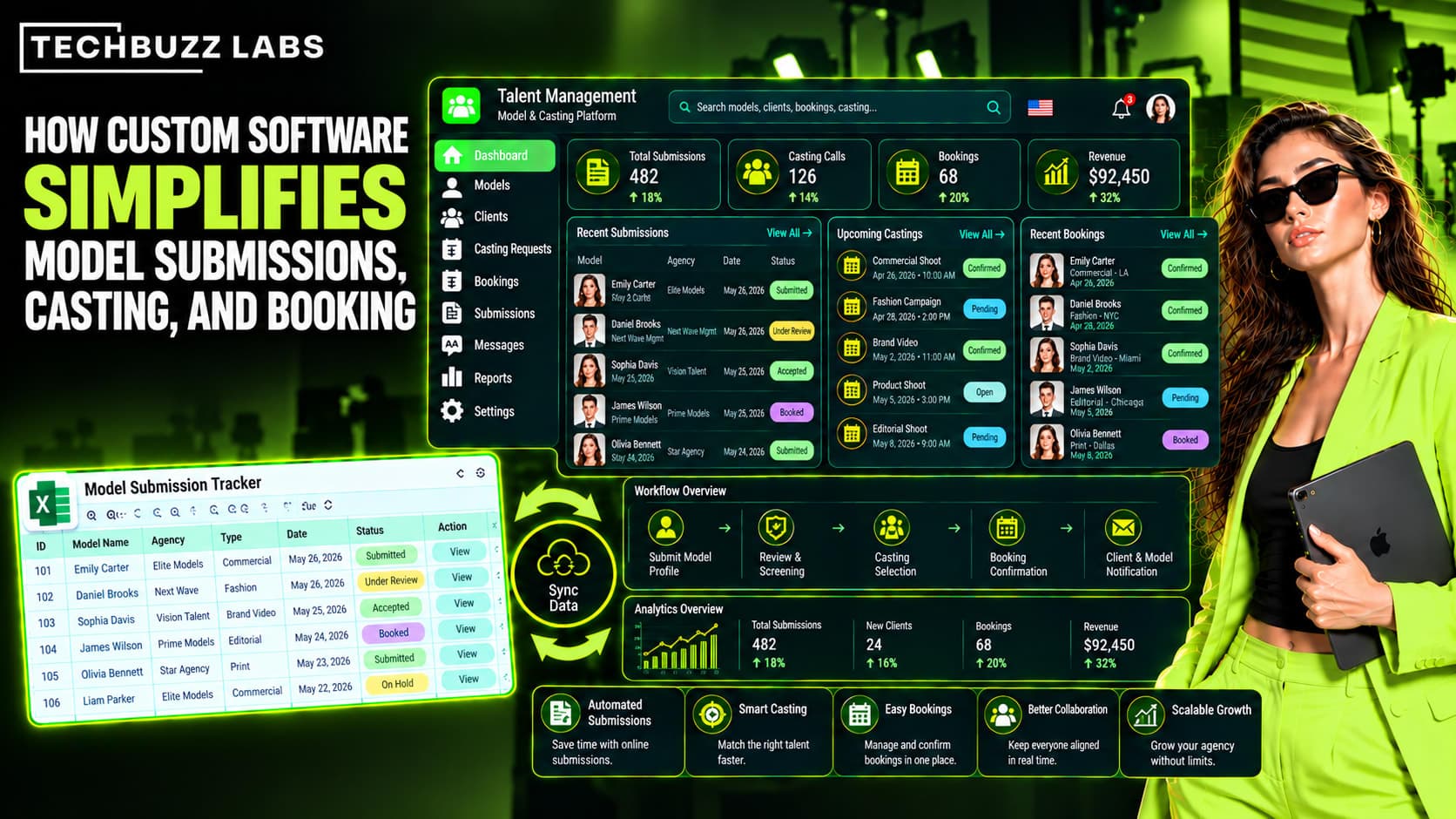
Top CRM Software Company for Modern Agencies: What Should You Expect?
A strong CRM software company should understand the specific workflow of its target industry and provide technology that solves real operational challenges.

Choosing the right CRM software company is an important decision for modern modeling and talent agencies. A CRM is no longer simply a tool for storing client contact information. Today, agencies need technology that can help manage talent profiles, casting opportunities, client relationships, availability, submissions, bookings, and internal workflows from a centralized platform.
For agencies in the USA, particularly those working in competitive markets such as New York, Los Angeles, Miami, Chicago, and San Francisco, having an organized CRM can help teams respond to opportunities faster and manage growing talent pools more efficiently. TechBuzzLabs highlights how CRM technology can connect talent, casting, client, and booking workflows.
What Should You Expect From a CRM Software Company?
Not every CRM software company offers the same type of solution. A general-purpose CRM may focus primarily on sales and customer relationships, while agencies often require a more specialized system.
For a modeling or talent agency, this means expecting more than a basic contact database. The platform should ideally support the complete journey from talent management and casting to client communication and bookings.
1. A Centralized Talent Database
One of the first things an agency should expect is a centralized database.
Modeling agencies may manage hundreds or thousands of talent profiles. Each profile can contain professional information, photographs, portfolio materials, experience, skills, location, availability, and other relevant details.
Instead of storing this information across multiple spreadsheets and folders, a CRM can keep it organized in one system.
A centralized database makes it easier for agents to find information and maintain updated records as the agency grows.
2. Advanced Search and Filtering
A large talent database is only useful when agents can quickly find the right person.
Modern agency CRM software should provide search and filtering capabilities that allow agents to narrow talent according to relevant criteria.
For example, an agent may need to find models in Los Angeles with commercial experience who are available on specific dates.
Advanced search can reduce the time spent manually reviewing profiles and help agents respond to client requests more efficiently.
3. Integrated Casting Management
Casting is one of the most important workflows for modeling and talent agencies.
A good CRM should allow agencies to create casting opportunities, record project requirements, identify suitable talent, manage submissions, and track client responses.
When casting information is connected to talent profiles, agents do not need to repeatedly transfer information between separate systems.
The workflow can become:
Client Request → Talent Search → Submission → Shortlist → Selection → Booking
This type of connected workflow can make casting easier to manage and provide better visibility to agency teams.
4. Strong Client Relationship Management
Client relationships remain at the center of every successful talent agency.
A CRM should allow agencies to organize client contact details, communication history, previous projects, preferences, and booking records.
This gives agents useful context when communicating with existing or potential clients.
For example, if a brand that has previously booked commercial models contacts the agency again, the agent can review previous activity before responding to the new request.
This can help agencies provide more personalized and consistent service.
5. Availability and Booking Management
A CRM designed for agencies should connect talent availability with casting and booking information.
A model may be a perfect match for a project but unavailable on the requested dates. Without centralized scheduling, agents may need to contact talent individually before confirming availability.
Connecting availability with bookings can give agents a clearer picture of schedules and help reduce potential conflicts.
Once a client selects a model, the system should also make it easier to move the project from casting into booking without recreating information from scratch.
6. Workflow Automation
Another feature to expect from a modern CRM software company is automation.
Agency teams often perform repetitive tasks such as sending casting notifications, requesting availability, following up with clients, creating reminders, and updating project statuses.
Automation can reduce the amount of manual work involved in these processes.
For example, a CRM could remind an agent to follow up with a client after a submission or notify a team member when a casting deadline is approaching.
The purpose is not to replace agents. Instead, automation gives professionals more time to focus on talent development, client relationships, and strategic work.
7. Team Collaboration
Modern agencies often have several agents working with the same talent and clients.
If information is stored in individual spreadsheets or personal inboxes, important updates can become difficult for other team members to access.
A centralized CRM gives authorized employees access to shared information.
An agent can review a model's profile, casting history, availability, client communication, and booking status without having to request information from another employee.
This can improve collaboration and reduce communication gaps.
8. Reporting and Analytics
A quality CRM should not only store information. It should also help agencies understand their performance.
Reporting tools can provide insights into casting activity, submissions, bookings, client activity, and other business metrics.
Managers can use this information to identify trends and potential bottlenecks.
For example, an agency might analyze which clients generate the most bookings or which types of casting opportunities have the highest success rates.
Data-driven insights can support better operational and business decisions.
9. Security and Data Management
Modeling agencies handle professional and personal information, including photographs, contact details, measurements, contracts, and client information.
Therefore, security should be an important consideration when choosing a CRM software company.
Agencies should evaluate features such as user permissions, authentication, backups, access controls, data retention, and other appropriate security measures.
A good platform should make information accessible to the right team members without unnecessarily exposing sensitive data.
10. Scalability and Customization
The CRM should be capable of growing with the agency.
A system that works for a small roster may become difficult to use when an agency expands its talent pool, client base, and number of projects.
Scalability allows the platform to support increasing amounts of data and users.
Customization is also valuable because every agency has a slightly different workflow. Some may focus heavily on modeling, while others may manage actors, influencers, commercial talent, or multiple categories.
A CRM software company should ideally offer solutions that can adapt to those operational requirements.
Why TechBuzzLabs Is Relevant to Modern Agencies
TechBuzzLabs focuses on technology solutions for modeling and talent agencies, with content and solutions around CRM, talent management, casting, automation, and agency workflows.
Its approach reflects an important shift in the industry: agencies increasingly need connected technology rather than isolated tools. CRM technology can bring together model profiles, client information, casting opportunities, availability, submissions, and bookings in one environment.
For an agency that has outgrown spreadsheets and disconnected applications, this type of centralized approach can provide a stronger foundation for managing operations and future growth.
Conclusion
When evaluating a top CRM software company, modern modeling and talent agencies should look beyond basic contact management.
A strong solution should provide centralized talent profiles, advanced search, casting management, client relationship management, availability tracking, booking workflows, automation, collaboration, reporting, security, and scalability.
The right CRM should make the agency's workflow more connected rather than adding another disconnected tool to the technology stack.
For U.S. modeling and talent agencies, this can mean faster responses to clients, better talent organization, fewer repetitive tasks, and improved visibility across the entire agency operation.
With technology solutions such as those offered by TechBuzzLabs, agencies can explore a more centralized approach to managing talent, clients, castings, and bookings while building a scalable foundation for modern agency operations.