How to Manage Hundreds of Model Portfolios With Custom Agency Software
For modeling agencies across the United States, the right software can improve internal coordination, support client communication, and create a scalable foundation for future growth.

Managing a growing roster of models requires more than storing photographs and contact details. Modeling agencies must maintain accurate profiles, organize digital portfolios, track client submissions, monitor availability, and share the right talent with clients at the right time. When an agency represents hundreds of models, handling these responsibilities through spreadsheets, email attachments, and separate folders can become increasingly difficult.
Custom agency software helps modeling agencies centralize talent information and create more organized portfolio management workflows. By connecting model profiles with image libraries, casting activities, and booking records, agencies can reduce repetitive administrative tasks and manage a growing talent database more effectively.
Why Managing Hundreds of Model Portfolios Becomes Challenging
Each model may have multiple photographs, professional experience, measurements, skills, contact information, and portfolio versions. These details can change frequently, particularly when models complete new projects or update their images.
When an agency relies on disconnected tools, common problems include:
Outdated profiles: Agents may accidentally share old photographs or incorrect details.
Duplicate records: Multiple versions of a model's information can create confusion.
Slow talent searches: Finding candidates for a specific casting brief may require reviewing numerous folders.
Manual portfolio preparation: Teams may spend unnecessary time assembling presentations for clients.
Limited workflow visibility: Managers may struggle to track submissions, feedback, and booking progress.
Custom agency software can address these challenges by organizing information within a centralized, searchable system.
1. Create a Centralized Model Database
A centralized talent database is the foundation of effective portfolio management. Every model should have a dedicated profile containing consistent, clearly organized information.
Depending on the agency's requirements, profiles may include photographs, professional experience, skills, measurements, location, contact details, portfolio links, and relevant booking history.
Custom software allows agencies to define profile fields according to their business processes. This can be especially useful for agencies managing different types of talent, including fashion, commercial, fitness, and lifestyle models.
A single source of information helps authorized team members access consistent records instead of searching through multiple spreadsheets and folders.
2. Organize Thousands of Portfolio Images
Managing hundreds of models can mean managing thousands of image files. Without a clear structure, agents may struggle to locate suitable photographs or identify the latest approved portfolio.
Custom agency software can organize images into searchable galleries and categories. Useful capabilities may include image previews, upload dates, file labels, and straightforward image replacement.
For example, an agency preparing a commercial campaign submission could quickly review a model's approved commercial photographs instead of searching through unrelated files.
Agencies should also evaluate image storage capacity, backup procedures, file quality, and permissions before choosing a platform. A clear process for approving and replacing images helps maintain accurate portfolios.
3. Use Advanced Search and Filtering
A large talent database is only useful when agents can find the right profiles efficiently.
Search and filtering tools can help narrow the roster based on relevant requirements, such as location, experience, availability, skills, and portfolio category.
Imagine a U.S. advertising client looking for talent for a campaign in Los Angeles. Rather than manually opening hundreds of profiles, an agent could filter the database using the campaign's legitimate requirements and review a relevant shortlist.
Agencies should keep profile information current and use consistent data fields so search results remain useful and reliable.
4. Automate Routine Portfolio Updates
Model profiles need regular maintenance. New photographs, updated experience, contact changes, and availability information should be reflected in the system.
Custom software can support reminders, profile update forms, review notifications, and approval workflows. These features can help staff identify records that need attention and reduce reliance on manual follow-ups.
A practical update process might involve requesting new materials, reviewing the information, approving photographs, updating the profile, and making the latest approved version available to authorized users.
Automation should support the process rather than replace necessary human review. Agencies still need to verify information and confirm that photographs are approved for their intended use.
5. Simplify Digital Portfolio Sharing
Modeling agencies regularly share portfolios with brands, casting directors, photographers, and production companies. Preparing a separate presentation for every inquiry can consume valuable time.
Custom agency software may support digital comp cards, shareable portfolio links, client-specific shortlists, and downloadable presentations.
These tools help agents prepare relevant selections without repeatedly collecting files from different sources. They can also support a consistent presentation style across the agency.
Access controls are important. Agencies should be able to manage who can view portfolios and understand whether shared links can be restricted or revoked. Image rights and privacy requirements should also be considered when sharing talent information.
6. Connect Portfolios With Casting and Booking Workflows
Portfolio management becomes more useful when it connects with other agency operations.
A connected platform can help agents move through the process of reviewing a client brief, searching for talent, sharing portfolios, recording feedback, and coordinating bookings.
For example, when a client requests models for a retail campaign, the team could create a project record, shortlist suitable talent, track submissions, and record selection decisions within the same system.
This reduces repeated data entry and gives authorized team members a clearer view of each project's progress.
Agencies exploring this approach can also learn more about model portfolio management software and talent profile organization.
7. Improve Data Security and Team Collaboration
As a modeling agency grows, more employees may need access to talent profiles and client records. Not every user should have the same permissions.
Custom software can support role-based access, allowing agencies to define who can edit profiles, approve photographs, manage client information, or share portfolios externally.
Agencies should also evaluate secure authentication, backups, data retention, and appropriate privacy controls. Clear responsibilities for maintaining records help prevent outdated information and inconsistent updates.
A combination of suitable technology and well-defined internal procedures makes portfolio management more reliable.
Custom Agency Software vs. Ready-Made Tools
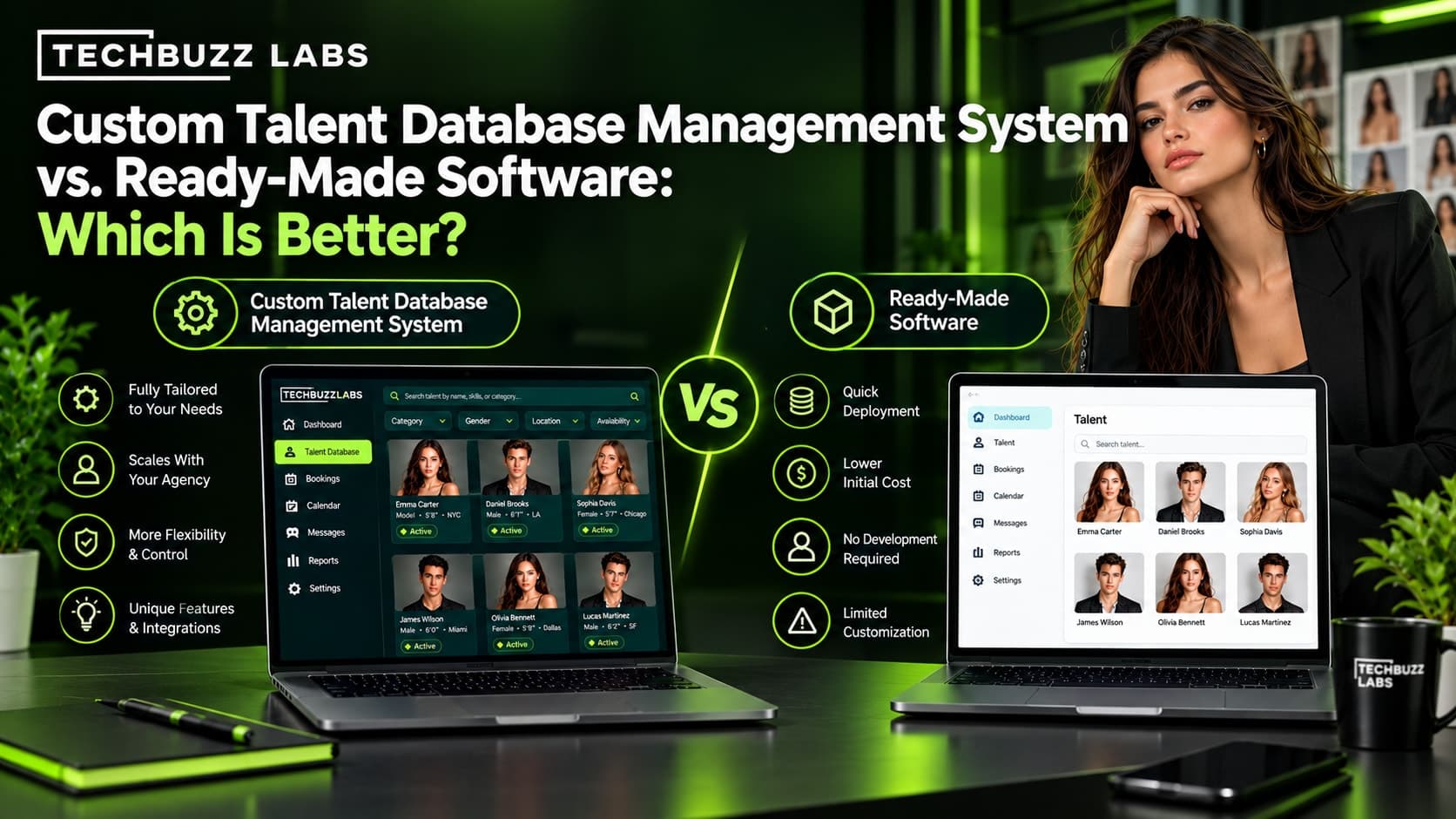
Ready-made portfolio platforms may work well for agencies with straightforward needs. However, agencies with specialized workflows or complex integrations may benefit from custom software.
A customized solution can be designed around specific profile fields, casting processes, reporting requirements, and connections to existing CRM or booking systems.
The decision should consider more than the initial development cost. Agencies should compare implementation time, maintenance, support, usability, security, and future scalability. A phased rollout can also help teams test essential features before moving the entire talent database.
How TechBuzz Labs Can Help
TechBuzz Labs is a technology option for modeling agencies exploring custom software, CRM solutions, and workflow improvements.
Agencies considering a tailored platform should begin by identifying their biggest operational challenges. These might include outdated portfolios, slow talent searches, repetitive client submissions, or disconnected booking records.
From there, they can define the required features, integrations, access permissions, budget, and implementation priorities. This approach helps keep software development focused on practical business needs.
Conclusion
Managing hundreds of model portfolios requires accurate records, organized image libraries, effective search tools, consistent updates, and secure sharing processes. Custom agency software can bring these activities together and connect them with casting and booking workflows.
For U.S. modeling agencies planning to expand, the right solution can reduce avoidable administrative work and support better coordination across the team. By choosing features that address real operational challenges, agencies can manage larger talent databases more systematically and prepare their workflows for continued growth.